Key Points
Dual enrollment gives high school students the opportunity to take college classes and helps them prepare for college.
Offering dual enrollment requires a great deal of coordination between the institutions of higher education (IHEs) and the districts and/or high schools.
With support from New Jersey’s Opportunity Meets Innovation Challenge grant, three IHEs established dual enrollment partnerships.
All three IHEs established strong partnerships with memoranda of understanding, named contacts at each organization, and clear communication practices.
Dual enrollment courses must be taught by qualified staff, and each partnership developed strategies to help high school teachers become qualified.
Each partnership recruited and supported students throughout their dual enrollment course taking.
The number of students taking and passing dual enrollment courses dramatically increased over 2 years.
Introduction: Dual Enrollment
With dual enrollment, or dual credit,1 programs, high school students have the opportunity to take college courses, simultaneously earning both high school and college credits. A review of five studies of dual enrollment that meet What Works Clearinghouse standards reported that programs such as these have positive impacts on postsecondary enrollment and degree attainment (What Works Clearinghouse, 2017). Three of these studies examined programs in which students enrolled in college-level courses while progressing toward their high school diploma. In each case, those who took dual enrollment courses earned college credits in high school. These studies found statistically significant positive effects of dual enrollment and earning a college degree (An, 2013; Giani et al., 2014; Struhl & Vargas, 2012). Two of these studies focused on the early college high school model, in which schools are organized to provide dual enrollment opportunities and supports to all students in the school. One found that those immersed in dual enrollment opportunities via early college were more likely to earn high school diplomas (Berger et al., 2014), while the other study found a positive association between attending this type of school and subsequently obtaining postsecondary credentials (J. Edmunds et al., 2016).
Dual enrollment can provide a mechanism for students to overcome academic, financial, and cultural barriers to college attendance. In general, college courses are more academically challenging than high school courses, and taking them in high school can reduce academic barriers by helping students develop key cognitive strategies such as problem solving, interpretation, and communication (Conley, 2012). Earning college credits in high school can reduce financial barriers by lowering the cost of college (J. A. Edmunds et al., 2022). Additionally, college courses can reduce cultural barriers by shifting educational responsibilities more directly on the shoulders of students than high school courses do (Appleby, 2014), thereby giving students a more gradual process for becoming more independent as they learn.
Although dual enrollment can benefit students, those in groups underrepresented in college are less likely to participate in dual enrollment. In 2017–18, 82% of public high schools offered an opportunity for students to earn dual credit. However, only 71% of schools where at least 75% of students were eligible for free or reduced-price lunch offered this opportunity (National Center for Education Statistics, 2020). Of those students whose parents did not complete high school, 26% earned dual credit, compared with 42% of those whose parents had a bachelor’s degree or higher. Of Black students, 27% earned dual credit, compared with 38% of White students (National Center for Education Statistics, 2019).
Those in groups traditionally underserved in college may not participate in dual enrollment because their school does not offer it or because their parents and teachers do not encourage them to do so. In 42% of cases, the students and their families incur costs for dual enrollment (National Center for Education Statistics, 2020), which may prevent some from participating.
Forty-eight states and Washington, DC, have state-level dual enrollment policies. Eighteen states require all high schools to offer some dual enrollment program, and 41 states specify student eligibility criteria for a dual enrollment program. Criteria typically include the student’s grade level, meeting the postsecondary institution’s entrance requirements, and having a recommendation from a school official. Across the United States, 55 dual enrollment programs are offered within high schools, 54 dual enrollment programs are offered in postsecondary educational institutions, and 27 programs are offered online (Education Commission of the States, 2022a).
Some schools may not be able to offer dual enrollment because they have not been able to establish strong partnerships with institutions of higher education (IHEs). The high school and college educational systems developed and operate independently of each other. They have different schedules and offer different kinds of courses. High school students may not know which courses they need to take to qualify for taking college courses, and they may not understand how to register for college courses. High school staff may not be qualified to teach college courses, but college faculty may not be available to teach in the high schools. For dual enrollment to succeed, both parties need to foster a partnership.
This brief focuses on dual enrollment in New Jersey, where approximately 20% of 11th and 12th graders take at least one dual enrollment course (New Jersey School Performance Report, n.d.). We include findings from an evaluation of three projects with the goal of expanding access to dual enrollment for low-income students. We examine the structures and processes each dual enrollment partnership established, their strategies for strengthening the instructor pipeline, and their strategies for increasing the student pipeline.
Dual Enrollment in New Jersey
State Context
In New Jersey, state law allows a school district with a high school to enter into a dual enrollment agreement with an IHE. This IHE and the school district delineate the dual enrollment program through which high school students can take courses offered by the IHE at either the high school or the college campus (NJ Rev Stat § 18A:61C–10, 2023). However, this policy does not include statewide student eligibility criteria or requirements for student advising. New Jersey lacks a statewide articulation of dual enrollment courses, and the policy does not state who contributes to paying the student costs of dual enrollment (Education Commission of the States, 2022b). Thus, across New Jersey, the opportunities for students to take dual enrollment courses vary from one district to the next. Districts and colleges make independent decisions about the courses that should be offered, student eligibility for these courses, and funds to cover student participation in dual enrollment.
The OMIC Project
In spring of 2021, the state of New Jersey offered the Opportunity Meets Innovation Challenge (OMIC) Grant to fund programs in institutions of higher education designed to support them in implementing systemic reforms to help students in college. The grant (funded by Governor’s Emergency Education Relief) funding awarded about $28.5 million to 35 institutions that receive state operating aid. IHEs submitted proposals to increase college completion, address barriers to student success, and develop sustainable reforms (New Jersey Office of the Secretary of Higher Education, 2021). Three IHEs won OMIC awards to create fee-free dual enrollment opportunities for economically disadvantaged students. Specifically, these three OMIC grants had the following goals: (1) increase access to dual enrollment, which will lead to college completion; (2) provide equity for underrepresented students; and (3) increase the number of qualified instructors who can teach dual enrollment courses within partner high schools. Under this grant, the three colleges worked with an intermediary organization to develop K–12 college partnerships, expand the student dual enrollment pipeline, and increase the number of teachers qualified to teach dual enrollment. Each partnership determined which dual enrollment courses to offer, and the partnerships offered dual enrollment in many subjects including environmental science, music history, and physics. These were all general education courses, which had no prerequisites. To prepare students for the academic demands of college courses, each partnership offered a summer bridge program for OMIC-eligible students. To increase the number of qualified instructors, each partnership offered professional development opportunities for teachers. Each IHE partnered with multiple high schools. In this initiative, three colleges participated, and they created partnerships with 11 high schools.
Evaluating the OMIC Dual Enrollment Projects
From 2021 through 2023, RTI International and the Early College Research Center at the University of North Carolina at Greensboro, assessed the implementation and outcomes for these three IHEs. Specifically, we examined the extent to which the project activities were implemented as intended, and how the program influenced students. Addressing questions about implementation required collecting data from project artifacts such as memoranda of understanding; course articulation agreements; teacher professional development data; interviews with key leadership at IHE, high schools, and supporters (10 total); and surveys from high school and IHE staff involved in the project (38 total). Addressing questions about student outcomes involved collecting such data from both the IHEs and the high schools. The evaluation team wrote final reports for each partnership describing its program context, activities, outcomes, and implications (Coyle & Edmunds, 2023b, 2023a; Gupta & Martin, 2023).
Results Overview
In the 2 years of this initiative, 350 students earned 1,899 dual credits. Individual sites saw significant expansion; between 2020–21 and 2021–22, one IHE doubled the number of students in its dual enrollment courses. The evaluation of the OMIC dual enrollment projects provided insights in two primary areas:
Factors necessary to creating strong dual enrollment partnerships, including building structures to support the partnerships, focusing on a strong teacher pipeline, and developing a pipeline of students ready for dual enrollment.
Factors that need to be in place to support dual enrollment partnerships, including supports from intermediaries and state supports.
Creating Strong Partnerships
Structures and Processes
Expanding dual enrollment requires establishing management structures and agreeing on a range of policies around aligning select course requirements, managing course scheduling and transportation, and ensuring both the high school and the college communicate about students’ progress. Having well-established structures enables the partners to collaborate and build trusting relationships, which then permits students to take and pass dual enrollment courses. In the K–12/IHE partnerships in this OMIC project, the partnerships engaged in the following activities: establishing a dual enrollment management committee to lead the work; naming a single point of contact at the school district and the partnering IHE; creating processes to ensure consistent, clear, and timely communication; and developing clear policies through memoranda of understanding and articulation agreements.
Instructor Pipeline
Dual enrollment can be delivered either by college faculty or qualified high school instructors; either way, a successful partnership depends on having strong instructors in place. States differ in the qualifications required for high school teachers to teach college courses. Across the United States, 42 states have policies specifying necessary instructor qualifications. Twenty-nine states require instructors meet the postsecondary institution’s faculty requirements, 15 states require meeting institutional accreditor requirements, and 9 states require high school teachers to have a graduate degree (Education Commission of the States, 2022a). In New Jersey, high school teachers are required to have master’s degrees to teach college courses.
These OMIC partnerships emphasized developing the teacher pipeline. Expanding dual enrollment offerings requires having instructors who are qualified to teach college courses to high school students. Increasing the pool of qualified instructors could result if the district identifies or hires teachers that meet the qualifications to teach college-level courses. Districts can also develop programs to train or mentor high school teachers to teach dual enrollment courses. Finally, college instructors may choose to teach their college courses to high school students. The partnership would determine the most strategic way to offer these courses. High school teachers could become qualified to teach dual enrollment, the college faculty member could travel to the high school, the high school students could take courses at the college, or a course could be offered online.
In New Jersey, high school teachers had to have master’s degrees to teach dual enrollment courses. All three OMIC partnerships worked with the district to identify qualified teachers and invite them to join this endeavor. Of the three OMIC partnerships, one OMIC partnership had college faculty go to the high schools to teach or teach online. They established a mentoring program where teachers who had master’s degrees could collaborate with the faculty and co-teach the classes. The college faculty member might teach two days per week while the high school teacher taught the other days. After the mentorship, these teachers then qualified as adjunct faculty and could teach dual enrollment on their own (Coyle & Edmunds, 2023a). Another partnership had a Summer Symposium for high school teachers and college faculty to develop a co-teacher relationship and class materials for dual enrollment classes. During this symposium, two of five participating teachers became qualified to teach college courses independently (Coyle & Edmunds, 2023b). In the third OMIC partnership, led by a 4-year institution, they established a pilot program where high school teachers could earn master’s degrees from that university, which would qualify them to teach dual enrollment courses in New Jersey. College faculty worked with high school teachers who had master’s degrees, jointly teaching the college courses (although the college faculty member remained the teacher of record) (Gupta & Martin, 2023). However, this approach to expanding dual enrollment is not possible within 2-year institutions unless they partner with a 4-year institution to support teachers in earning master’s degrees. At the end of this mentorship and upon obtaining a master’s degree, these high school teachers were qualified to teach dual enrollment courses.
Student Pipeline
Having qualified staff teaching dual enrollment courses is only fruitful if students are interested in and prepared to take these courses. College courses are more demanding than high school courses, and college faculty expect students to work more independently than high school teachers do. All three partnerships worked to recruit eligible students and prepare students for the challenges of college course taking. In each partnership, the district was responsible for identifying students who would be eligible to participate. An OMIC goal was to increase dual enrollment for economically disadvantaged students; all partnerships required that participating students be eligible for free or reduced-price lunch. Some partnerships also considered academic criteria, such as whether an 11th- or 12th-grade student was already taking academically rigorous high school courses.
All partnerships provided extensive supports to students in the dual enrollment program. They supported those in the pipeline for this program by offering a Summer Bridge program in 2022 and 2023 for students in the OMIC program and in the pipeline to become dual enrollment course takers through OMIC. The Summer Bridge programs offered academic activities as well as counseling from college and high school staff. Some partnerships included having current OMIC students mentor the younger students. Throughout the year, partnerships provided wraparound support to OMIC students. This support included counseling from high school and college staff. Partnerships also created opportunities for these students to feel at home in the college setting. They gave students college IDs, had them visit the campus, and taught them about campus resources such as application portals, financial aid offices, and the library.
With this program and these supports, more students took and passed dual enrollment classes. Obtaining college credit requires earning a grade of “C” or better, and most dual enrollment course takers did. In one partnership, all students who attempted to earn dual credit did so (Gupta & Martin, 2023). In the 2 years of this initiative, 350 students earned 1,899 dual credits. As the OMIC program became established, more students could and did participate. Between 2020–21 and 2021–22, one IHE doubled the number of students in its dual enrollment courses (Gupta & Martin, 2023).
Supporting Dual Enrollment Partnerships
Given the complexity of managing a dual enrollment program, partners will need external help, which can include technical assistance from an intermediary organization as well as support from the state level.
Intermediary Organizations
Intermediary organizations can help organizations design a shared goal and implement their goal. They may convene meetings of key personnel, foster the co-creation of a specific vision of the work, and lead communication about the work across the partnership and to interested parties outside of the partnership. They may collaborate with partners to develop action plans that will move the project forward (Hartung et al., 2020).
Throughout this project, all three partnerships received support from an intermediary organization, which met with college and high school leaders, conducted school-based meetings at site visits, advised on memoranda of understanding, and provided guidance on courses offered/articulation agreements. This intermediary organization provided teacher professional development and student recruitment materials. Throughout the OMIC initiative, the intermediary organization met with the evaluation team to discuss data collection and analysis strategies.
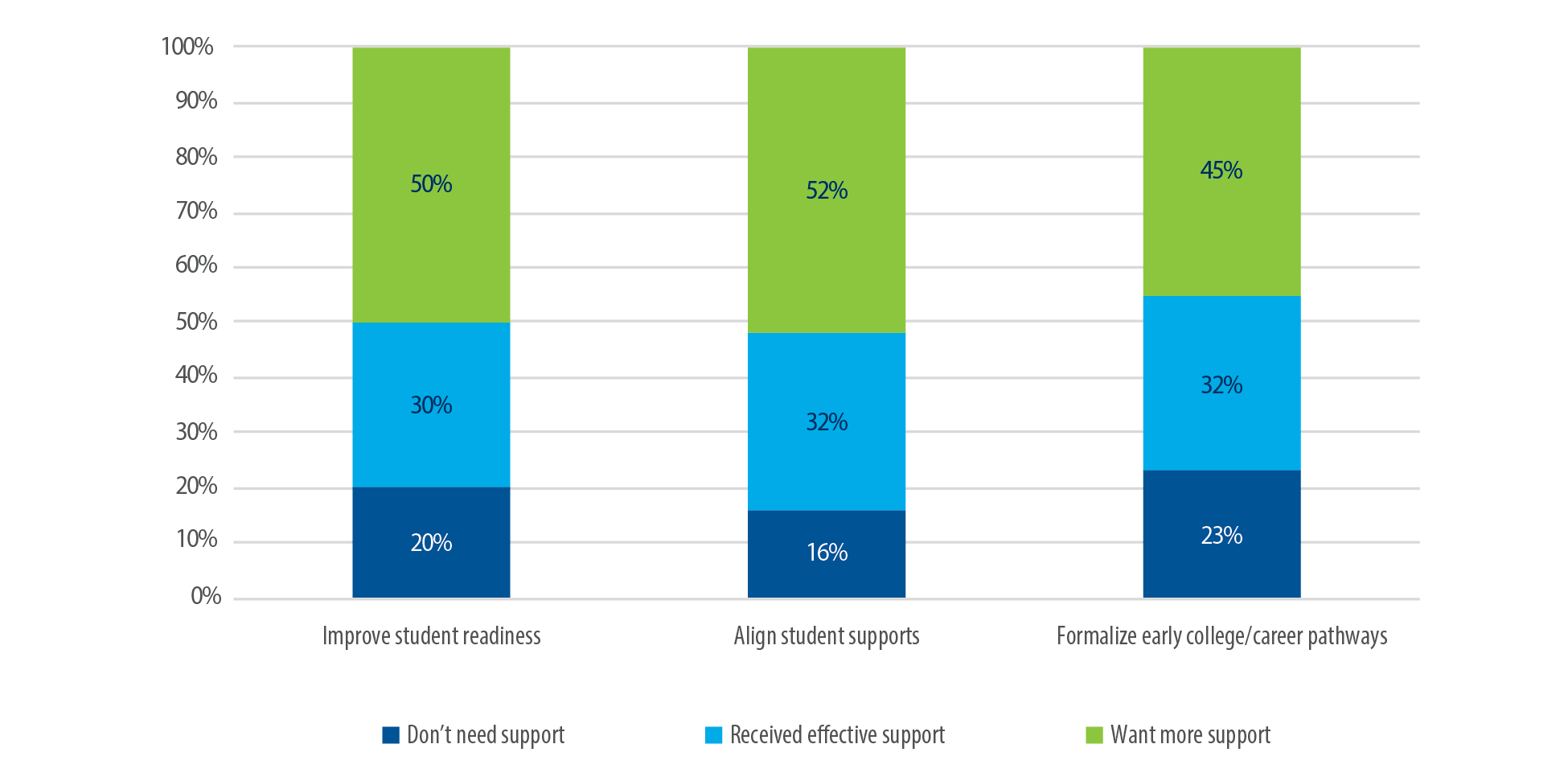
In the survey, we asked about program participants’ perceptions of this intermediary’s assistance to improve student success, align collaborative student supports, and formalize early college and career pathways. Participants could respond that they did not need support in an area, that they had received effective support, or that they wanted more support (Figure 1). For each question, about half of the respondents said they did not need help or that they received effective support; however, about half of the respondents said they would like more support.
State Supports
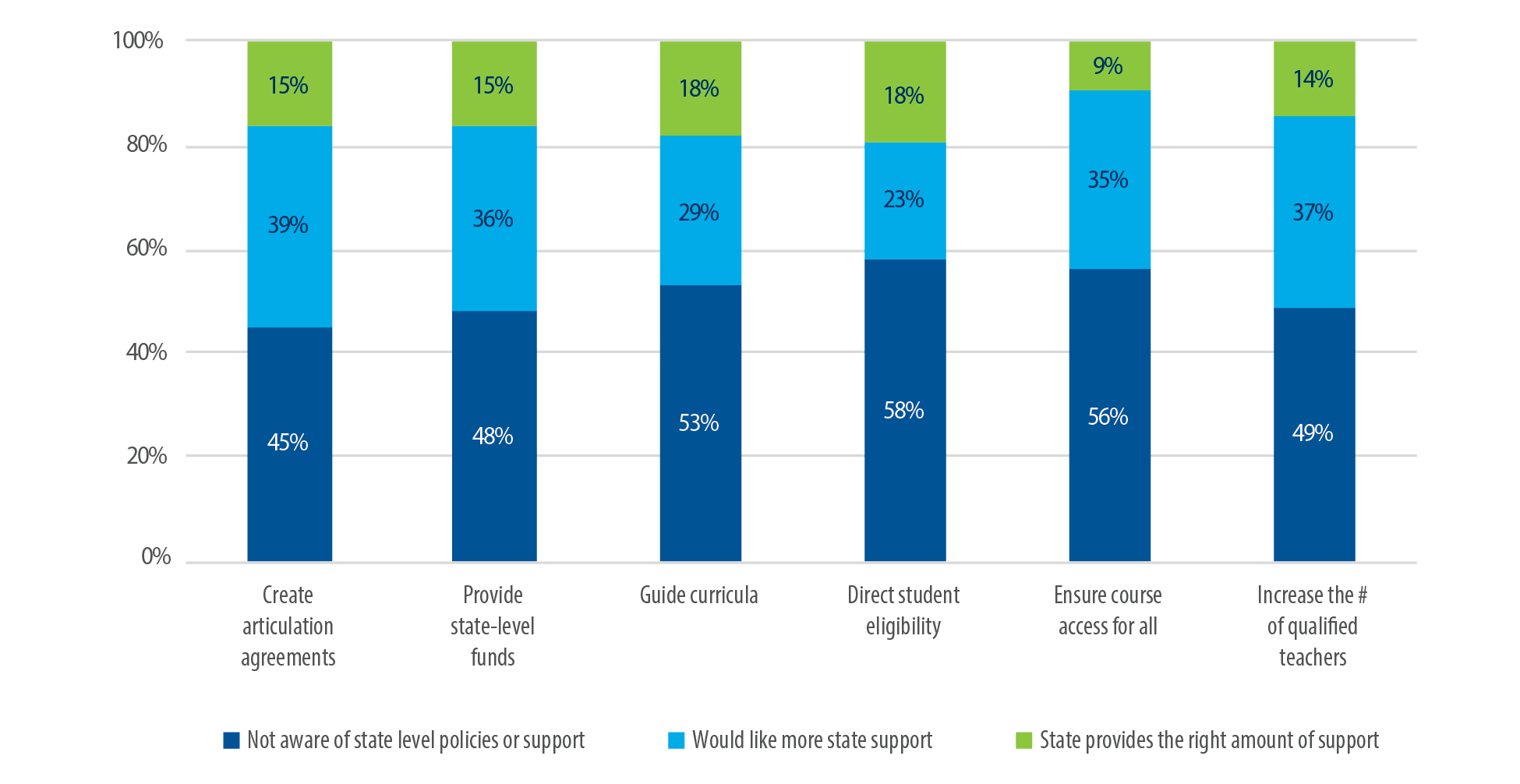
Implementing dual enrollment is easier when the state provides policy and financial supports (J. A. Edmunds et al., 2022). The programs in the OMIC initiative focused on enrolling and supporting economically disadvantaged students, but nationally, very few dual enrollment programs provide incentives to encourage participation by underserved students (Education Commission of the States, 2022a). Overall, participants in the OMIC dual enrollment projects would have appreciated more support from the state. We asked survey respondents their perceptions of the following state supports: creating articulation agreements, providing state-level funds, guiding curricula, directing student eligibility, ensuring course access for all, and increasing the number of qualified teachers. For each of these supports, respondents could say they were not aware of state-level policies or support, they would have liked more support, or the state provided the right amount of support (Figure 2). For each item, fewer than 20% said the state provided enough support. About one-quarter to one-third of respondents said they would like more state support in each area. About half of the time, respondents did not know whether the state provided this kind of support.
Policy Implications
During this 2-year initiative, the numbers of dual enrollment course offerings, qualified teachers, and economically disadvantaged students earning dual credit increased. The implementation evaluation identified key components that should be in place to ensure success for dual enrollment programs to succeed.
Establishing an effective dual enrollment program requires a strong partnership between districts or high schools and IHEs. The dual enrollment partnership must ensure that qualified instructors—from the high school or college—are prepared to teach high school students. The partnership must recruit and support students, particularly those who may not have support for college course taking at home. Members of the partnership must be able to communicate clearly about activities at both the high school and the college. Our findings have led to suggestions of local and state practices that can support dual enrollment programs.
Local-Level Policies and Practices
The following components will support a strong dual enrollment partnership: a committee or management team to guide the work; a memorandum of understanding that lays out responsibilities for the work; and a curriculum plan that outlines course taking sequences. The management team should include members from each institution who can derive policies that work effectively for all partners. Additionally, an external partner can provide guidance and technical assistance around this work.
Helping students enroll in and succeed in dual enrollment requires the following supportive activities: readiness activities to help prepare students for these types of classes; advising and career counseling around dual enrollment options; and support for students while they take dual enrollment courses.
A strong dual enrollment program requires a cadre of strong instructors; these could be high school teachers credentialed to teach college courses or college instructors who are prepared to teach high school students. Districts can identify high school instructors with possible credentials or provide support to help instructors gain credentials. Districts and/or colleges can provide professional development to prepare high school and college instructors to effectively teach dual enrollment.
State-Level Legislation
State statutes should explicitly define and authorize dual enrollment and the entities responsible for overseeing this program. Ideally, the state would fund dual enrollment tuition for all students or a subset of students. If the state cannot provide funding, then they should provide guidance or suggestions for options to fund tuition, fees, or books. For example, in Texas, the Financial Aid for Swift Transfer program provides funds to public IHEs to pay for dual enrollment courses for economically disadvantaged students. These students do not incur costs for dual enrollment courses (Texas Education Agency, n.d.).
Having explicit definitions of dual enrollment and standard funding for these courses will ensure that state educators share a common language and common expectations around eligibility requirements for students. This common language and funding will ensure more equity for students participating in dual enrollment.
States can require that districts let students know about dual enrollment options and let families know of the potential savings for higher education in the long run.
Statewide articulation agreements can help ensure that college-level courses taken in high school will transfer to a 4-year institution.
Embedding dual enrollment participation in the state accountability model can help increase interest in dual enrollment.
States can provide support for high school teachers to obtain credentials necessary to teach dual enrollment courses.