Background
A series of high-profile incidents in which police officers killed members of the public, disproportionally Black men, have characterized the recent decade. The police killings of Eric Garner, Philando Castile, Michael Brown, Freddie Gray, and many others have served as an inflection point for a national conversation about police use of force and the functions of police generally. Recently and notably, the arrest and death of George Floyd on May 25, 2020, led to sustained public outcry over police brutality. This tragic event led to widespread protests against police use of force, support for the Black Lives Matter movement, and calls for defunding the police (Lowrey, 2020). Increased attention on police violence in the last several years has inspired a substantial body of research investigating its prevalence and the implications of police use-of-force incidents.
Although fatalities involving the police are still relatively rare when taking into account the total number of police interactions with the general public, the National Academies of Sciences, Engineering, and Medicine reports that members of minority communities disproportionately shoulder the burden of police violence (Edwards et al., 2019). This report highlights that police violence is not only a public safety and justice issue but also a severe public health problem: police violence is the leading cause of death for young men in the United States. Police violence is more common against Black men, who have about a 100 in 100,000 chance of being killed by police, compared with about 39 per 100,000 for White men (Edwards et al., 2019). Police violence and aggressive policing more generally can have deeply negative implications for those who survive their injuries, including psychological distress, illness, and degraded educational performance, and result in unfavorable attitudes toward law enforcement (Bor et al., 2018; Brunson & Miller, 2006; Geller et al., 2014; Legewie & Fagan, 2019; Weitzer & Tuch, 2004).
After high-profile police killings (“critical incidents”), the erosion of relationships between the police and communities is evident in unrest in communities, calls for increased accountability through body-worn cameras or additional oversight (Ariel et al., 2017), and shifts in official policy to limit the potential for harm (Kindy et al., 2020). In addition, a growing body of research also identifies the detrimental effects of police violence on communities more broadly, some of which have serious implications for public safety. Of foremost concern, these findings identify (1) a crisis of the legitimacy of policing and (2) a more direct understanding of how police behavior can affect not only perceptions and trust, but also residents’ behaviors, including their willingness to engage with law enforcement. Note that “resident” refers to a member of the public who may or may not live in the local jurisdiction. This includes commuters, tourists, and other persons who may make up the ambient population.
Police legitimacy, defined as the trust and view that the police and the broader legal system are lawful and valid, is an important metric for assessing public perceptions of the police (Tyler, 1990, 2004). Legitimacy is key for police functioning because it is associated with compliance with the law and voluntary cooperation with the police (Hinds & Murphy, 2007; Mazerolle et al., 2013). The public’s confidence in police fell to 48 percent in 2020, its lowest level since longitudinal polling began in 1993 and in contrast to the high of 64 percent in 2004 (Jones, 2020). This decline demonstrates an increasingly strained relationship between the police and the public, especially among Black people (Jones, 2015). There are large racial differences in confidence and trust in the police; specifically, according to a recent Gallup poll, only 19 percent of Black adults report having a “great deal” or “quite a lot” of confidence in police, whereas 56 percent of White adults reported these levels of confidence and support (Jones, 2020).
Critically, Desmond and colleagues’ (2016) study published in American Sociological Review evaluated the potential effects of the legitimacy crisis, examining whether high-profile situations involving police violence against a person of color can affect the extent to which community members call 911 to report crimes after such an event. The underlying logic of their investigation was that police violence can increase legal cynicism in the community (i.e., the belief that law enforcement agents are unresponsive, incompetent, or illegitimate) (see Kirk & Papachristos, 2011). Therefore, residents may avoid engaging with the police when possible, which instances of voluntarily and proactively reporting crime to law enforcement authorities (Baumer, 2002). Desmond and colleagues posited that formal social control may be replaced by a “code of the street” (Anderson, 2000) whereby residents rely on informal mechanisms of conflict resolution, such as mutual respect and retributive violence. If police violence does in fact lead to fewer 911 calls for crime and other issues, there are clear and meaningful implications for community violence and safety more generally.
Employing an interrupted time series design, Desmond and colleagues (2016) found that Milwaukee residents, especially those from disproportionately Black neighborhoods, were significantly less likely to report crime after the broadcasting of the severe beating of an unarmed Black man, Frank Jude, by both on- and off-duty police officers in 2004. The effect persisted for longer than 1 year and resulted in a total net loss of about 22,200 calls for service over the next year following the incident. These critical findings suggest that police violence can severely undermine public safety because residents become less likely to report crime-related issues. Without reporting of crimes, perpetrators will not be held legally accountable for their actions and may be free to commit future crimes. Furthermore, others may feel encouraged to engage in criminal behavior if they believe their actions will not be reported. At the same time, police departments may reduce their presence and resources in affected areas if decline in demand for service is mistaken for decline in criminal activity.
Desmond and colleagues’ (2016) study is widely considered a seminal piece in the field of policing research (see Johnson et al., 2017; Nix & Pickett, 2017; Shjarback et al., 2017). The Frank Jude case was particularly horrific and a blatant example of misjustice by police officers in Milwaukee, with uneven community responses in their engagement with police. Police actions, be they misconduct or use of force, can have far-reaching consequences for community engagement and safety. This possibility engenders the need for replication based on other instances of police use of force and the expansion of the methodology to further disaggregate the process by which communities withdraw engagement with the police.
In this paper, we replicate and expand on the original methodology by investigating the effect of a separate police shooting on engagement with the police. The incident in question is the fatal police shooting of a Black man in the fall of 2016 in a mid-sized city in the Southeastern United States. This incident resulted from an interaction with the subject during a stop-and-frisk as part of enhanced police enforcement in that area after an increase in crime. This event was not widely reported outside of the city but was both significant and familiar enough to residents to produce the anticipated effects. Importantly, this event differs from the case of Frank Jude in its immediate publicity. Whereas Desmond and colleagues (2016) note that it took months for Frank Jude’s killing and then subsequent unrest to reach even local news, our incident of concern was immediately known to the community, and protests for both justice and reform took place the following day. Shortly after the incident, the police department found that there was no violation of administrative policy or procedure.
This event is salient enough within the community, particularly the Black community, that we presumed, if a critical incident of police violence can generate meaningful changes in engagement between the community and the police, this event would. Beyond replicating the methodology of Desmond and colleagues (2016) to provide additional evidence of lowered resident crime reporting, we examined the inverse of this pattern. In other words, we examined whether the police hesitate to engage in proactive policing and initiate their own calls for service after a critical incident resulting from proactive police enforcement. This counterpart to the public hesitating to engage with the police examines evidence of potential de-policing or reallocation of police resources after a critical incident.
The concept of de-policing entered the national conversation after the 2014 police shooting of Michael Brown in Ferguson, Missouri. It is the theory that in response to intense public scrutiny and tense relationships with the public, police have pulled back on proactive policing and engagement with the community. De-policing is so linked with these events that the term “Ferguson Effect” is used to explore the effect of de-policing on increases in crime. The evidence that reflexively limiting proactive policing is responsible for increases in crime is both widely explored and contested in the literature (Capellan et al., 2020; MacDonald, 2019; Pyrooz et al., 2016; Rosenfeld & Wallman, 2019; Wolfe & Nix, 2016).
Although the long-term effects of de-policing may be unclear, the reduction in proactive policing and community engagement following high-profile incidents is evident. In Missouri specifically, Shjarback and colleagues (2017) observed a reduction in police stops, searches, and arrests, particularly in departments serving populations of primarily people of color. They attribute this officer-level behavior change and decreases in morale and organizational trust to increased scrutiny and the perceived “war on cops.” Nix and Wolfe (2018) reinforced this idea, finding that most police command staff in sample agencies felt this shift in public perceptions over the past few years, and this perception was associated with the command staff’s stronger belief that police departments are de-policing. Most recently, Cheng and Long (2022) provided strong evidence that critical incidents lead to significant decreases in officer-initiated activities and arrests. From a public health perspective, these trends suggest that research should examine the effects of police violence weighed against the potential effects on residents of under-policed or underserved areas.
In the current study, we investigate the impact of the previously described fatal police shooting on the levels of engagement between the community and the police. Our analysis focuses on hundreds of thousands of calls for service recorded in the city’s police department computer-aided dispatch (CAD) within 1 year before and after the event. Following the methods presented by Desmond and colleagues (2016), we used interrupted time series analysis to determine whether the level or trend in 911 resident calls showed statistically significant changes after the event, differentiating between predominantly Black and White neighborhoods across the city. Critically, we also applied this same methodology to the subset of police-initiated calls to understand whether the level or trend in police activity changed after the event.
Methods
Calls for Service Data
We obtained all police calls for service recorded in the police department’s CAD system over a 5-year period (N = 2,102,668). These data encompass 911 calls to police initiated by residents, police-initiated events, and calls originating from other sources, including automated alarms. In addition to call source, each call in the dataset has the date-time information, latitude and longitude coordinates (allowing for geocoding), and a field for the nature or type of the call. In line with the methodology of Desmond and colleagues (2016), we used call nature to limit the analysis of resident-initiated 911 calls to police to those that can be considered discretionary, which we expect would be affected by attitudes toward law enforcement. In this context, discretionary calls are typically for non-emergency situations in which citizens may feel empowered to call police but under no obligation, such as community disturbances, social disorder, or property offenses. This excludes resident-initiated 911 calls to police with codes indicating fire, medical emergencies, traffic-related calls, alarm activity, or hang-up calls. For our analysis of police-initiated events, we did not limit the dataset by the call type field. See Tables 1 and 2 for distributions of call type for resident-initiated 911 calls and internal police calls (a proxy for police-initiated events), respectively, in the full CAD dataset.
Table 1.
193004Distribution of call types for discretionary resident-initiated 911 calls
Note: Discretionary calls categorically exclude fire response, medical emergencies, traffic-related calls, alarm activity, and hang-up calls over a 5-year period.
Table 2.
193005Distribution of call types for police-initiated events
Note: Pertains to the entire dataset of internal police calls for service (equated to police-initiated activity) over a 5-year period.
Measures
In an effort to replicate the methodology of Desmond and colleagues (2016) as closely as possible, we employed the same pre-intervention time trend, explanatory, and control variables. For an in-depth discussion justifying the inclusion and use of these variables, please refer to that paper. The primary dependent variables retained the same structure as the Desmond et al. method, a weekly count of 911 calls at the block group level. Importantly, this approach differed in the parameters for call inclusion. The total universe of 911 calls for service was divided based on call source: whether the event was initiated by a resident 911 call or by the officer. We retained all officer-initiated events for the proactive, call-dependent group, but limited the resident-initiated calls by call nature. We focused on the discretionary call types described above, which are more likely to be affected by changes in resident sentiment toward police. We ran an additional analysis limited to resident-initiated calls about violent crimes, but all coefficients for level and trend were insignificant across all neighborhoods. Models restricted to the White- and Black-majority neighborhoods did not converge because of small numbers.
We used the volume and scope of calls in the year before the incident to define the trend of the counterfactual (comparison) group. We limited analyses to 52 weeks before and after the event. This time frame is similar to the 46-week time frame employed in the Desmond et al. (2016) analysis, although both are arbitrary. To account for criticisms of the original methodology (Zoorob, 2020), we ran a sensitivity analysis with the same models using time periods of 42 and 62 weeks to assess the robustness of our findings. The interpretation of the results did not notably change.
The primary explanatory variable in this case was the interruption in the slope of expected call volume following the critical incident in question, included as a binary measure of pre- and post-event calls. Using the reported approach of Desmond and colleagues (2016), we include block group and month fixed effects in the models. We also use the same control variables, drawn from the U.S. Census American Community Survey (United States Census Bureau, 2022), for the percentage of the population that is Black, the percentage of the population that is Hispanic, the percentage of households below the poverty line, the percentage of households that rent, and weekly crime counts. To account for the amendments to the original methodology, we employ an equivalent measure of temperature, as included in the Desmond et al. (2020) reply. Table 3 provides descriptive statistics of the reported measures to ground the city’s crime and sociodemographic landscape.
Table 3.
193006Summary statistics for population, call, and crime variables for predominantly Black and predominantly White neighborhoods
SD = standard deviation
Note: Summary data are for 152 block groups, including 25 predominantly Black and 54 predominantly White neighborhoods. Crime and call statistics pertain to the observation period: 52 weeks before and after the high-profile police shooting of a Black man.
a Definitionally, at least 65 percent of individuals residing in neighborhood must be one race for a neighborhood to be “predominantly” Black or White.
b One block group was omitted from the averaging of internal police calls for majority-White neighborhoods because it had extremely high internal police calls for service. For this cell, n = 53. The neighborhood does account for the maximum number of internal police calls for White neighborhoods (144).
Methodology
To determine whether the level or trend in 911 calls made by residents significantly changed in the weeks after the high-profile case of police violence, we replicated the interrupted time series method presented by Desmond et al. (2016). In an extension of their technique, we also investigated patterns in the volume of internal police calls to determine whether the level or trend in police activity changed after the event.
Following the original method, we implemented a negative binomial model with block group and month fixed effects and time indicators. We set exposure to the total population of the block group. We created two models—one focused on resident-initiated 911 calls and one on internal police calls—to test for changes in the level and slope of these outcomes after the event. We modeled the volume of all discretionary resident-initiated calls among block groups that are predominantly (> 65 percent) Black or predominantly White, controlling for the percentage of the population that is Black, the percentage of the population that is Hispanic, the percentage of households living in poverty, the percentage of households that rent versus own their home in the block group, and the daily high temperature recorded at the nearest weather station. We included weekly crime counts to control for changes in crime that could otherwise explain the volume of calls. When analyzing internal police calls, we also included a control for weekly resident-initiated 911 calls in the neighborhood.
We looked at diagnostics for including quadratic terms in the models and chose the best model for each outcome based on the Akaike information criteria (AIC) and Bayesian information criteria (BIC) values. Table 4 presents AIC and BIC values for all models. We checked for outliers in the rate of calls per block group for all models. We omitted one block group from the analysis of internal police calls in predominantly White neighborhoods, but all other data points were within a reasonable range and included in the models.
Table 4.
193007Model fit statistics
Results
Here, we address our central question: whether the event affected both resident crime reporting and officer-initiated activity across neighborhoods. Table 5 displays the overall results of the negative binomial regression model testing the effect of the officer-involved shooting for all 911 calls and officer events across all neighborhoods in the city.
Table 5.
193008Estimating the effect of a high-profile case of police violence in predominantly Black and White neighborhoods
Note: These models focus on the observation period 52 weeks before and after the event. Where the outcome is internal police calls for service, we included an additional control for neighborhood volume of resident-initiated 911 calls. Black and White neighborhoods are defined as those in which at least 65 percent of individuals residing in a particular neighborhood are Black or White (as per the American Community Survey; United States Census Bureau, 2022) at the available sample time closest to the event. Coefficients and standard errors (in parentheses) are presented.
* P < 0.05 (two-tailed test).
a We omitted one block group from the analysis of internal police calls for majority-White neighborhoods because it had extremely high internal police calls for service.
As Figure 1 demonstrates, the base rate of weekly resident 911 calls was relatively constant over the reporting period and remained substantively unchanged after a brief increase after the shooting. However, the significant and dramatic reduction in officer-initiated events persisted in the year after the shooting.
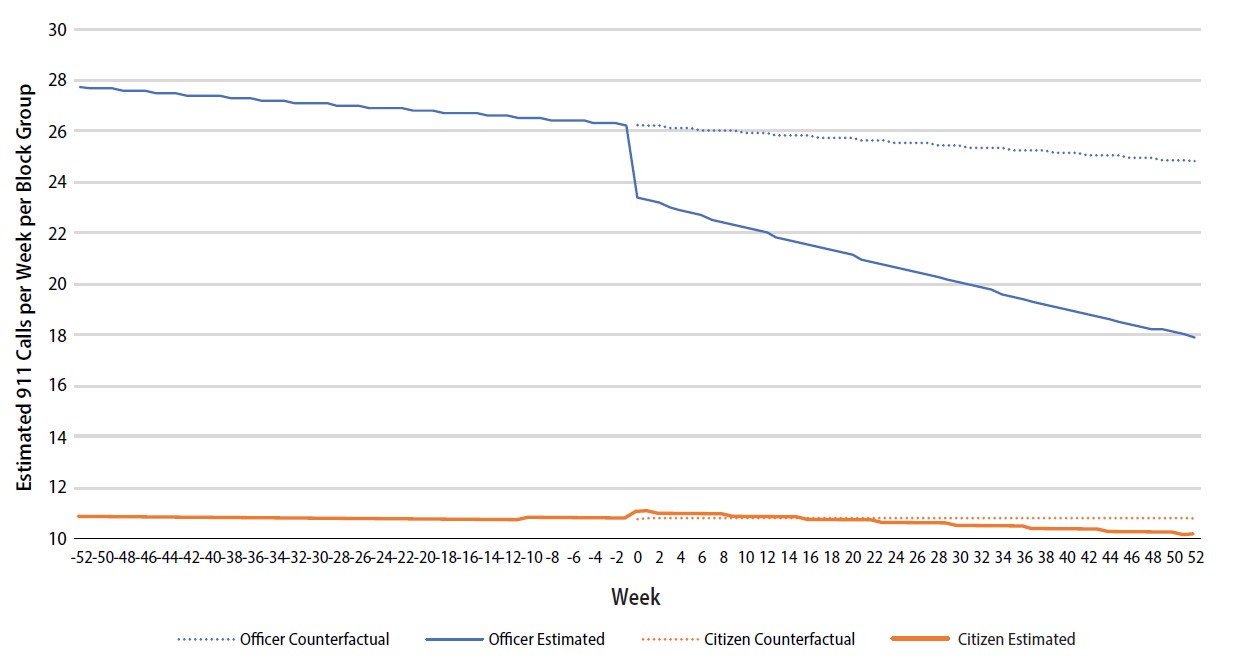
Table 5 also displays the results of negative binomial regression models estimating the relationship between neighborhood characteristics, weekly high temperatures, resident-initiated 911 calls, and police-initiated events in predominately Black and predominantly White block groups in the city. By disaggregating calls by neighborhood type and call source, we can replicate and expand on the Desmond and colleagues (2016) methodology. Similar to the findings presented by Desmond et al., our results suggest that resident-initiated 911 calls significantly declined in predominantly Black neighborhoods and did not significantly change in predominantly White neighborhoods after the chosen high-profile case of police violence. From our extension of the original method, we also found that the number of police-initiated events in Black neighborhoods significantly fell immediately following the event. The decline continued during the following weeks in predominantly Black neighborhoods, although the pace of the decline decreased. In predominantly White neighborhoods, internal police calls did not significantly fall immediately following the event, and during the following weeks, police activity significantly increased. Figures 2 and 3 graph the disaggregated results.
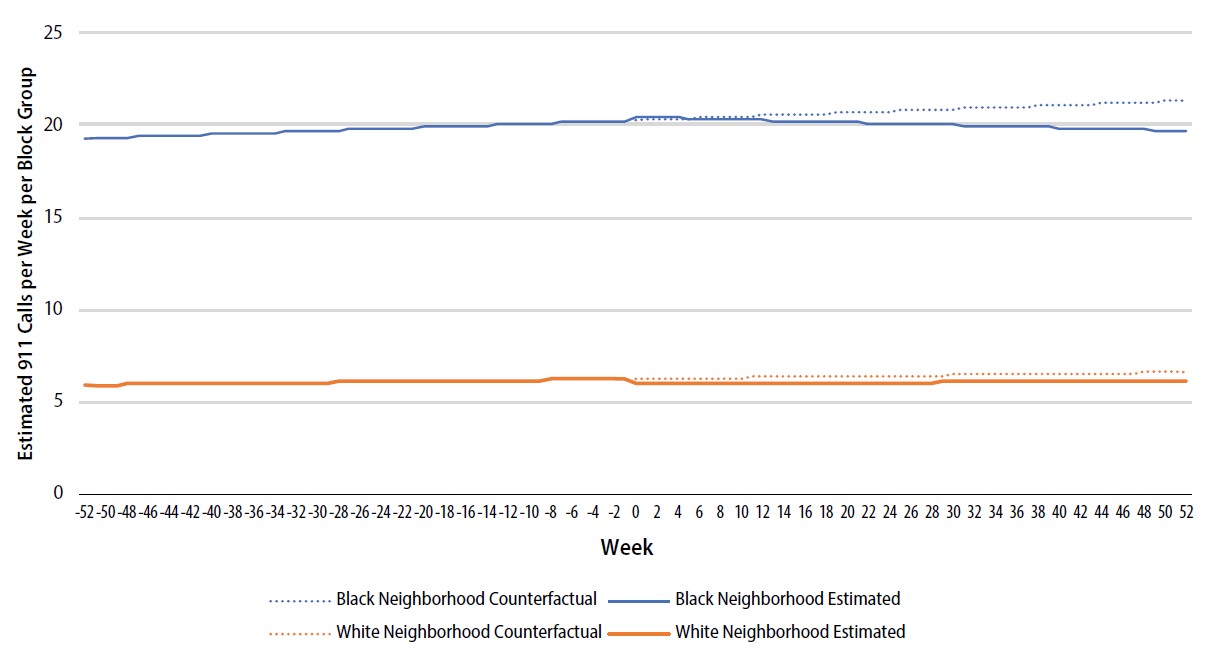
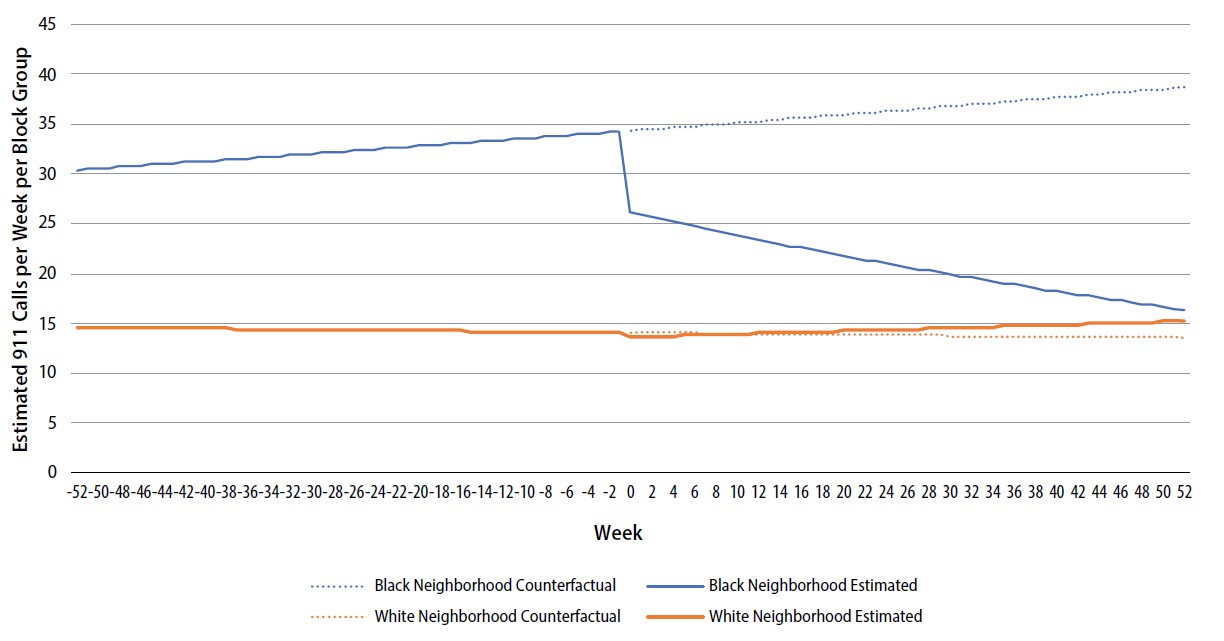
By subtracting the estimated post-event 911 calls from the estimated counterfactual 911 calls, we estimate that 967 additional discretionary resident-initiated 911 calls to police would have been placed in predominantly Black neighborhoods in the year after the event had the event not occurred. This equates to about a 5 percent loss in the expected number of 911 calls in Black neighborhoods during this period. We estimate that 20,730 additional internal police-initiated calls would have been placed in Black neighborhoods in the year following the event had it not occurred, which represents a 43 percent loss in the expected number of internal police calls in Black neighborhoods during this period.
Discussion
Policing is undergoing a crisis of legitimacy, and it is imperative that research intensely focuses on the issue of police violence and its effects on communities, particularly communities of color. Police use of force represents not only a significant public safety priority but also a matter of public health (Edwards et al., 2019). In addition to being the leading cause of death for young Black men, police use of force also has broader implications on health and wellbeing, including physical injuries and psychological and emotional distress (Jindal et al., 2022). An emerging body of research is also demonstrating that police behavior can affect community perceptions of trust and legitimacy, as well as community members’ willingness to take action and engage with law enforcement (Brunson & Wade, 2019; Desmond et al., 2016). However, what has been less clear is whether extreme cases of police use of force also affect police activity, including geographic shifts or re-prioritization in patrol officer activity after these events.
In this study, we replicate and expand the original methodology used by Desmond et al. (2016) by analyzing the impact of a fatal police shooting of a Black man in a mid-sized city in the Southeastern United States in 2016. Although the deadly shooting in our study was not a prominent national news story, it did receive almost immediate coverage in the local media and was met with a rapid sequence of protests and calls for reform beginning the very next day. Importantly, our study also sought to extend the methodology used by Desmond and colleagues (2016) to examine whether and how these types of critical incidents of police use of force affect police behavior, specifically proactive enforcement, as measured by police-initiated calls for service, which are not associated with resident calls to 911. Other studies of high-profile police use-of-force events also found this concept of de-policing or pulling back on proactive engagement, also referred to as the “Ferguson Effect,” including in the form of reduced officer-initiated activities such as police stops, searches, and arrests (Cheng & Long, 2022; Shjarback et al., 2017). As such, we applied our same methodological approach to police-initiated calls measured in CAD to understand how police activity changed after the event.
Several notable findings from this research warrant discussion. First, our study validates a critical finding presented by Desmond et al. (2016), demonstrating that resident calls to 911 significantly declined in majority-Black neighborhoods but did not significantly change in majority-White neighborhoods after a high-profile case of police killing a Black person within the local city. The replication of key findings from previous studies, using similar research questions and methods, confirms that police violence also significantly affects individuals’ help-seeking behavior, including community trust and perception of legitimacy, as demonstrated by residents’ willingness to call 911 to report crimes or request other forms of emergency police service. With this replication, we validate that the pattern extends to a different incident of police violence, in a different geographic area, receiving a slightly lower level of media attention (mostly subnational). Specifically, majority-Black community members were less likely to call 911 for police response after these incidents; the decline in calling 911 was observed in majority-Black neighborhoods but not majority-White neighborhoods.
One clear question regarding the decline in resident calls to 911 within predominantly Black communities is, what do these changes represent? As Desmond and others have argued, similar high-profile incidents of police violence exacerbate legal cynicism in the communities most directly affected, which in turn reduces the likelihood of their participation in crime reporting. In other words, the use-of-force incident was a tipping point within communities where confidence and trust in the police was already strained. Less desire to call 911 is a clear indicator of a breakdown in trust and the perceived legitimacy of the police. The implications are that the killing of a Black person by a police officer reduces voluntary and proactive crime reporting to law enforcement, particularly in Black communities. That may in turn undermine public safety and the ability to hold criminal offenders accountable.
We argue that the implications of these findings are broader in scope than crime reporting. We believe these findings reflect a more-expansive drop in engagement with police within particular communities after acts of police violence, as defined by residents’ willingness to request any emergency police services. Although it is difficult to accurately determine the true intent of each 911 call from CAD data, call nature categories can inform our analysis. Most CAD calls from residents in our study period were coded as not crime related. Among all calls to the police over the study period, 6 in 10 were labeled as reporting a disturbance (25.1 percent), requesting police assistance (18.3 percent), raising a quality-of-life issue (12.5 percent), or calling related to mental health (2.5 percent). A smaller proportion of calls, about one in five, were labeled as property crime (20.1 percent). Only 4.4 percent of calls were labeled as violent crime. As such, we contend that the effects of lethal police violence extend beyond crime-reporting behaviors to affect a broader willingness within communities to engage with the police on matters.
A second critical finding that warrants additional discussion is the immediate and prolonged reductions we observed in police-initiated activity after the incident. These activities, which can be prompted by what officers observe taking place in these areas, include directed patrols for community engagement or crime prevention purposes, proactive policing in designated areas, and traffic stops. After the incident, police shifted more discretionary patrol activity from Black communities to White communities. Our findings demonstrate that the same critical incidents of police violence can heavily influence police-initiated activity, as recorded in CAD systems. In our extension of the original method, we found that the volume of police-initiated activity (as measured through police-initiated calls for service) fell significantly in predominantly Black neighborhoods just after the shooting. The trend continued during the following weeks in predominantly Black neighborhoods. Although the pace of the decline decreased over time, it did not level out or reverse during the tracked year. In contrast, in predominantly White neighborhoods, police-initiated activity increased immediately after the event and throughout the year after (although at a lower rate than the decrease in predominantly Black neighborhoods, not replacing that loss in activity). In other words, patrol officers’ discretionary activity changed following the incident.
The questions, then, are why is this happening and what do shifts in police-initiated activity across communities represent? There are multiple possible explanations. For instance, police officers may have wanted to avoid making unnecessary contact or taking actions (e.g., traffic stops, citations, and arrests) that they believed members of the community would view as hostile. Alternatively, police-initiated activity may have shifted because police officers were concerned for their own personal safety, believing that certain neighborhoods were “hot” (i.e., dangerous) after the high-profile incident. Another possibility is that officers may have believed that residents in predominantly Black neighborhoods, particularly those with elevated levels of distrust for the police, did not want them there during this aftermath period. These potential explanations are not mutually exclusive, and multiple factors could contribute to our findings.
The motivations for these changes in policing activity are unknown, prompting another question: who or what is driving the shift? For example, are the significant, immediate changes in police-initiated calls after the high-profile incident influenced by individual officers’ decisions or by informal guidance from peers or supervisors to change their discretionary policing patterns? Alternatively, were these changes influenced, directly or indirectly, by agency leaders, or derived from an official departmental policy handed down to rank-and-file officers? We assume the latter is least likely, given that agency leaders would presumably be asked to justify this shift in policy within the department and likely to city leaders, community members, and the media.
Finally, this study highlights the importance of expanding the use of CAD data as an indicator of both police activity and the intensity of police services across communities. The continued refinement of CAD-based measures could represent not only a critical set of metrics for assessing public trust of the police across different neighborhoods but also community members’ willingness to request public safety and emergency services that address physical and mental health needs. These steps could also lead to an expanded collection and reporting of standardized metrics across jurisdictions that rely on calls-for-service data. Although the Federal Bureau of Investigation’s (FBI’s) National Incident-Based Reporting Program collects data on crimes reported to the police, no national system exists for recording, standardizing, and analyzing CAD data. Our study underscores the need for a standardized national collection of calls-for-service data. A standardized system would make these data available to support more research into the relationships between police use of force, resident crime reporting, and law enforcement activity (see also Cramer & Wire, 2022).
Our study offers important findings and implications for policy and practice, but certain limitations must be acknowledged and discussed. For one, the variability in CAD data collection and standardization both within and across agencies is a key obstacle in this line of research. The results presented here are only as accurate as the agency’s processing and categorization of CAD data, which is known to have some amount of inaccuracy. Moreover, the results only apply broadly (i.e., across agencies) if agencies measure call natures and outcome in a similar way, and some agencies do not. Through our work and the work of other researchers, we also are aware that law enforcement agencies have considerable autonomy in deciding how to classify calls, what aspects of each call to record, and whether and how proactive activities will be recorded within CAD. For instance, directed patrol made up roughly 57% of recorded officer-initiated activity for this agency, yet other agencies do not require that directed patrol be logged as a specific type of activity. Although internal data-recording procedures did not change in this agency over the course of this study, leaving our dataset variables internally consistent, this field of research must better understand how and which calls are recorded both within and across police departments. In addition, this discussion highlights the critical need for law enforcement agencies across the nation to implement a more consistent process for documenting proactive and community-based actions.
Another possible limitation to our study that must be acknowledged is our analysis approach. Although an unpaired time series model is not intended to be causal, we remain confident that the results relate to the critical incident because of the immediate observed changes on both resident and police reporting. In addition, the agency in our study had a change in police leadership around when the high-profile incident of police use of force used in our analysis occurred. We assume that a new police chief’s appointment would not affect resident reporting to 911. However, although we believe it is unlikely, we cannot rule out that an intentional pullback in police-initiated activity was because of directives from leadership, a possibility that was beyond the scope of this particular study.
Conclusions
This study is a critical step in disaggregating declines in 911 calls by call source after a critical incident of police use of force. Although the effects on both resident reporting and police proactivity are statistically significant, it is clear that a pullback of officer-initiated activity is responsible for most of the overall decline in calls-for-service events. However, these data and effects should be replicated in other jurisdictions and further disaggregated. We touched on the breakdown of CAD call types that comprise the universe of resident and police events, but further dissection of the nature of these calls will provide additional insights into what types of events are most affected by critical incidents of police use of force. For example, future studies could examine whether rates of resident reporting of domestic violence and civil complaints differ from each other in the wake of a critical incident.
Another valuable area for further study is more closely exploring what a decline in the discretionary types of 911 calls, such as calling the police to report a quality-of-life issue such as loud music or disorderly conduct, truly represents and what it affects. This is especially relevant given the rise in alternative response programs, some of which divert behavior health or other non-crime-related calls to third-party responders. One important question here is the level of need and urgency involved with the request for 911 emergency service. Another area to examine is, if the issue went unreported to 911, whether the problem or issue was resolved by means outside of the police, possibly through another municipal service such as 311 or 988 or a community-based resource. Finally, additional research should further examine and unpack whether a critical incident of police violence results only in a decline in trust in the police through the belief that law enforcement would be unresponsive, not meet the needs of the caller, or even represent a safety risk to the caller versus a decline in trust in the collective 911 emergency response system. As such, although we classified medical and fire-related calls as nondiscretionary for this and related studies, it would be useful to justify this decision by exploring a broader impact on 911 emergencies beyond policing.
An additional area of consideration is the type and proximate nature of the incident of police violence in question. In other words, how important is it that the use-of-force incident resulted in a fatality or took place in the immediate jurisdiction as opposed to another location, including a location far away? The recent study from Brantingham et al. (2022), which analyzed resident calls to 911 in Los Angeles and New York City in the weeks following George Floyd’s murder, raised questions about whether and how nationally publicized critical incidents of police use of force that do not involve local law enforcement affect residents’ willingness to call 911, with mixed evidence. Events may have a stronger impact on perceptions and behaviors of residents in the area of the event (including willingness to call 911).
Regarding “de-policing,” our study’s findings suggest a more-nuanced approach may be required to conceptualize and measure the overall concept. A larger examination of what it means for community safety, including for communities of color, is also required. More specifically, defining the nature, type, and frequency of activities involved in any reduction or scaling back of police functions would be necessary to assess community impact. For instance, in recent discourse on de-policing, one assumption has been that police are pulling back indiscriminately from activities, including directed patrols, proactive policing, traffic stops, citations, and arrests. However, our results demonstrate that police officers did not recede evenly from officer-initiated activity, but instead shifted their more proactive and discretionary attention from predominantly Black neighborhoods to other areas of the city. Regardless of the causes, the sustained decline in police-initiated activity within the majority-Black communities after the killing did lead to reduced police presence within these areas.
Finally, the effect of the high-profile killing on proactive policing was so substantial and immediate that it is important to look deeper into the possible reasons. The question remains of whether a pullback in proactive enforcement resulted from an executive decision to reduce perceived pressure on these communities; a temporary shift in deployment to accommodate officer safety, community relations, or both; collective officer-level decisions to avoid potential conflict; a mix of these factors; or other factors. These are important distinctions that may help guide policy in the future. We also posit that analyzing changes in police service and community engagement should not be limited to post hoc research studies. Law enforcement agencies themselves could integrate and monitor community-level metrics so agency leaders can monitor a more-nuanced set of trends and proactively address these dynamics as part of CompStat meetings or other internal decisions. Ultimately, this type of approach can enable a more responsive and understanding form of policing that is rooted in the active and often complex needs of the local community.
RTI Press Associate Editor: Lissette Saavedra