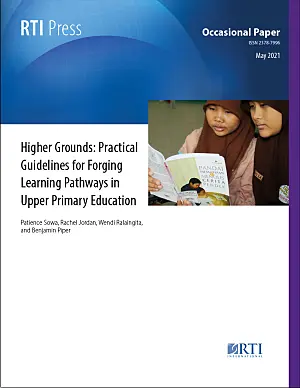
Higher grounds: Practical guidelines for forging learning pathways in upper primary education
Key Points
- To address chronically low primary school completion rates and the disconnect between learners’ skills at the end of primary school and the skills learners need to thrive in secondary school identified in many low- and middle-income countries, more investment is needed to improve the quality of teaching and learning in upper primary grades.
- We provide guidelines for improving five components of upper primary education: (1) In-service teacher professional development and pre-service preparation to improve and enhance teacher quality; (2) a focus on mathematics, literacy, and core content-area subjects; (3) assessment for learning; (4) high-quality teaching and learning materials; and (5) positive school climates.
- We provide additional suggestions for integrating a whole-school climate curriculum, social-emotional learning, and school related gender-based violence prevention strategies to address the internal and societal changes learners often face as they enter upper primary.
Abstract
To address chronically low primary school completion rates and the disconnect between learners’ skills at the end of primary school and the skills learners need to thrive in secondary school identified in many low- and middle-income countries, more investment is needed to improve the quality of teaching and learning in upper primary grades. Accordingly, we provide guidelines for improving five components of upper primary education: (1) In-service teacher professional development and pre-service preparation to improve and enhance teacher quality; (2) a focus on mathematics, literacy, and core content-area subjects; (3) assessment for learning; (4) high-quality teaching and learning materials; and (5) positive school climates. We provide foundational guiding principles and recommendations for intervention design and implementation for each component. Additionally, we discuss and propose how to structure and design pre-service teacher preparation and in-service teacher training and ongoing support, fortified by materials design and assessment, to help teachers determine where learners are in developmental progressions, move learners towards mastery, and differentiate and support learners who have fallen behind. We provide additional suggestions for integrating a whole-school climate curriculum, social-emotional learning, and school related gender-based violence prevention strategies to address the internal and societal changes learners often face as they enter upper primary.
 © 2026 RTI International. This work is licensed under a Creative Commons Attribution-NonCommercial-NoDerivatives 4.0 International License.