Understanding Plasticizers: Navigating a Changing Landscape for Phthalate Regulations


Behind the Curtain: Plasticizers used to make consumer products, such as shower curtains, are facing varying regulations amid continued concern over health risks.
Phthalate regulations are becoming more fragmented. Federal agencies and states are advancing different rules across product categories and industries.
Health concerns continue to drive regulatory scrutiny. Certain phthalates have been linked to reproductive, developmental, and metabolic health risks.
Proactive risk management is increasingly important. Supply chain visibility, testing, and regulatory monitoring can help companies reduce exposure and compliance risk.
Phthalates are additives that are commonly incorporated into consumer products, including shower curtains, vinyl flooring, fragrances, food packaging, and medical equipment, such as intravenous (IV) bags. They add flexibility to rigid plastics and serve as stabilizers in personal care products. This functionality has made phthalates pervasive across manufacturing processes and use cases.
Despite their popularity, phthalates pose many health concerns, and regulation across states and agencies varies and can be confusing. Companies need to stay on top of the latest regulations and scientific advancements to thrive in a complex landscape. RTI International’s experts in exposure science, public health research, and regulatory support help companies make science-based decisions about phthalates and other chemicals of concern.
Some phthalates—particularly shorter-chain ortho-phthalates—have been linked to reproductive toxicity and developmental harm. This class of chemicals is also known to cause “phthalate syndrome,” a collection of reproductive development abnormalities linked to prenatal phthalate exposure. Exposure to di(2-ethylhexyl) phthalate (DEHP) and diisononyl phthalate (DINP) has been associated with adverse health outcomes, including preterm births. Additionally, several phthalates, including DEHP and dibutyl phthalate (DBP), are considered possible obesogens that may promote weight gain or affect fat storage.
Humans can be exposed to these chemicals through their diet, through skin absorption, and by breathing them in, which means that phthalates should be treated as a cumulative burden instead of a series of isolated exposures.
Federal authority to regulate the use of phthalates in consumer products is split across three agencies with their own distinct mandates, and additional legislation at the state level leads to an even more complex regulatory landscape.
FDA governs phthalate exposure where it intersects with food safety, cosmetics, and medical devices. This includes food contact materials, such as packaging, processing equipment, and other materials that may transfer chemicals into food.
In 2022, FDA prohibited 25 phthalates that are no longer used by industry. This formalized the phase-out of compounds already disappearing from the market, but the agency did not expand beyond those 25 to establish broader restrictions, citing a lack of scientific evidence that other phthalates demonstrate harm at current exposure levels.
EPA governs phthalate exposure under the Toxic Substances Control Act (TSCA). In December 2025, EPA announced that it will begin to regulate dozens of uses of certain phthalates, including DBP, DEHP, butyl benzyl phthalate (BBP), dicyclohexyl phthalate (DCHP), and diisobutyl phthalate (DIBP). These restrictions primarily aim to address environmental and workplace risks. Based on established TSCA procedures, EPA must publish a final rule to manage those risks within 2 years.
Most recently, EPA incorporated BBP into the draft Contaminant Candidate List 6 (CCL 6) to begin monitoring the presence of this contaminant in public drinking water systems.
CPSC has the most established phthalate regulatory program of the three federal agencies, rooted in the Consumer Product Safety Improvement Act of 2008. This act established permanent prohibitions on the sale of children’s toys and child care articles containing concentrations greater than 0.1% of DEHP, DBP, or BBP. An additional 2017 rule expanded those restrictions to encompass DIBP, DINP, DCHP, dipentyl phthalate (DPENP), and di-n-hexyl phthalate (DHEXP).
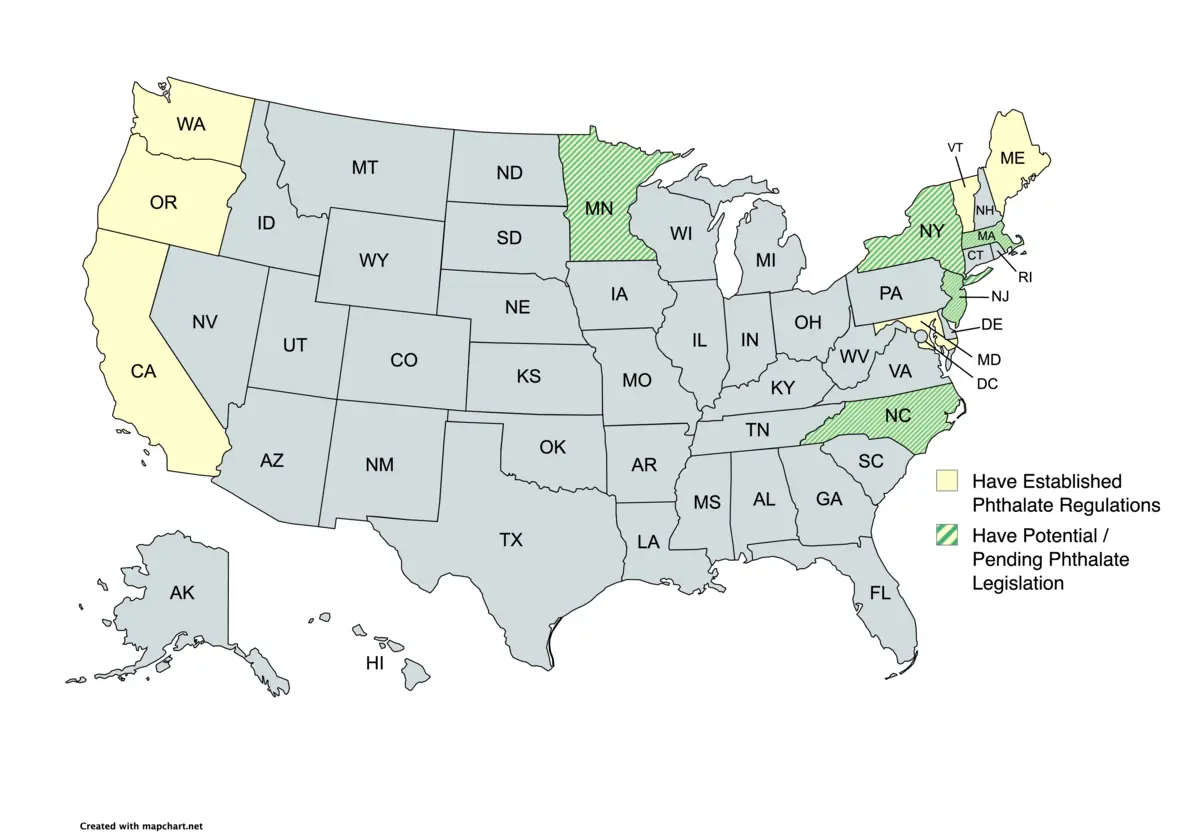
Individual states are increasingly driving a patchwork of regulations across the country. Currently, six states have enacted phthalate regulations, and five have potential or pending legislation. The enacted and potential legislation address a range of phthalate exposure categories, including cosmetics, children’s products, food packaging, and more.
Amid a complex regulatory landscape, we advise and inform companies as they consider proactive steps to limit risk exposure, such as the following:
Phthalate regulation is becoming more fragmented, product-specific, and state-driven. Companies that proactively improve supply chain visibility and track policy developments will be better positioned to manage risk and respond with confidence.
From evolving policy signals on ultra-processed foods to per- and polyfluoroalkyl substances in consumer products, RTI has helped companies across the food value chain navigate complex regulatory environments to protect consumer health while also meeting business objectives.
By integrating scientific rigor with a systems-based approach, we help companies reduce risk, pinpoint innovation opportunities, and accelerate the path from idea to market. Learn more about RTI’s scientific solutions to address chemicals of concern and sign up for The Growth Brief Newsletter to get insights in your inbox.