Impact
A Cost-Effective Solution to Expand Energy Supply and Reduce Methane Emissions
Objective
To understand the potential of renewable natural gas (RNG) in the energy infrastructure of North Carolina. RNG is an emerging substitute for fossil gas that can also reduce methane emissions from waste streams while leveraging existing energy infrastructure, helping U.S. states meet their climate action goals. With a proper RNG network, it can also support emerging energy applications and the growing demand for power from industry, data centers, and electric vehicles.
Approach
We used a spatial optimization approach to envision a cost-effective RNG network, from biogas feedstocks to major energy users. Pipeline injection constraints and transportation costs strongly shape where RNC projects are viable.
Impact
We found that, in North Carolina, RNG could produce enough natural gas to serve about 60,000 households for a year. Landfills and livestock manure represent the most economically feasible feedstocks. We determined that if the state wants to expand its RNG network, placing new facilities near Charlotte, Greensboro, Asheville, and Raleigh would take advantage of strong feedstock availability and infrastructure access.
Waste methane is a cost-effective renewable energy opportunity hiding in plain sight
State governments are facing growing pressure to meet rising energy demand while managing emissions, infrastructure constraints, and waste-related methane. As data centers, EV adoption, industrial growth, and other energy-intensive activities expand, many states are looking for practical solutions that can support economic development, improve energy resilience, and advance environmental goals at the same time.
Renewable natural gas is one option worth closer attention. RNG is derived from waste-based feedstocks such as landfills, livestock manure, and wastewater. Gas from these materials can be upgraded into a pipeline-compatible fuel that can be used in place of conventional natural gas. That means RNG is not only a fuel option. It is also a methane mitigation strategy.
But RNG does not scale automatically. The economic feasibility depends on where feedstocks are located, how far gas must travel, whether upgrading facilities are nearby, and how much injection capacity exists in the pipeline network. In other words, RNG is fundamentally a spatial infrastructure problem, not just a fuel supply question.
Why spatial optimization matters for RNG deployment
Many discussions of RNG focus on national potential or average carbon intensity. Those views are useful, but they can miss the local infrastructure realities that determine whether a project pencils out.
Our team recently studied the potential of RNG production and usage in North Carolina. We used a spatial optimization framework to identify cost-effective RNG network designs. The model evaluates where biogas feedstocks are available, where upgrading facilities could be built or expanded, how gas can be transported, and which injection points can accommodate new volumes. By integrating geospatial data with cost and infrastructure constraints, the framework helps reveal which projects are economically feasible and which bottlenecks matter most.
In North Carolina, the model estimates roughly 8.2 Bcf of annual RNG production potential. Landfills account for the largest share of cost-effective supply, followed by livestock manure. Figure 1 shows that the optimal network is also highly concentrated geographically, with new upgrading facilities selected near major metropolitan and infrastructure corridors, including areas around Charlotte, Greensboro, Asheville, and Raleigh.
Figure 1
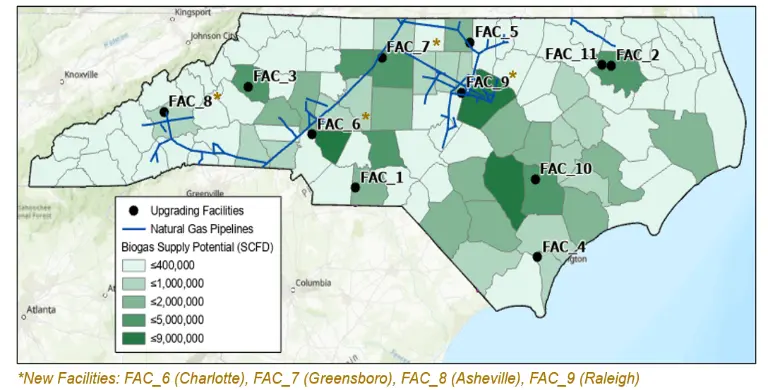
Natural gas infrastructure in North Carolina
The biggest constraint may not be feedstock. It may be RNG infrastructure.
One of the clearest lessons from this analysis is that feedstock availability alone does not determine deployment potential. Injection access matters just as much.
Our modeling shows that most RNG flows are routed through a very small number of injection points, suggesting that existing compressor and pipeline interconnection capacity can become a binding constraint. This is important for policymakers, utilities, and project developers. If injection capacity is limited, expanding feedstock capture alone will not unlock the full value of RNG. Strategic investments in interconnection infrastructure, facility siting, and permitting coordination may be just as important as project-level incentives.
This type of system view is especially relevant as states and regions evaluate clean fuel strategies, methane reduction pathways, and infrastructure planning priorities.
RNG’s role in a broader clean energy strategy
RNG is often discussed as a transportation or utility decarbonization tool, but its potential uses are broader.
For example, RNG may serve as a feedstock for hydrogen production, particularly in pathways that combine steam methane reforming with carbon capture. In North Carolina, the modeled RNG supply could support about 50 million kilograms of hydrogen production per year, highlighting a potential link between RNG development and federal hydrogen incentives such as the 45V production credit.
RNG may also have relevance for data center development. AI, cloud services, and high-performance computing are driving rapid data center expansion, increasing pressure on power systems and raising new questions about resilient energy supply, siting, and infrastructure planning. In that context, RNG could help provide firm, lower-carbon fuel for on-site generation or combined heat and power applications in selected locations.
That does not mean RNG is a universal solution. Its value depends on lifecycle emissions, feedstock pathway, infrastructure access, and project economics. But it does suggest that RNG can play a more strategic role when evaluated as part of a broader energy and industrial system rather than as a standalone niche fuel.
What decision-makers should focus on next for RNG infrastructure
For RNG to scale cost-effectively, the next questions are practical ones:
- Where are the highest-value feedstock clusters?
- Where are pipeline access and interconnection capacity creating bottlenecks for RNG deployment?
- When does trucking make sense versus pipeline transport?
- How should incentives be designed to reflect differences across pathways and locations?
These are the questions spatial optimization can help answer. Instead of treating RNG as a one-size-fits-all opportunity, this approach helps identify where targeted state investments can unlock the greatest methane, energy, and infrastructure benefits.
As states plan for rising demand for lower-carbon fuels, resilient infrastructure, and new energy supply for industrial uses, RNG may offer the most value where waste management systems, pipeline access, and end-use demand intersect. For states, the challenge is not simply whether RNG is promising, but where it can be deployed cost-effectively under real infrastructure constraints. Better planning and additional clean energy research can help identify where RNG investments can support energy, methane, and economic development goals most effectively.