Insights



With advancing weaponry and changing tactical warfare, the uniforms troops wear to keep them safe have become more important than ever. Troops need uniforms that are highly functional, comfortable, and protective from natural elements and combat risks, including chemical, biological, radiological, and nuclear (CBRN) hazards.
As the U.S. approaches its 250th anniversary, we look back on the uniforms troops have used throughout the years and why. In today’s combat landscape, it might seem foolish to wear the bright-colored uniforms of the Revolutionary War, whereas modern heavy protective gear would be unthinkable for colonial troops favoring little equipment and maximum mobility.
Regardless of the time period, American military uniforms have been a vital tool in easing battle identification and promoting service, individual accomplishments, and unit pride. Uniforms also employ battle-tested and, in modern times, scientifically designed protective features. Science-based solutions are essential in crafting and testing military protective garments that keep warfighters safe as they protect America’s freedom.
A Brief History of U.S. Military Uniforms
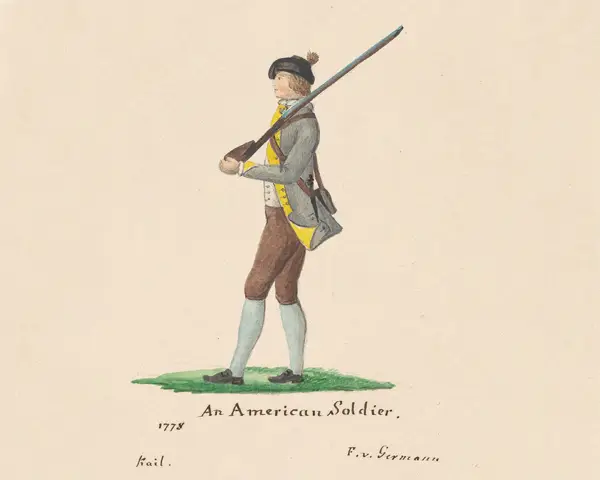
This drawing from 1778 shows an American militiaman in typical dress. Image from Wikimedia Commons.
Revolutionary War (1775 – 1783)
A Continental troop often wore a dark blue wool regimental coat over a linen shirt. The headgear included a black tricorn leather or felt hat that sometimes signaled a soldier’s rank indicated by a pin or ribbon on the hat.
While uniform variations differed among the upstart Continental Army, the standard blue coats distinguished Revolutionaries from the British “redcoats.” Bright colors were significant because officers needed to see their troops to command them in battle through the dense layers of black clouds created by gun powder.
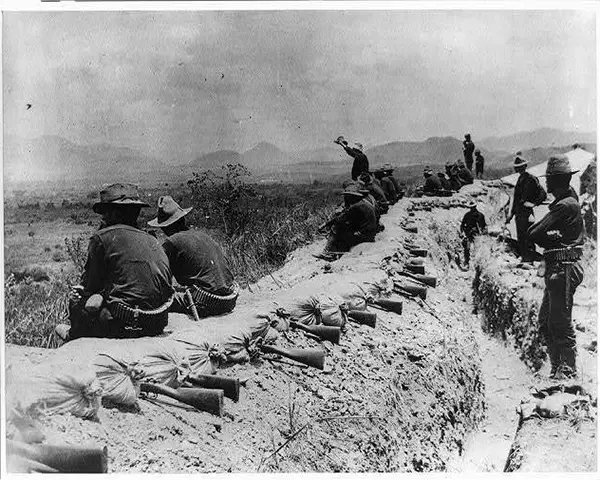
This 1898 photo from the Library of Congress, via the Department of War, shows American soldiers atop trenches near Santiago, Cuba, during a truce in the Spanish-American War.
Spanish-American War (1898)
Colorful uniforms quickly disappeared during the Spanish-American War. Troops transitioned from a blue wool uniform to a khaki color that was more appropriate for the Caribbean and Pacific climate. As warfare changed and new weaponry such as smokeless powder and machine guns emerged, high visibility among troops became a liability. This also marked the first time that a combat uniform became standardized among officers and enlisted men.
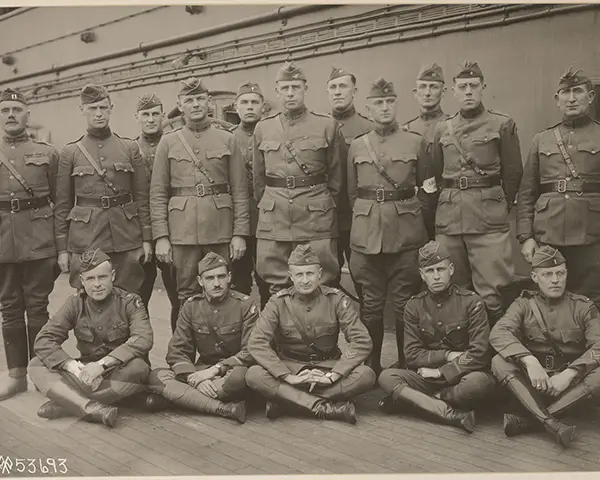
This National Archives photo, via the Department of War, shows officers of the Ohio National Guard aboard ship, returning from World War I in 1919.
World War I (1914 – 1919)
Troops wore an olive uniform that featured a tunic with multiple pockets and wool trousers that tapered around the calf to fit inside a boot. This uniform was crafted for wet and muddy trench warfare. Dog tags became standardized among combat soldiers, providing essential medical information and identification in the case of casualties. Some troops also wore gas masks and steel helmets for protection against poison gas, a lethal chemical arsenal first deployed during this war.
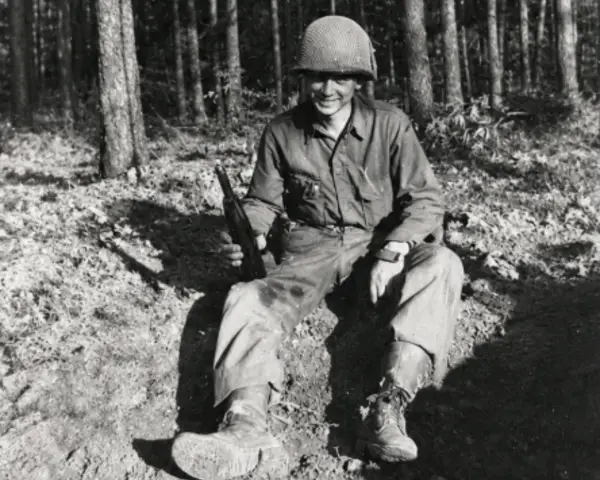
Sgt. Charlies N. Greathouse near the Mosel River in 1945. He is the grandfather of RTI staff member Blair Dodson.
World War II (1939 – 1945)
Helmets gained an added chinstrap for paratroopers, and tunics were replaced with a service shirt featuring an open collar. Boots were built with increased ankle protection for improved mobility. This marked the first time troops wore camouflage smocks called “frogskin,” which was developed to blend with the Pacific environment. Frogskin was famously reversible — one side had a brown and green design ideal for the jungle, while the other side’s tan and brown colors were used in a beach setting. Large-scale biological warfare agents were used to sicken people and livestock. In response, troops wore protective garments and equipment.
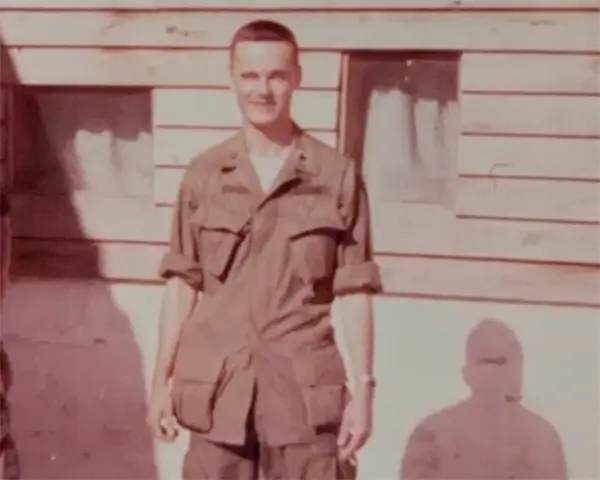
2nd Lt. Thomas R. Johnson in Vietnam around 1965. The father of RTI staff member Linda Wilson, he went on to a 20+ year career in military intelligence, retiring as a lieutenant colonel.
Vietnam War (1965 – 1975)
Uniform designs continued to evolve to more climate- and terrain-specific needs. Velcro emerged as an upgrade to uniforms, enabling troops to update their patches or hide their identify if needed. Combat uniforms transitioned from heavy wool to lightweight, fast-drying cotton and other synthetic materials suitable for jungle warfare. Two new camo patterns emerged: Tiger Stripe and Engineer Research & Development Laboratories, often referred to as ERDL. Troops also wore upgraded full-faced respirators, gloves, and protective materials to protect against chemical warfare.
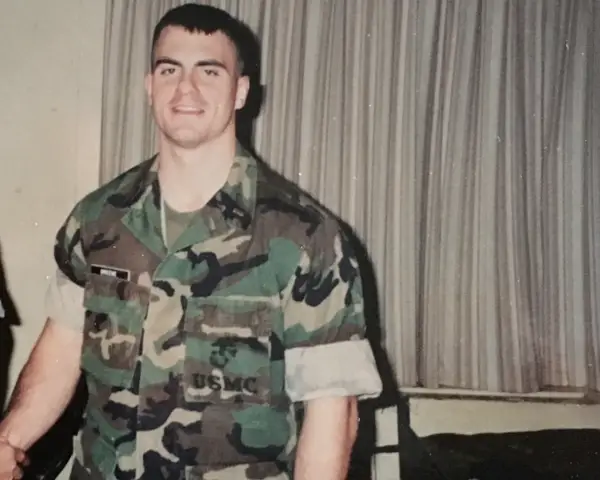
2nd Lt. Joseph Greene, a transport helicopter pilot for the Marines, wearing M81 Woodland camouflage battle dress uniform. The father of RTI staff member Lauren Greene, he later retired as a major.
Gulf War (1990 – 1991)
A camouflage uniform became consistent across all U.S. military branches, with the pattern periodically evolving to better distort troop visibility, keeping them safe. Troops wore a desert night camouflage battle dress uniform (BDU) that protected them from being spotted via enemy night vision devices. New uniforms also added body armor for protection and technologies that improved equipment weight distribution.
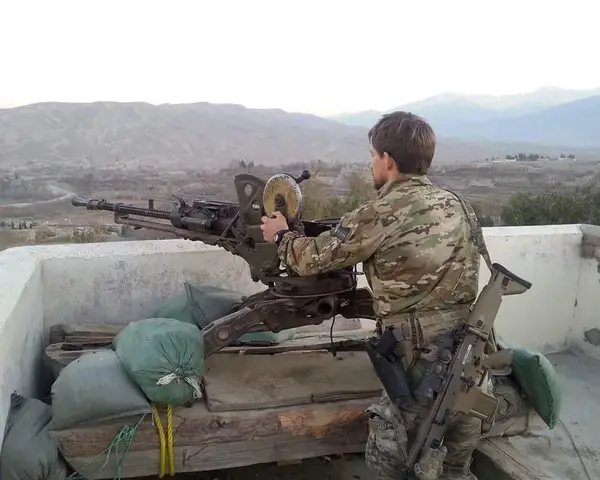
Special forces medic and special forces operations SFC Jonathan Zeisset served in the 3rd Special Forces Group (Airborne) for the Army. He retired as a Master Sergeant and is now an RTI staff member.
Global War on Terror (2001 – 2021)
Garments became more specialized with each branch of the military, making significant updates to gear. Tactical vests replaced the body armor, and new pixelated camouflage replaced the traditional blotches featured in the BDU. Camouflage patterns also became more specific depending on the operational environment.
Other changes included uniforms with Mission-Oriented Protective Poster Level IV (MOPP IV) configuration, which provides hours of CBRN exposure protection. There was also a strong need to reduce the burden of heat, weight, and dexterity loss while protecting against chemical and biological warfare. This drove the need for new materials and garment designs. RTI developed the current test methods for evaluating how well certain materials protect troops from CBRN particulates and aerosols. Our scientists have also developed new methods to ensure our tests are effective and up to date.
The Future of Military Protective Clothing
Lessons learned from previous wars and new environments often influence the need for upgraded military garments. With most upgrades, science has played a unique role in discovering novel technologies that improve U.S. military uniforms.
RTI experts conduct protective clothing testing for the U.S. military, ensuring that the garments that make up a troop’s uniform function to their fullest capability. Our testing methodologies target hazards unique to the military, such as chemicals and bioaerosols exposure.
How it Works
Our core capability in protective garment safety is the Improved Aerosol System Test (I-AST). In this test, a person wearing the protective ensemble is exposed in a controlled wind tunnel to a safe, particle-based aerosol while performing realistic movements. We then measure exactly where and how much contamination penetrates the garment.
The I-AST provides is a highly detailed, quantitative assessment that identifies a garment’s weak points. These results help clients design garments that balance safety, durability, and wearer comfort.
Exploring Next Generation Smart Military Uniforms
Beyond improved fabrics and body armor, future military uniforms may function as integrated wearable systems that help monitor a troop’s health and environment in real time. Researchers are exploring smart textiles that can incorporate sensors directly into garments to track physiological indicators such as heart rate, hydration status, body temperature, fatigue, and exposure to environmental hazards. RTI has contributed to this field through efforts such as the AlphaWear platform, which translates wearable sensor data into actionable information to support decision-making in operational environments.
These technologies could provide early warning of heat stress, dehydration, injury, or physiological decline while reducing the burden on troops operating in challenging conditions. Advanced protective garments may also incorporate embedded chemical and biological detection capabilities, alerting warfighters to potential threats before symptoms appear. Looking further ahead, future uniforms could support field medical assessment by continuously monitoring vital signs and injury status, helping medics prioritize care and enabling faster treatment decisions. Emerging concepts also include integration with wearable drug delivery systems that could administer therapeutics, pain management, or prophylactic countermeasures in response to environmental exposures or medical emergencies.
Combined with lightweight communications technologies and wearable computing systems, future uniforms could serve as both protective equipment and a source of critical situational awareness. As these innovations mature, rigorous testing will remain essential to ensure that new technologies enhance protection, reliability, and performance without compromising comfort, mobility, or mission effectiveness.
Supporting Troop Safety Through Protective Garment Testing
Uniforms worn by U.S. troops are more than just clothes — they’re protective garments that seek to keep the warfighter safe and effective. The needs of the battlefield require ever-changing technology to optimize protection. We are proud to play a small role in helping keep warfighters safe through protective garment testing. As we celebrate this July 4th, let’s not forget our history, but look forward to new inventions that support our troops who protect the freedoms we enjoy daily.
The appearance of U.S. Department of War (DoW) visual information does not imply or constitute DoW endorsement.
Disclaimer: This piece was written by Howard Walls (Lead for Aerosol Control and Protection) and Blair Dodson (Senior Scientist, Respiratory Health) to share perspectives on a topic of interest. Expression of opinions within are those of the author or authors.