Introduction
The LGBTQIA+ community (i.e., lesbian, gay, bisexual, transgender, queer, questioning, intersex, asexual, and other sexual and gender identities in the LGBTQIA+ community) is a strong and diverse community that has challenged systems of oppression to create inclusive and welcoming spaces for others. However, research has been slow to recognize and prioritize the needs of LGBTQIA+ individuals, often centering research narratives on the experiences of cisgender, heterosexual individuals by excluding LGBTQIA+ populations and their priorities from research. This not only produces inaccurate or nonapplicable findings for LGBTQIA+ individuals but also perpetuates the systemic neglect, marginalization, misrepresentation, and stigmatization of these populations (Phillips, Felt, Perez-Bill, Ruprecht, & Glenn, 2022). Researchers, advocates, and affinity groups have begun to call attention to this issue by encouraging the development and implementation of LGBTQIA+ inclusive and equity-centered research (DeChants et al., 2021; National Academies of Sciences, Engineering, and Medicine, 2022; National Science and Technology Council, 2023; Phillips, Felt, Perez-Bill, Ruprecht, Glenn, et al., 2022; Venkateswaran et al., 2023). Similarly, the Biden-Harris Administration recently released guidance that prioritizes improvements in research to advance LGBTQIA+ equity (National Science and Technology Council, 2023). Echoing this call to action, we call for the implementation of equity-centered research that (1) advances the research community’s understanding of LGBTQIA+ research priorities and (2) assists in dismantling the systems of oppression that influence the outcomes and opportunities for these resilient communities.
Despite these various calls to action, there is still ample confusion surrounding equitable research practices with LGBTQIA+ populations because of the lack of “gold standards” for research methodologies—like data collection, measurement, and community engagement—with these populations (Phillips, Felt, Perez-Bill, Ruprecht, Glenn, et al., 2022). This confusion from the limited and mixed guidance that exists can inadvertently lead to inaction and poor-quality research, leaving many researchers unprepared to depart from inaccurate historical precedents. However, useful recommendations do exist across several different sources that can guide how researchers approach their work. Accordingly, this article digests some of the guidance that exists for conducting research with LGBTQIA+ populations so researchers are equipped with tools that can help inform their own practices.
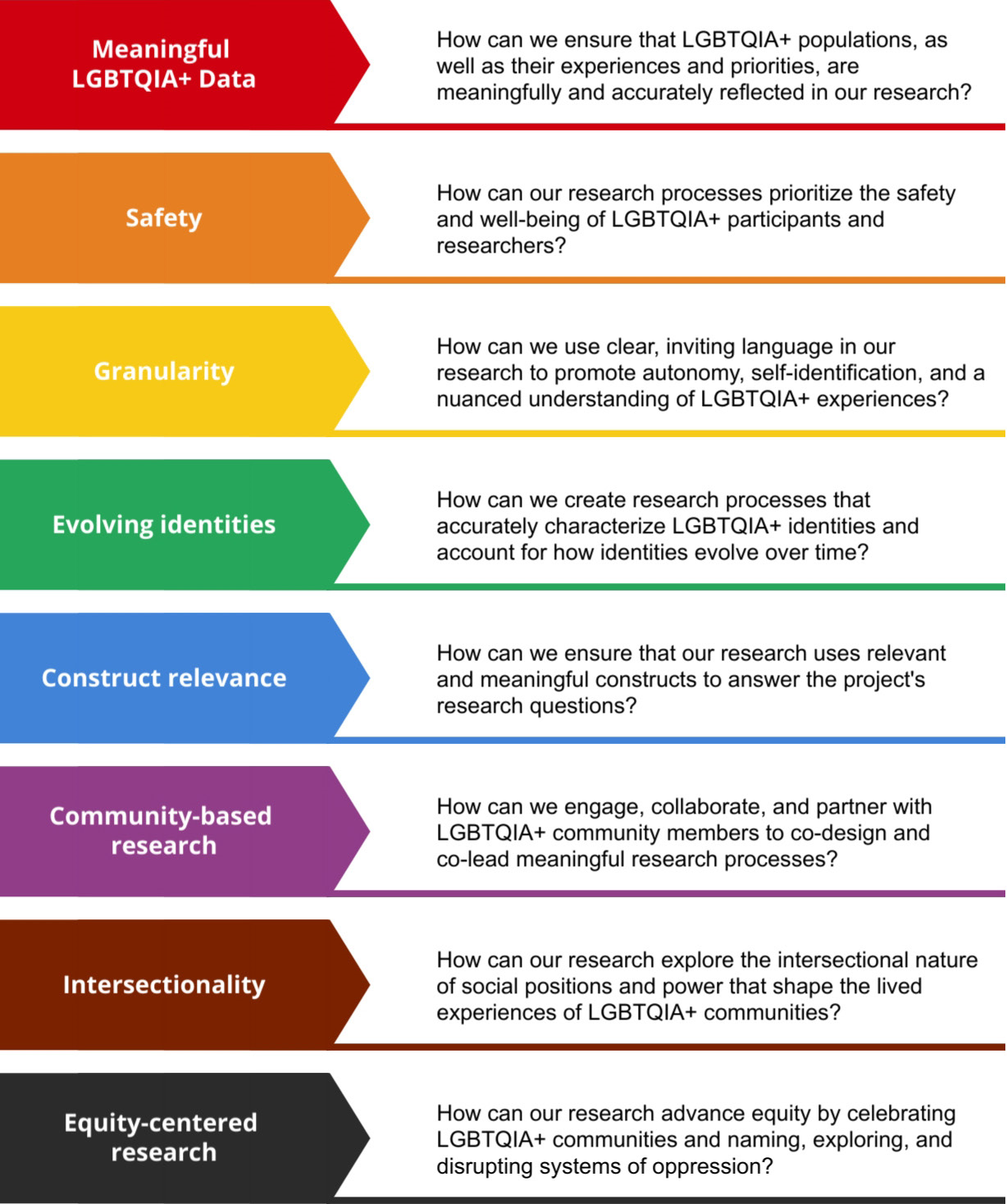
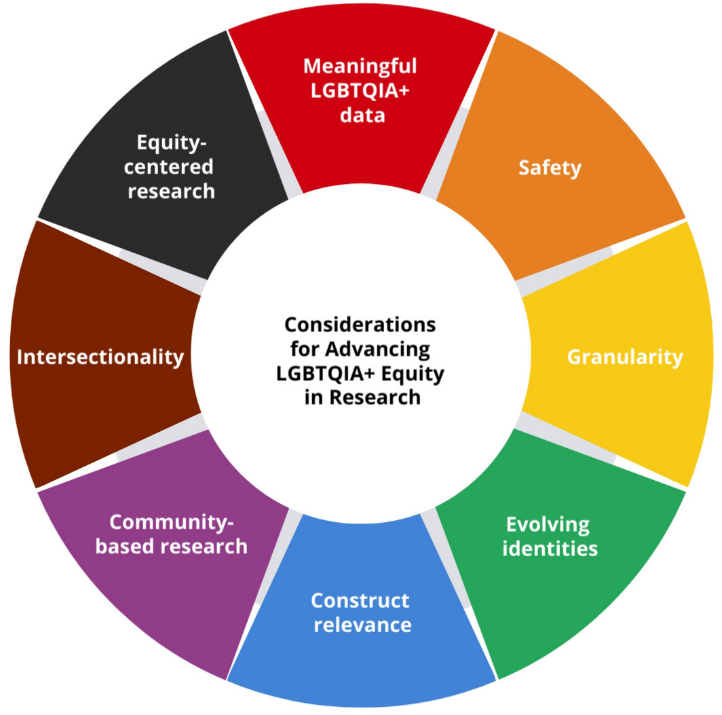
We, the authors, are all members of a working group within the RTI International Global Gender Center that aims to advance LGBTQIA+ equity in research. For this manuscript, we reviewed journal articles and gray literature from LGBTQIA+ advocacy organizations to identify equity-centered considerations to LGBTQIA+ research. We used our expertise and findings from this review, not a systematic review process, to select eight considerations as priorities to advance LGBTQIA+ equity: meaningful LGBTQIA+ data, safety, granularity, evolving identities, construct relevance, community-based research, intersectionality, and equity-centered research (see Figure 1).
We recognize equity as a continual process and propose this list of considerations not as an exhaustive checklist but rather as a set of critical topics to begin prioritizing LGBTQIA+ equity and the strengths of this community in research. As researchers, it is important that we all engage in this process to understand our own positionality and knowledge related to the LGBTQIA+ community and take steps to educate ourselves, reduce biases, and amplify LGBTQIA+ voices (Streed et al., 2023). This article is intended as a first step for researchers to navigate this process.
Organizing Existing Practices and Recommendations
Prioritizing Meaningful LGBTQIA+ Data
Prioritizing meaningful LGBTQIA+ data means that researchers should strive to engage LGBTQIA+ populations in their work in a way that meaningfully characterizes their life experiences and research priorities. This includes collecting data that characterizes systems of oppression (e.g., transantagonism1) and the manifestations of those systems (e.g., restricting access to gender-affirming care) (Zeeman et al., 2019) so that we can disrupt those systems, as well as collecting data that characterizes the strengths of the LGBTQIA+ community (e.g., community support) and how those strengths confer resilience and joy for the community (Colpitts & Gahagan, 2016; Edwards et al., 2023). In this section, we highlight the need for meaningful LGBTQIA+ data and the benefits of its collection.
Accurate and meaningful data are needed to identify disparities caused by systems of oppression and to develop evidence-based policies that disrupt and respond to the consequences of these systems (DeChants et al., 2021; National Science and Technology Council, 2023). Despite calls for data collection, however, these data are not always readily available (Cahill et al., 2014; Grasso et al., 2019). For example, researchers have noted the troubling absence of sexual orientation, gender identity, and intersex identity (SOGII) data collected for COVID-19–related outcomes, leaving public health officials unable to identify any gaps in care for LGBTQIA+ populations in health care settings (Cahill et al., 2020). Similarly, many national surveys, like the Youth Risk Behavior Survey, do not contain measures for intersex identity (Underwood et al., 2020), thereby erasing intersex people from the research. In cases where SOGII data are collected, not all data are useful or meaningful for LGBTQIA+ populations. Some researchers have pointed out the inaccurate, confusing, and stigmatizing language that is still used in electronic health record data collection and research practices, such as including an “other” option for gender identity without allowing patients to further elaborate (Kronk et al., 2022). Collecting inclusive and meaningful SOGII data in health research has already been shown to improve awareness of and responses to health disparities. Upon adding an optional module for sexual orientation and gender identity to the Behavioral Risk Factor Surveillance System in 2014, multiple states identified numerous disparities experienced by LGBTQIA+ individuals—including greater prevalence of chronic health conditions and mental health challenges, and less access to affirming health care compared with their cisgender, heterosexual peers—and designed programs to address these disparities (Restar et al., 2021).
Beyond simply identifying these failings in public health systems and opportunities to respond to them, it also is important to take a strength-based approach in research with LGBTQIA+ populations. Strength-based approaches depart from research that focuses on deficits by acknowledging the positive strengths and protective factors, like resilience, that influence lived experiences (Colpitts & Gahagan, 2016; Edwards et al., 2023; Ghabrial & Andersen, 2021; Kia et al., 2023). For example, one study found that gender-affirming social factors, such as legally changing one’s name to their chosen name, is associated with positive mental health outcomes for Black transgender women living with HIV (Crosby et al., 2016). Other factors that positively contribute to the resilience and health of LGBTQIA+ youth include positive relationships with guardians and peers and the presence of community-based organizations that offer supportive services (Johns et al., 2018; Kia et al., 2023).2 These strength-based and community-driven solutions present an alternative to disparities-focused research, which often uses deficit framing and stigmatizing language. They further challenge the notion that addressing deficits is the best way to improve health by acknowledging that one’s identities and experiences can confer many protective factors (Crosby et al., 2016; Edwards et al., 2023). This has prompted researchers from national and community-serving organizations to advocate for the collection of LGBTQIA+-related data in most areas of public health research and the adoption of research practices that promote engagement with LGBTQIA+ populations and their research priorities (Fenway Institute, 2014; National Academies of Sciences, Engineering, and Medicine, 2022; National Science and Technology Council, 2023).
Prioritizing Safety
LGBTQIA+ populations experience violence and discrimination at much higher rates than their cisgender, heterosexual counterparts because of systemic stigmatization and hate in society (Flores et al., 2020; Grant et al., 2011; Human Rights Campaign Foundation, 2021). As such, they are more likely to express safety concerns related to reporting SOGII data because of fears of unintentional disclosure, harassment, and victimization (Flores et al., 2020; Grant et al., 2011). Recognizing that these concerns may arise in research settings, community organizations and researchers have made recommendations to protect LGBTQIA+ respondents, as well as LGBTQIA+ researchers. These include measures such as clearly explaining why demographic data are being collected, how the data will be used, and how the data will be safely stored (Suen et al., 2022; We All Count, 2021). Other options include allowing individuals to skip questions about SOGII and suppressing data from incredibly small samples that might otherwise lead to unintentional disclosure (Office of Management and Budget [OMB], 2023). Advocates have suggested implementing these measures to avoid ethical violations associated with forcing participants to provide these data if they are concerned about their safety (Office of Management and Budget [OMB], 2023).
Although some of these safety measures might raise concerns about participant nonresponse or missing data, LGBTQIA+ researchers and advocates have noted that, generally, people understand SOGII questions, are comfortable responding to them, and see the value in answering SOGII questions in a variety of contexts (Cahill et al., 2014). Evidence suggests that this remains true even for populations of LGBTQIA+ youth when researchers take appropriate measures to prioritize participant safety, such as waiving guardian consent for studies on sexual health research and creating safe spaces where people can use their chosen name or a pseudonym (Cwinn et al., 2021; Macapagal et al., 2017; Schrager et al., 2019). Studies have shown that many LGBTQIA+ youth who are not “out” about their identity to a caregiver report that they would participate in research without caregiver consent, but they would not participate if caregiver consent were required, for reasons such as fear of unintentional disclosure and negative attitudes toward LGBTQIA+ people that their caregivers hold (Cwinn et al., 2021; Macapagal et al., 2017). These same studies have also shown that LGBTQIA+ youth who are not comfortable participating in research that requires caregiver consent might lack social support, be more vulnerable to mental health challenges, and have more negative attitudes about their identities (Cwinn et al., 2021). This demonstrates that some LGBTQIA+ populations, like LGBTQIA+ youth who are not “out” to their caregivers, might not be accounted for in research because they have concerns about disclosure. Excluding these populations from research can distort the data and lead to incorrect conclusions. Although not applicable for every study, researchers should work with their institutional review boards and community advisors to determine whether and how research procedures might need to be adapted to protect participant safety and autonomy while also adhering to ethical research practices like obtaining informed consent from participants.
In addition to adapting interview and survey measures, LGBTQIA+ advocates have echoed the importance of collaborating and building rapport with LGBTQIA+ communities to establish participant safety. Suggestions include partnering with interviewers and researchers who are members of the community (e.g., nonbinary field interviewers for research with nonbinary individuals) and ensuring that all researchers are trained in cultural humility, especially when the research focuses on LGBTQIA+ populations (Cahill et al., 2014; Suen et al., 2022). We will discuss these types of community-centered research methods below in more detail. Because LGBTQIA+ populations have been and continue to be stigmatized and discriminated against in society and in research, establishing safe spaces and trust with these communities is crucial to remedying this mistreatment of LGBTQIA+ researchers and participants (Human Rights Campaign Foundation, 2021; Streed et al., 2023). These steps can help LGBTQIA+ participants and researchers feel more comfortable and connected to the work, as well as ensure that non-LGBTQIA+ members of the research team are aware of and respectful of the experiences of LGBTQIA+ participants and colleagues (Hwang et al., 2022; Singh et al., 2018).
Prioritizing Granularity
In both quantitative and qualitative studies, researchers have recognized the importance of expanded granularity, or increased specificity, to correctly characterize SOGII. Generally, we support the use of increased granularity and specificity in research, given that it is in appropriate in the context of the study and in line with the values of communities participating in the research.
Of note, the degree of granularity is context-dependent. For example, some recommend measuring a limited number of sexual orientation identities (e.g., lesbian, gay, bisexual, straight) on general federal surveys to prevent small sample sizes or easily identifiable data (National Academies of Sciences, Engineering, and Medicine, 2022; Williams Institute, 2020). Others have noted the benefit of providing more options (e.g., lesbian, gay, bisexual, pansexual, queer, straight) and write-in options (i.e., an “identity not listed here” field that allows participants to elaborate) to include populations that are often excluded from research settings, identify emerging trends, promote autonomy, and improve the accuracy of findings (DeChants et al., 2021; Office of Management and Budget [OMB], 2023; Suen et al., 2020). Studies have shown that limited response options can sometimes confuse LGBTQIA+ participants because the options might not acknowledge the diversity and fluidity of their identities (Suen et al., 2020). However, in some instances, sample sizes or other contextual factors like safety might not allow for the use of granular, disaggregated data. Health equity researchers have provided alternative responses to these types of situations, such as letting participants self-identify from fewer categories and explaining to participants the rationale for this choice and how the data will be used (We All Count, 2021).
Increased granularity is especially important for research focusing on LGBTQIA+ populations and their research priorities. For example, studying the protective nature of gender-affirming policies or studying harassment and bullying experienced by LGBTQIA+ youth would likely warrant collecting more-detailed and more-granular data about gender identities (e.g., nonbinary, genderqueer, demigirl, demiboy, etc.) than general federal surveys because of the nuances that exist in lived experiences (Kosciw et al., 2022). Additionally, as language evolves, it is crucial to recognize that some terms or measures may need to be adapted to reflect inclusive and meaningful language (DeChants et al., 2021; Moseson et al., 2020). For example, the term “gender modality” has recently been introduced as a term for “how a person’s gender identity stands in relation to their gender assigned at birth” (Ashley, 2022; Kronk et al., 2022), indicating a possible emerging shift in LGBTQIA+ research terminology and methodologies. Researchers should monitor evolving language and methodologies when considering the appropriate level of granularity.
Prioritizing Evolving Identities
An individual’s concept of self is a learning process, and as such, one’s identity can evolve over time before or after “coming out.” Because of this phenomenon, it is important to capture SOGII data over time using longitudinal studies, in addition to cross-sectional studies (DeChants et al., 2021; National Academies of Sciences, Engineering, and Medicine, 2020). For longitudinal studies, repeated measures of SOGII may be necessary, as one’s sexual orientation, gender identity, sexual behavior, gender expression, and so forth might differ from one wave of data collection to the next (National Academies of Sciences, Engineering, and Medicine, 2020; National Science and Technology Council, 2023). Additionally, various researchers recommend providing participants with the option to indicate that they are questioning their identity in survey measures in recognition that people may be at different stages in understanding their identity (DeChants et al., 2021).
Prioritizing Construct Relevance
SOGII data are often collected and used to characterize LGBTQIA+ populations. Numerous researchers have noted that when collecting this information, it is vital to describe how terms are being defined, to acknowledge whether measures are being used as proxies for another construct, and to consider whether there is a more-accurate measure to assess the construct in question (Ybarra et al., 2019). For example, researchers at The Trevor Project who work with LGBTQIA+ youth define constructs like sexual orientation, gender identity, sex assigned at birth, and variations in sex characteristics in survey questions in case youth are unfamiliar with the terminology (DeChants et al., 2021). Some other common examples of constructs that researchers approximate with SOGII or the term “sexual and gender minority” include sexual behavior, sexual and romantic attraction, gender expression, and SOGII-related stigma and discrimination (Ybarra et al., 2019).
Recognizing that SOGII data are often incorrectly used as proxies for these types of constructs, researchers should consider and measure constructs that are most salient for their research (Suen et al., 2020). For example, different dimensions of sexual orientation (i.e., sexual attraction, sexual behavior, and sexual identity) are often used interchangeably or used as proxies for one another, even though research has shown that this approach is not accurate (Moseson et al., 2020; Ybarra et al., 2019). With this in mind, measuring sexual behavior in addition to SOGII might be more informative for studies examining the effects of health policies on sex positivity, sex education, or sexually transmitted infections, for example (Ybarra et al., 2019). Similarly, measuring SOGII might not adequately capture constructs like identity-based discrimination or resilience, for which there are measures, like the Queer People of Color Identity Affirmation Scale, that researchers can use in tandem with measuring SOGII data (Ghabrial & Andersen, 2021; Zelaya et al., 2021). Given the limited insights SOGII data can provide about the scope and diversity of experiences within the LGBTQIA+ community, constructs that are more specific to the research question (e.g., sexual behavior, resilience, experienced discrimination) can provide additional nuances about the factors that may be influencing one’s well-being.
Prioritizing Community-Based Research
LGBTQIA+ advocates have urged for the adoption of community-based research methods, like community-based participatory research (CBPR), that prioritize partnerships with LGBTQIA+ communities (Hwang et al., 2022; Mann-Jackson et al., 2021; National Science and Technology Council, 2023; Ricks et al., 2022). Community-based methods often call for the decolonization of research—a process in which researchers depart from Eurocentric research methodologies and perspectives (Hunt, 2016; Phillips, Felt, Perez-Bill, Ruprecht, & Glenn, 2022; Singh et al., 2018). Whereas Eurocentric research methodologies impose values about what is considered meaningful (e.g., variable definitions, statistical tests) and justify the creation of hierarchies of power in research based on the fallacy that data and researchers are objective and free of bias, decolonizing and community-based methods strive to center the experiences of communities participating in the research by prioritizing the worldview, expertise, and leadership of communities with whom the research is conducted (Hunt, 2016; Phillips, Felt, Perez-Bill, Ruprecht, & Glenn, 2022; Singh et al., 2018; We All Count, 2021; Wesp et al., 2019).
To begin prioritizing CBPR and decentering our own worldviews, it is critical to be self-reflexive and address researcher positionality—in other words, to consider how the various aspects of a researcher’s identity might influence their power in relation to the research partners, participants, and processes (Muhammad et al., 2015). Researchers have noted that, although understudied, recognizing the nuances of positionality could produce significant positive and meaningful research outcomes (Keene & Guilamo-Ramos, 2021). For instance, Keene and Guilamo-Ramos (2021) note that Black and Latine sexual minority scholars might have a multilevel nuanced positionality (e.g., cultural knowledge and expertise, mutual trust with the community) that can better inform the research they conduct with this population relative to someone who is not a member of that community. Other leaders in this space have likewise advocated for LGBTQIA+ research projects led by and conducted in partnership with LGBTQIA+ individuals, especially community members who will be participating in the research, by reimagining the dynamic of a research team through this lens (Kronk et al., 2022; Streed et al., 2023). This might involve intentional power-sharing with these communities throughout the research process and at decision-making stages to influence the direction of the research and facilitate bidirectional learning (Moseson et al., 2020; Muhammad et al., 2015; Ricks et al., 2022; We All Count, 2021). When conducting this work, it is crucial to ensure that LGBTQIA+ community members, leaders, and researchers are adequately supported, compensated, and recognized for their labor, given the emotional vulnerability that often accompanies LGBTQIA+ research (Hwang et al., 2022).
Of note, the LGBTQIA+ community is heterogeneous and consists of people with many different identities. Individuals within this community have varying sexual orientations, ages, and neurodiversity, among many other identities. For research that is specific to a subset of the LGBTQIA+ community, it is important to have individuals from that part of the community driving the research process (Hwang et al., 2022; Kronk et al., 2022). For example, one research team studying resilience among transgender and gender-diverse (TGD) people, although still led by and comprised of TGD researchers, developed a community advisory board of TGD people who provide peer support within the TGD community to triangulate ideas and improve research processes (Kia et al., 2023). Drawing on the expertise of LGBTQIA+ communities, these types of community-based approaches have been shown to increase community satisfaction, autonomy, and participation and lead to more-relevant, more-sustainable results and policies (Hwang et al., 2022; Leung & Flanagan, 2019).
Given the proven success of community-based methods, it is important to collaborate with LGBTQIA+ community members and other LGBTQIA+ researchers to identify which research questions, definitions, measures, and analyses are most meaningful and provide the best insight into the underlying mechanisms that contribute to disparate outcomes (Hwang et al., 2022; Ricks et al., 2022; Streed et al., 2023; Venkateswaran et al., 2023; We All Count, 2021). As identities are inherently personal, different audiences and cultures may understand, experience, and express LGBTQIA+ identities differently. As a result, it is important for researchers to consider the various contexts of communities participating in the research and the factors that may influence participants’ understanding of SOGII (Ricks et al., 2022). Community members may have insights into the nuances of how individuals perceive and define identities, and as such, can help craft language and methods that will be easily interpretable, celebrate community identities, and have practical implications for research findings (Anderson & Mastri, 2021; Leung & Flanagan, 2019). Considering these cultural contexts requires exploring tenets of decoloniality that encourage us to question long-standing definitions of SOGII that have been imposed (Phillips, Felt, Perez-Bill, Ruprecht, Glenn, et al., 2022). For example, Eurocentric pedagogies have imposed definitions of gender and sexual orientation that are incompatible with some indigenous cultures. Therefore, researchers should find ways to work with these communities to ensure that methods center on indigenous experiences and value systems (Hunt, 2016). Continuing to use existing measures without incorporating community voices can lead to systemic invisibility and perpetuate exclusion of already excluded populations, such as Two-Spirit individuals, from research and its benefits (Hunt, 2016).
Community-based methods can also be meaningful ways to share and apply research findings that benefit directly impacted individuals, rather than solely presenting and interpreting findings in academic contexts (Hwang et al., 2022; Ricks et al., 2022; Streed et al., 2023; Vaughn et al., 2013). For example, in one CBPR project conducted in North Carolina, a group of community members and researchers held interviews with other community members and organizations to identify their priorities and codesign an intervention to address disparities among young gay people, bisexual people, other men who have sex with men,3 and transgender women (Mann-Jackson et al., 2021). Other studies have created community advisory boards of LGBTQIA+ populations to inform, guide, and interpret the research because of their expertise and connection to the community (Geffen et al., 2023; Kia et al., 2023). Examples of feedback from these types of methods include how to share findings with communities, such as creating tangible outputs like pamphlets, graphics, animation, or documentaries that summarize findings, as well as other forms of communication, like community forums and presentations (Anderson & Mastri, 2021; Ricks et al., 2022; Vaughn et al., 2013).
Prioritizing Intersectionality
LGBTQIA+ individuals are not a homogeneous group, but rather a diverse set of individuals with varying ages, races, cultures, religions, socioeconomic backgrounds, and other identities. These varying identities interact with one another to determine an individual’s relation to systems of power and oppression, and consequently, these systems influence outcomes and opportunities for that individual (Crenshaw, 1989; Muhammad et al., 2015). This phenomenon is called intersectionality—a term coined by Kimberlé Crenshaw to characterize the discrimination experienced by Black women as a result of combined systemic racism and sexism (Crenshaw, 1989). Intersectionality posits that identities, like race and gender, are multidimensional, not independent, and are connected to social power (Bauer et al., 2021; Crenshaw, 1989). This concept is relevant for LGBTQIA+ research as well—someone might experience unemployment or loss of housing from varying manifestations of transantagonism, heteronormativity, and racism, for example (Grant et al., 2011). Intersectionality also helps characterize how communities, like LGBTQIA+ faith groups and LGBTQIA+ people of color, experience joy and resilience, which are crucial protective factors that improve well-being (Edwards et al., 2023). It is important to define and examine intersectionality in the context of LGBTQIA+ research to ensure that the research accurately characterizes and truly benefits LGBTQIA+ people.
Research on intersectionality has shown that LGBTQIA+ populations span several social positions of power; their other identities contribute to variations in lived experiences, inequities, and community strengths (Wesp et al., 2019). Existing research has shown that systems of oppression like structural racism perpetuate worse health outcomes for LGBTQIA+ people of color than white LGBTQIA+ people (Grant et al., 2011; Human Rights Campaign Foundation, 2021; Kosciw et al., 2022; The Trevor Project, 2022a). For example, a study by The Trevor Project found that LGBTQIA+ youth of color attempted suicide more frequently than their white peers (The Trevor Project, 2022a). It is also crucial to recognize that research on intersectionality can highlight the benefits of intersectional joy and resilience within LGBTQIA+ communities (Edwards et al., 2023; Phillips, Felt, Perez-Bill, Ruprecht, & Glenn, 2022). For example, studies have shown that resilience among LGBTQIA+ people of color is associated with identity affirmation and improved mental health outcomes (Crosby et al., 2016; Ghabrial & Andersen, 2021). Other research similarly suggests that connecting with LGBTQIA+ peers who have shared experiences might improve social support and well-being (Kia et al., 2023).
Unfortunately, not much data exist to characterize intersectionality for LGBTQIA+ populations because LGBTQIA+ research often focuses on the experiences of specific populations, like white gay cisgender men (Phillips, Felt, Perez-Bill, Ruprecht, & Glenn, 2022). Although many early advocates and mobilizers of the LGBTQIA+ rights movement in the United States were queer drag queens and trans women of color, these populations have continued to be excluded from and marginalized by LGBTQIA+ organizations, research, and policy (The Trevor Project, 2022b). Likewise, other populations, like LGBTQIA+ neurodivergent individuals, also have been excluded from research narratives and discussions around inclusive research practices. This exclusion deprives research of their rich perspectives, resulting in a dialog that lacks the unique expertise of these populations and produces findings that are not applicable to these communities (Phillips, Felt, Perez-Bill, Ruprecht, Glenn, et al., 2022).
As such, experts have suggested that researchers incorporate methods that support the exploration of intersectionality, such as qualitative research and expansive demographic data collection (Bauer et al., 2021; Ricks et al., 2022). This also includes departing from “nationally representative” sampling practices that largely exclude or prevent meaningful interpretations for these populations and instead using intentional methods like oversampling and purposive sampling to accurately capture the experiences of LGBTQIA+ populations (Phillips, Felt, Perez-Bill, Ruprecht, Glenn, et al., 2022; Schrager et al., 2019). Additionally, researchers can consider other methods like using community-accessible spaces, working with community organizations to recruit populations that are often excluded from research (e.g., transgender individuals), and working with these populations to develop research priorities (Anderson & Mastri, 2021; Ricks et al., 2022). When researchers are unable to achieve desired sample sizes to explore intersectional analyses in quantitative research, advocates have recommended novel analytic approaches, reporting what findings they do have with their limitations, or presenting data in alternative formats like tables so as to not intentionally exclude groups solely because of sample size (Bauer et al., 2021; We All Count, 2021). Last, as one of the important tenants of intersectionality is recognizing the relationship between systems and social power, researchers should also correctly name and study the structural systems that contribute to lived experiences (Bauer et al., 2021; Phillips, Felt, Perez-Bill, Ruprecht, Glenn, et al., 2022; Wesp et al., 2019).
Prioritizing Equity-Centered Research
All these considerations, like community-based research and intersectionality, are critical steps to promoting LGBTQIA+ equity in research. This section expands on how we can shift our approach to research beyond simply considering the previous priorities to actively naming and disrupting systems of oppression. Recommendations for equity-centered research emphasize the importance of acknowledging and exploring underlying explanatory structures and systems that perpetuate the inequities we notice in our research, such that our work aids in the disruption of these systems (Venkateswaran et al., 2023; Wesp et al., 2019). For instance, researchers advancing racial equity should discuss how disparities found in their work are produced by structural and explanatory systems, like structural racism, to prevent deficit-framing and stigmatizing populations (Venkateswaran et al., 2023). These practices are directly transferable to research with LGBTQIA+ populations; researchers should explore and acknowledge how the structural systems like cisnormativity, heteronormativity, and transantagonism that are present in societal norms, policies, and other practices produce disparities among LGBTQIA+ populations (Wesp et al., 2019; Zeeman et al., 2019). These systems impose societal hierarchies that marginalize populations and impose stressors that contribute to various inequities in socioeconomic status, mental health, sexual health, and a variety of other outcomes among these populations.
Liberation, or the absence of inequity and oppression, is the outcome of equity-centered research and should be what we as researchers strive to achieve in our work with LGBTQIA+ populations (Venkateswaran et al., 2023). Naming and researching the systems of oppression that contribute to LGBTQIA+ inequities are essential steps to disrupting these systems in equity-centered research (Phillips, Felt, Perez-Bill, Ruprecht, & Glenn, 2022). Research has often ignored this practice of differentiating between identity-based measures like SOGII and underlying systems like heteronormativity, thereby misinterpreting or misattributing findings to one’s identity rather than the socio-structural systems driving inequities. In light of this, experts have highlighted the importance of engaging in equity-centered research by correctly contextualizing our research narratives and empowering populations participating in the research (Leung & Flanagan, 2019; Venkateswaran et al., 2023). By correctly contextualizing our research in these systems, we can shift normative deficit-framing narratives to strength-based narratives that celebrate the rich identities, strengths, experiences, and joy of LGBTQIA+ communities (Colpitts & Gahagan, 2016).
In addition to characterizing our research in the context of broader systems, it is critical to acknowledge our own relationship to these systems (e.g., Are you a member of the LGBTQIA+ community?), examine how that might influence our connection to the work (e.g., Are you aware of current LGBTQIA+ terminology?), and consider what steps we can take to engage in equity-centered research (e.g., How can we improve our allyship and knowledge of the LGBTQIA+ community by engaging in trainings, partnering with LGBTQIA+ individuals on the research team, etc.?) to promote justice and liberation for LGBTQIA+ communities (Venkateswaran et al., 2023; Wesp et al., 2019).
Limitations
The limitations of these priorities include, first, that the language used in this article was current at the time of submission. Language is ever-evolving, so some of the language used in this article may require updating in the future. Second, although intended for a variety of research settings and topic areas, the priorities listed in this article might need to be adapted for different contexts (e.g., regions where LGBTQIA+ people are criminalized). Last, although all the priorities listed above are important to advancing equity for LGBTQIA+ populations, they are neither an exhaustive list nor a simple checklist that one can follow to achieve equity.
Conclusion
LGBTQIA+ populations have been excluded from and stigmatized in research, resulting in a lack of characterization of their research priorities and their unique expertise. Engaging LGBTQIA+ populations in research is vital to informing evidence-based policies that seek to disrupt systems of oppression and the disparities that accompany them. As such, researchers and advocates have provided considerations and guidance on how to engage with these populations in research. The considerations listed in this article, although not exhaustive, exemplify some actionable steps researchers and community advocates have highlighted that we as researchers can use to engage in conversations about how we can shift narratives to advance LGBTQIA+ equity in our own work (see Figure 2). Engaging in equity-centered research through these considerations is a continuous process. Researchers have a responsibility to engage with this process every day to dismantle systems of oppression and celebrate LGBTQIA+ communities.