Key Findings
Advances in wireless sensor technology have enabled the realization of smart city digital twins for urban planning and utility management and human digital twins for healthcare applications.
Researchers, first responders, and public health officials can leverage environmentally aware digital twins in both smart city and healthcare applications to understand interactions between people and the environment.
To understand the risk for contracting vector-borne and environmentally driven diseases, standards for data and metadata from wireless sensors; better use of edge computing for storage, computation, and communication; and access to labeled data are needed to leverage environmentally aware digital twin technology effectively.
Introduction
The use of Internet of Things (IoT) sensors has steadily grown over the past decade, providing real-time monitoring (e.g., temperature, humidity, light levels) capabilities for homes, buildings, and cities (Saxena et al., 2024). Coupled with advances in artificial intelligence and machine learning (AI/ML), IoT sensors can improve environmental surveillance for wildfires (Chan et al., 2024), sandstorms and landslides (Regula et al., 2024), and floods (Arshad et al., 2019). The past decade has also seen a steady growth in the use of wearable sensors (“wearables”), such as fitness bands, smartwatches, and smart rings, for understanding health (Ehizogie et al., 2024). Combined with data from mobile devices that provide other contextual information (e.g., location, social interactions, usage data), wearables can alert users to early warning signs of illness (Somasundaram et al., 2024) or asthma exacerbation (Hosseini et al., 2017) and track fitness to deliver personalized recommendations (Asgari Mehrabadi et al., 2024).
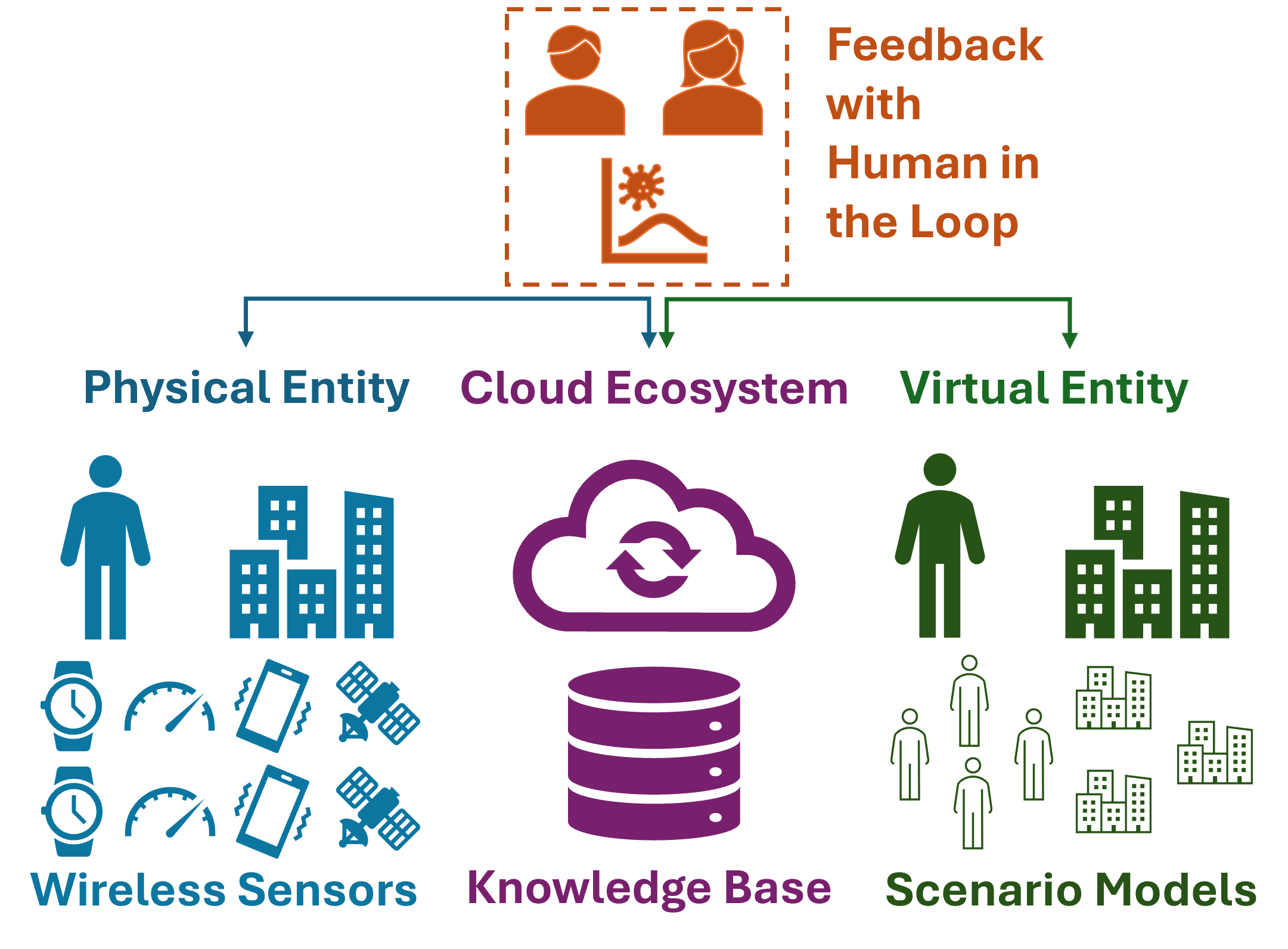
Because IoT sensors, wearables, and mobile devices collect continuous, real-time information with high spatial accuracy, these technologies are frequently suggested for use with digital twins (DTs). DTs are a virtual representation of a real-world object that can be used to simulate and understand responses to different scenarios (Figure 1). One of the key elements of a DT is bidirectional data flow between the real-world object and virtual representation, which is the gap that IoT sensors, wearables, and mobile devices have helped to fill. As more data are collected and different scenarios are encountered and tested (i.e., labeled data), the knowledge base that feeds the DT grows and leads to more accurate results and more complex simulations with less uncertainty (Riahi et al., 2025).
Figure 1.
307451Diagram of how DTs function
How to read the flow diagram: DTs use wireless sensors to collect data about physical entities and feed this information to virtual entities. Cloud-based ecosystems aggregate, parse, and store data from various sensors and public resources. Computational and AI/ML models fuse the multimodal data, create features, extract trends, and provide actionable insights. Feedback between the virtual and physical entities can range from fully automated to human-in-the-loop.
DTs can serve as a valuable resource for understanding interactions between humans and their environment. The literature discusses two types of environmentally aware DTs: smart city (SC) DTs and human DTs. To date, these environmentally aware DT technologies have not been fully integrated; SCs consider human interactions in aggregate (e.g., assuming equal risk among everyone regarding environmental exposures) whereas human DTs use ambient (e.g., from the nearest fixed monitoring location) versus local exposure information. Personalizing the reactions of the individual agents used in SCDTs and using more realistic predictions of local exposures for human DTs could improve the accuracy of simulations for both technologies. An emerging area of research that would benefit from the more intentional interaction of SC and human DT technology is forecasting and predicting vector-borne or environmentally driven diseases. It is critical to portray exposure risk and health symptoms accurately to (1) identify the source of the disease and (2) initiate treatment as quickly as possible.
To understand how environmentally aware SC and human DTs can be leveraged to understand and mitigate vector-borne or environmentally driven disease spread, this research brief describes the current state of environmentally aware SCDTs (including agricultural lands) and human DTs, with a focus on how IoT and wearable sensors are being leveraged in these applications. The research brief goes on to present a vision for the combination of these technologies and concludes with gaps in existing DT technology, particularly for scaling to large populations and providing timely feedback.
Environmentally Aware SCDTs and Agricultural DTs
One of the main applications discussed in the literature regarding environmentally aware SCDTs is understanding the impacts of and planning responses to natural disasters, such as hurricanes, earthquakes, and wildfires (Ariyachandra & Wedawatta, 2023; Astarita et al., 2024; Dale et al., 2023). Adding weather, climate, and environmental data to existing SCDTs can also improve the management of environmentally sensitive assets such as energy grids and transportation networks (Astarita et al., 2024; Dale et al., 2023). In addition to data from public resources, information from IoT sensors and social media (e.g., text, pictures) (Ariyachandra & Wedawatta, 2023; Dale et al., 2023) and imagery from unmanned aerial vehicles (UAVs) (Ariyachandra & Wedawatta, 2023) can provide situational awareness.
SCDTs have also been used to understand how the built environment affects the ambient environment, which can provide more accurate information for modeling health effects. For example, inexpensive sensors can provide high spatiotemporal resolution urban heat maps and can be used to understand “collective urban heat exposure” when combined with humidity sensors and cameras (Kaginalkar et al., 2021; Pan et al., 2024). Combining the heat index with the density of people at a given location enables simulations to account for the added thermal burden of being in a crowded space so that resources can be allocated effectively, especially for special events where spaces are more crowded (Pan et al., 2024).
Scientific- or research-grade instrumentation and IoT sensors for monitoring volatile organic compounds from industry and road traffic, particulate matter (PM), and ozone are also being used to provide better models of urban air quality (Kaginalkar et al., 2021; Topping et al., 2021; Zeng et al., 2024). Small, lightweight personal exposure monitors (PEMs) are becoming more affordable and are being used in research studies (Park et al., 2022). New modeling techniques that use data from multiple sources (e.g., topography, meteorology, and IoT sensors) can also provide better spatiotemporal resolution than existing monitoring infrastructure, enabling personal exposure to be more accurately predicted and buildings to be more efficiently controlled (Kaginalkar et al., 2021; Park et al., 2022; Zeng et al., 2024).
Similar to SCDTs, modern agricultural areas are being monitored using digital sensors and AI/ML technology is being used to optimize resources and improve operational efficiency. DT technology is used for both crop and livestock management. IoT sensors (soil moisture, pH, and temperature sensors), light detection and ranging (LiDAR) sensing technology, and drone imagery have been used in DTs of crops to forecast labor requirements, detect diseases and weeds, and monitor fertilization and irrigation to reduce water contamination (Purcell & Neubauer, 2023; Zhang et al., 2025). DT technology is becoming increasingly important as an agricultural decision support tool as weather patterns shift and data-driven models built and trained on historic data begin to fail (Purcell & Neubauer, 2023; Zhang et al., 2025). Regarding livestock, DTs have been used to control temperature and air quality in barn systems and to optimize their design, monitor and manage the health of individual animals, and optimize feeding schedules and breeding strategies (Chatterjee et al., 2021; Purcell & Neubauer, 2023; Symeonaki et al., 2024; Zhang et al., 2025).
Environmentally aware SCDTs provide an excellent opportunity to manage resources more effectively and understand the impacts of changes in the built landscape. One of the major challenges regarding SCDTs is communicating the information generated by simulations to the public or emergency response officials during disaster events in a timely manner (Ariyachandra & Wedawatta, 2023; Astarita et al., 2024). Another major challenge is the accuracy of the simulations when IoT and PEM sensors are used, because many of the models that are being used were trained and validated using research-grade instrumentation (Park et al., 2022). Additionally, current process-driven models are computationally expensive, and AI/ML techniques may be able to generate results quicker once these models are trained (Purcell & Neubauer, 2023; Topping et al., 2021).
Environmentally Aware Human DTs
DTs provide the opportunity to understand how people, especially firefighters, maritime workers, and military personnel, will perform in extreme environmental conditions. Temperature, humidity, wind speed, altitude, and other variables all interact, which makes it difficult to perform experiments in laboratory conditions to understand environmental health effects (Werner et al., 2024). Individual demographic factors, as well as dynamic factors such as nutrition, sleep, and illness, also impact physiological responses (Riahi et al., 2025; Werner et al., 2024).
The military has been primarily responsible for advancing the understanding of how people respond to extreme environmental conditions. The U.S. Army Research Institute of Environmental Medicine (USARIEM) created the Warfighter Physiological Status Monitor (WPSM), which integrates several sensing modalities (e.g., heart rate, respiration rate, blood pressure, physical activity, posture) to understand a soldier’s health in near real-time (Borsotto et al., 2004; Werner et al., 2024). USARIEM has used the WPSM and other tools to monitor, predict, and optimize performance, especially regarding risk for developing heat stress (Cuddy et al., 2013; A. W. Potter et al., 2017), cold stress (A. Potter et al., 2023; A. W. Potter et al., 2020), and altitude sickness (Norris et al., 2012). DTs for understanding health effects in extreme environments will be improved as more labeled, real-world data become available (Werner et al., 2024). For example, it has been challenging to monitor pilots during flight to understand stress responses (Shaw & Harrell, 2023).
DTs of a body’s systems, functions, or organs (instead of the complete organism) have also been developed to test different treatment options and drug interactions and support clinical and operational decision making (Avanzato et al., 2024; Katsoulakis et al., 2024; Riahi et al., 2025). Regarding environmental exposures, the COVID-19 pandemic saw the realization of DTs of the lungs to optimize ventilator resources, and this research could be leveraged to understand the impacts of air pollution or other hazards on respiration (Katsoulakis et al., 2024). DTs of the lungs have also been used to improve and automate diagnosis to improve efficiency and reduce healthcare costs (Avanzato et al., 2024). Smart inhalers and nebulizers, smartwatches and wearable oximeters, and wearable or smartphone-based cough monitors are now being used to monitor people living with chronic respiratory conditions (Gonsard et al., 2024; Park et al., 2022). Geolocation data from smartphones can also be used to personalize ambient exposure predictions (Kaginalkar et al., 2021; Park et al., 2022). Coupled with information about local air quality and models of airflow, gas exchange, and tissue motion/deformation, respiratory DTs are being leveraged to better understand exacerbation likelihood, personalize treatment, and enable early identification of disease or disease progression (Gonsard et al., 2024; Kaginalkar et al., 2021; Park et al., 2022).
When receiving regular updates from wearable and IoT sensors, environmentally aware DTs of individual systems or whole organisms provide information in a more timely manner and at a greater frequency than traditional health data sources like blood tests and imaging results, which can take up to a day to process (Johnson & Saikia, 2024; Riahi et al., 2025). This is important for mitigating serious health consequences for both acute (e.g., heat-related illnesses) and chronic (e.g., asthma) conditions. However, like IoT sensors for SCDTs, data from wearable sensors are not as accurate as the data from clinical-grade instruments that were used to train and validate many health models. Data security and privacy also represent challenges for human DTs that consume health data (Johnson & Saikia, 2024; Park et al., 2022; Riahi et al., 2025).
Integrating Environmentally Aware DT Technologies
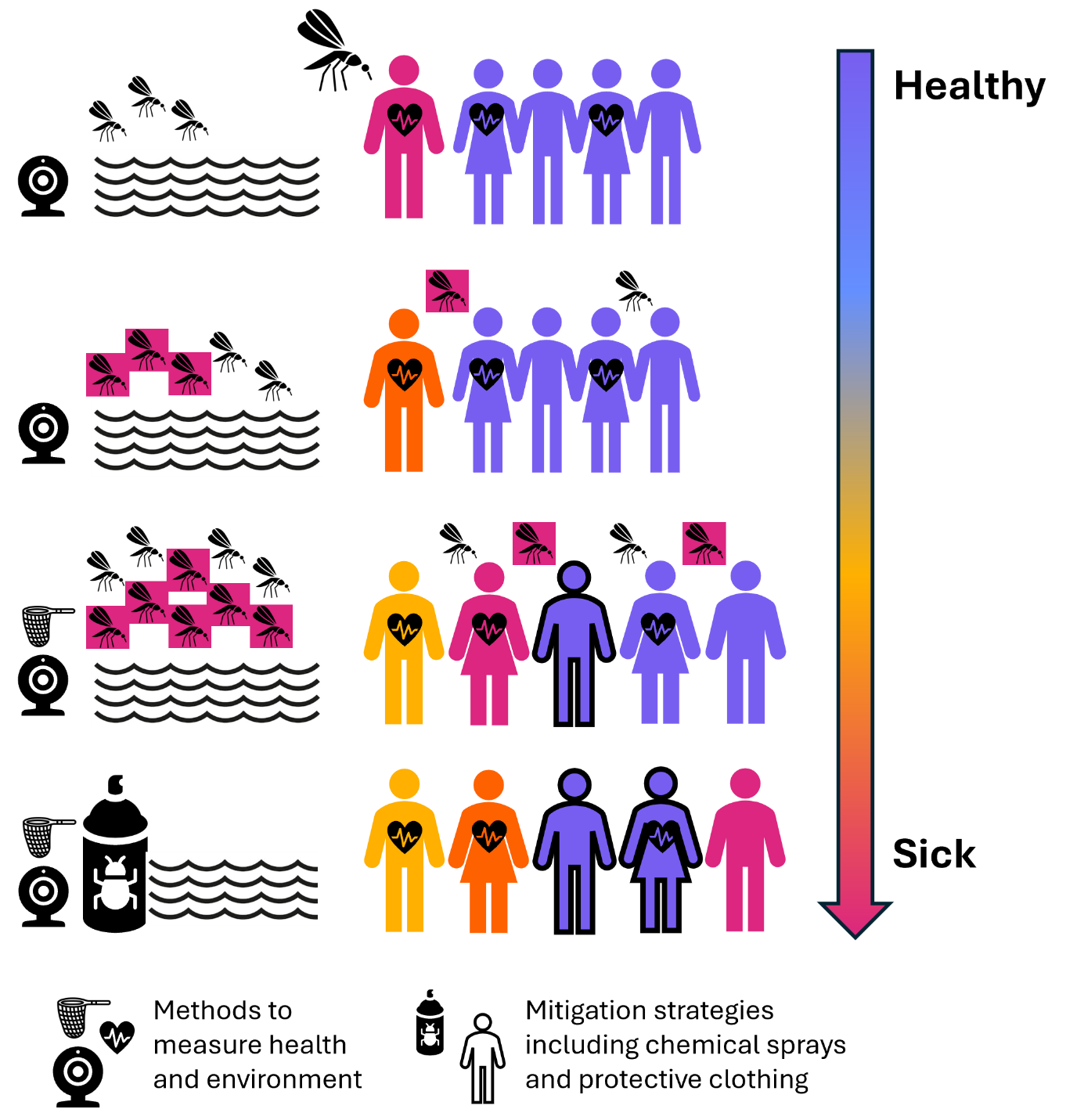
The literature reviewed in the previous sections indicates the importance of incorporating environmental data into SCDTs and human DTs for making timely decisions to prevent the loss of human life. Combining these technologies could be beneficial for modeling disease spread in situations where the local or built environment affects risk. For example, temperature, rainfall, and windspeed affect local mosquito populations, which can modify risk for diseases like Dengue fever, West Nile virus, and Zika virus (Gizaw et al., 2024). Aside from vector-borne diseases, some fungal infections like Valley Fever and Histoplasmosis are caused by spores that people breathe in when dirt or dust that carries the fungus is stirred up (Howard et al., 2024; Smith et al., 2022; Zaheri et al., 2023). Bringing together SCDTs and human DTs could help identify outbreaks sooner by understanding how people interact with each other and the environment and test different mitigation techniques to determine which will be the most effective (Figure 2).
Figure 2.
307452Measurement methods and mitigation strategies
How to read the diagram: Using sensors to monitor temperature, humidity, and water accumulation, as well as using traps to capture mosquitos, can help estimate mosquito population size and the presence of disease. Wearable sensors can also be used to monitor human health. Together, these metrics can inform infection risk, track disease spread, and offer mitigation strategies.
Vector-Borne Diseases
A growing number of people are being impacted by mosquito-borne diseases (Gizaw et al., 2024). Urbanization causes shifts in population density and changes in the landscape that affect local wind and temperature patterns in addition to changing locations where water collects, affecting exposure risk (McDevitt-Galles et al., 2024). SCDTs can be leveraged to model how buildings trap heat and pollution to make urban heat islands and street canyons, which can impact windspeed (Pan et al., 2024). This technology can also be used to understand how structures and ground cover affect water runoff and accumulation (McGrane, 2016). Using SCDTs to forecast where mosquito populations are likely to emerge could suggest mitigation approaches (e.g., eliminating standing water, treating breading areas, using mosquito nets) and help manage resources.
Many mosquito-borne diseases have symptoms (e.g., fever, fatigue) that can be measured using wearables. Other physiological symptoms such as increased resting heart rate and reduced heart rate variability may precede overt symptom onset and provide early indications of infection (Gaur et al., 2024; Temple et al., 2023). From the perspective of improving the accuracy of vector-borne transmission models, including human DTs who are monitored using wearables could identify individuals who were infected more quickly (e.g., presymptomatic detection) and more accurately (e.g., not everyone seeks medical care) than public health records.42 The combination of environmentally aware SCDTs and human DTs to understand exposure risk (e.g., based on location-specific and contact-specific risk) could help individuals seek treatment earlier, when antivirals are most effective.
Disease spread is also relevant to the agricultural sector because West Nile virus, Eastern equine encephalitis, and Rift Valley fever affect livestock. As with humans, behavior changes in livestock can also be monitored using sensors to provide early indications of infection and track disease spread (Chatterjee et al., 2021). Modern agricultural lands are also being monitored using technology like IoT sensors and aerial imagery to manage irrigation, fertilizer and pesticide application, and weed control (Hassan et al., 2021). Similar strategies for monitoring, predicting, and managing disease spread in humans living in SCs could be applied to livestock in agricultural areas.
Environmentally Driven Diseases
Risk for Valley Fever is affected by wind and drought conditions that increase the amount of dust or fine PM, including spores, present in the air. In places like California and Arizona, the number of cases of Valley Fever, which is caused by the Coccidioides fungus, has risen quickly in recent years because of changes in precipitation patterns (Howard et al., 2024). Other types of fungus, such as Histoplasma capsulatum, which causes histoplasmosis, thrive in damp soil and are associated with droppings from birds and bats (Kamel Boulos & Zhang, 2021). Certain occupations like farming and landscaping can increase the risk of contracting histoplasmosis, especially for people living in the Ohio and Mississippi River Valley. Using environmentally aware SCDTs to model PM concentration and windspeed in combination with human DTs to understand travel patterns and model respiration rate changes with physical activity may help predict someone’s risk of contracting these fungal infections. Providing timely information regarding risk to individuals who may develop severe infection could result in more timely diagnosis and treatment to prevent further health complications (Zaheri et al., 2023).
Discussion and Conclusion
Both SCDTs and human DTs provide an opportunity to better understand the bidirectional relationship between people and the environment to improve our ability to forecast and mitigate health risks from vector-borne or environmentally driven diseases. To achieve this goal, DT technology will need to scale to accommodate large numbers of people and different digital technologies. Researchers should prioritize methods to clean, harmonize, and reduce sensor data either at the sensor itself or at data ingestion to ensure interoperability and to enable downstream algorithms and models to operate efficiently (Astarita et al., 2024; Johnson & Saikia, 2024; Kaginalkar et al., 2021; Zeng et al., 2024). This will require data and metadata standards for IoT sensors, PEMs, and other wearable sensors (Topping et al., 2021). Researchers will also need to develop cloud-based approaches to enable algorithms and models to scale based on available resources (Johnson & Saikia, 2024; Zeng et al., 2024) and engage with stakeholders such as urban planners and first responders so that this technology can be used effectively (Ariyachandra & Wedawatta, 2023; Astarita et al., 2024; Dale et al., 2023).
One of the biggest challenges that needs to be overcome to realize the successful integration of environmentally aware SCDTs and human DTs is access to labeled datasets for training and validation. Specific to vector-borne and environmentally driven disease spread, we need to understand the physiological signature of the disease (e.g., especially before symptom onset) and how this signature may differ among individuals (e.g., symptom presentation, onset, and recovery), which necessitates accurate documentation of exposure. Exposure, and even symptom information, can be difficult to obtain in free-living conditions, and human challenge studies can be valuable for obtaining this level of precision (Temple et al., 2023).
Similarly, we also need detailed information to describe the dynamic between the built environment and the vector (e.g., mosquito population or dust particles), which will require better sensing infrastructure. Data privacy, security, and trust form another barrier to large-scale adoption of DT technology when results are provided at the individual versus population level. Data need to be secured and access must be tracked to comply with existing regulations such as the Health Insurance Portability and Accountability Act (HIPAA) and General Data Protection Regulation (Katsoulakis et al., 2024). Other legal and ethical guidelines also need to be established regarding the use of personal health data and location information with AI applications (Kamel Boulos & Zhang, 2021).
Successfully integrating environmentally aware SCDTs and human DTs could benefit individuals, public health officials and first responders, and urban planners and researchers. Individuals could use integrated DT technology to understand health risks accurately (e.g., for heat-related illness, asthma exacerbation, and vector-borne or environmentally driven diseases), take mitigating actions (e.g., by avoiding certain locations or wearing a mask), and seek treatment sooner. Public health officials and first responders could use integrated DT technology to allocate resources effectively (e.g., cooling stations or mosquito spraying campaigns) and plan evacuation routes. Urban planners and researchers could use integrated, environmentally aware DTs to make better design choices and evaluate mitigation strategies to reduce health risks arising from the interactions between humans, animals, insects, and the built environment. Taken together, more lives could be saved by providing timely information through the integration of AI/ML models and data from IoT and wearable sensors.