Key Findings
Randomized controlled trials (RCTs) included in the Cochrane Review do not provide enough evidence to determine how nonpharmacological care affects important clinical outcomes for infants with or at risk of neonatal opioid withdrawal syndrome (NOWS).
Evidence in the Cochrane Review (from RCTs and non-RCTs) and emerging in a recently published, large, multi-site study suggests that caring for the mother-infant dyad with supportive, nonstigmatizing, and individualized nonpharmacological care when their newborn infants are experiencing symptoms or at risk of NOWS may improve outcomes.
Ongoing and recently published research evaluates newer assessment methods and shows promising results regarding how these methods may help guide treatment of infants with or at risk of NOWS.
Background
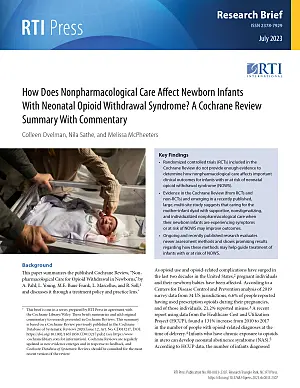
This paper summarizes the published Cochrane Review, “Non-pharmacological Care for Opioid Withdrawal in Newborns,” by A. Pahl, L. Young, M.E. Buus-Frank, L. Marcellus, and R. Soll (2020) and discusses it through a treatment policy and practice lens.1
As opioid use and opioid-related complications have surged in the last two decades in the United States (Substance Abuse and Mental Health Services Administration, 2020), pregnant individuals and their newborn babies have been affected. According to a Centers for Disease Control and Prevention analysis of 2019 survey data from 34 US jurisdictions, 6.6% of people reported having used prescription opioids during their pregnancies, and of those individuals, 21.2% reported misuse (Ko et al., 2020). A recent report using data from the Healthcare Cost and Utilization Project (HCUP), found a 131% increase from 2010 to 2017 in the number of people with opioid-related diagnoses at the time of delivery (Hirai et al., 2021). Infants who have chronic exposure to opioids in utero can develop neonatal abstinence syndrome (NAS) (Patrick et al., 2020). According to HCUP data, the number of infants diagnosed with NAS increased by 82% from 2010 to 2017, with the national estimated rate of NAS being 7.3 per 1,000 hospital births in 2017(Hirai et al., 2021).
Because NAS is a broader diagnosis that includes prenatal exposure to an array of substances, a newer term, “neonatal opioid withdrawal syndrome” (NOWS) is now used to describe this subset of NAS (Kelly et al., 2020). Opioid receptors are predominantly located in the central nervous system and the gastrointestinal tract. The most common clinical symptoms of NOWS involve these systems and include tremors; high-pitched, continuous crying; decreased sleep; loose stools; feeding difficulties; vomiting; sweating; and fever; the most severe symptoms are seizures (rare) and severe weight loss (Patrick et al., 2020).
The care of infants experiencing NOWS can be expensive for the healthcare system. Newborn infants with NAS, a large subset of whom are diagnosed with NOWS, spend on average 9 days in the hospital compared with 2 days for other newborn infants in the United States. The average cost of a hospital stay for an infant with NAS is nearly 7 times the cost of a hospital stay for a newborn infant without NAS (Centers for Disease Control and Prevention, 2023). The 2020 clinical guidance from the American Academy of Pediatrics (AAP) recommends nonpharmacological care beginning at birth for any infant with substance exposure, regardless of additional pharmacotherapeutic interventions, while noting the evidence base to support and guide such care is sparse (Patrick et al., 2020).
The Cochrane Review by Pahl et al. (2020) examined the evidence for the safety and efficacy of nonpharmacological treatment of infants who are at risk for or who are exhibiting symptoms consistent with opioid withdrawal. The review also considered the evidence for the safety and efficacy of concurrent nonpharmacological treatment alongside pharmacological treatment to infants exhibiting symptoms consistent with opioid withdrawal. Pahl and colleagues rated their certainty in the evidence for the primary and most clinically relevant secondary outcomes using the GRADE (Grading of Recommendations, Assessment, Development and Evaluation) system, and concluded that their certainty in the evidence was low to very low for all outcomes (Pahl et al., 2020). Most outcomes were downgraded due to risk of bias concerns, as well as imprecision, where the confidence intervals (CIs) of the effect estimates allowed for both benefit and harm because there were only a few, small studies eligible for inclusion.
We conducted an appraisal of the quality of the systematic review using AMSTAR2 (A MeaSurement Tool to Assess Systematic Reviews; Shea et al., 2017) and concluded with high confidence that Pahl and colleagues provide an accurate and comprehensive summary of the results of the available studies addressing the research questions.
Methods
The Cochrane Review considered two different comparisons with slightly different study populations and outcomes of interest.
Comparison 1
The study population for comparison 1 included infants born at term (37 weeks’ gestation or greater) and late preterm (34 weeks’ gestation to 37 weeks’ gestation) who had a known or suspected prenatal exposure to opioids or who were exhibiting symptoms consistent with opioid withdrawal in the first 7 days of life. The experimental interventions were single or bundled nonpharmacological interventions compared with either no intervention or a different single or bundled nonpharmacological intervention. Nonpharmacological interventions involve a wide range of care, and for the sake of the review, were categorized into three aspects of care: (1) modifying environmental stimulation (e.g., low light or low noise, swaddling, infant positioning, nonnutritive sucking, massage); (2) focusing on feeding practices (e.g., breastfeeding, infant-led feeding, high-calorie feeding); (3) supporting the mother-infant dyad (e.g., rooming-in, skin-to-skin care, mental health support). The primary outcomes for this comparison included length of hospitalization and pharmacological treatment with either opioids or sedatives.
Comparison 2
The study population for comparison 2 included term and late preterm infants who were receiving opioid treatment for opioid withdrawal in the first 28 days of life. Comparison 2 considered the addition of concurrent nonpharmacological interventions compared with pharmacological treatment alone. For this comparison, the primary outcomes included the length of hospitalization as well as the length of pharmacological treatment and the maximum and cumulative dose of opioid medication.
Search Methodology
The Cochrane Review authors searched for randomized controlled trials (RCTs), quasi-RCTs, and cluster trials in multiple medical literature databases, as well as in clinical trial databases and references lists of retrieved articles. The authors conducted their searches in October 2019.
Main Results
The review included six RCTs, which included 353 infants with known or suspected opioid withdrawal symptoms, addressing the first comparison. The review authors did not find any RCTs addressing the second comparison. Thirty-four nonrandomized studies were excluded (29 of which addressed comparison 1, and 5 of which addressed comparison 2).
Comparison 1
Of the included studies, four RCTs modified environmental stimulation compared with standard care, through the following interventions: a mechanical rocking bed, prone positioning, a nonoscillating waterbed, and a low-stimulation nursery. One RCT modified feeding by offering a higher calorie formula as the intervention versus a lower calorie formula, and one RCT offered tailored breastfeeding support compared with standard care (categorized by the review authors as an intervention supporting the mother-infant dyad).
Only two included studies reported on the length of hospitalization, so meta-analysis was not possible. One study assessed modifying environmental stimulation, and the other study assessed supporting the mother-infant dyad, with no evidence of a difference in the length of hospitalization in either study.
Five studies reported on the use of pharmacological treatment. Meta-analysis was conducted for the three studies of modifying environmental stimulation, suggesting no evidence of a difference in the use of pharmacological treatment (risk ratio [RR] 1.00, 95% CI: 0.86 to 1.16; 92 infants). Both the study of feeding practices and the study supporting the mother-infant dyad showed no evidence of a difference in effect on the use of pharmacological treatment.
The review authors noted the paucity of RCTs as a limitation of the review and presented a narrative summary of the nonrandomized evidence they identified while conducting the review, although they neither systematically searched for non-RCTs nor assessed their quality. Pahl and colleagues summarized findings from 34 nonrandomized studies, which most commonly included breastfeeding, rooming-in, and quality-improvement initiatives consisting of bundles of nonpharmacological care. Of the 34 non-RCTs included in the summary, the majority showed either a decrease or no change in the length of hospitalization, the use of pharmacological treatment, and the length of treatment.
Cochrane Review Authors’ Conclusions
Currently completed and published RCTs do not provide enough evidence to determine how nonpharmacological care affects important clinical outcomes for infants at risk for or experiencing symptoms of NOWS. The review authors rated their confidence in the evidence as low to very low due to the limited number of studies, the small sample sizes in the included studies, and risk of bias, due in part to a lack of blinding, which for some studies was not possible because of the nature of the study (i.e., rooming-in or breastfeeding). The heterogeneity of study designs and outcome reporting also limited the analyses. The authors observed in both the included RCTs and the summarized non-RCTs that there was often larger variability in outcomes between study sites than between comparison groups within a study, which may suggest that other variables beyond those being studied affected the care of the included newborn infants.
Although the review authors acknowledged that the existing expert guidance for clinicians is to initiate nonpharmacological care for all infants with or at risk of NOWS, they concluded that there is not sufficient evidence to recommend specific clinical practices. As such, they called for larger, well-designed studies that aim to reduce heterogeneity by clearly defining the study populations and nonpharmacological interventions (including their timing and duration) and that consistently measure important short- and long-term outcomes. The authors recognize that such studies would be particularly challenging because some nonpharmacological practices are difficult to randomize, impractical to blind, and require cultural changes within hospital care practice and attention to complex social issues (e.g., stigma, racism, and poverty).
Commentary: Implications of the Cochrane Evidence for Policy and Practice
Clinical care of infants with NOWS varies greatly across the United States, and consequently, so do clinical outcomes (Young et al., 2021). Conclusions from the Cochrane review highlight the sparse evidence for nonpharmacological care for newborn infants at risk of or exhibiting symptoms of NOWS. That said, nonpharmacological approaches can offer supportive, family-centered care to address infants’ symptoms in a cost-effective manner. The AAP, the leading US-based professional organization whose clinical treatment guidelines and recommendations inform neonatal care in the United States, recommends that individualized, nonpharmacological care begin at birth for all infants with substance exposure (Patrick et al., 2020). AAP’s most recent NOWS clinical report stresses the importance of keeping the mother-infant dyad intact throughout care of exposed infants, particularly through rooming-in, trauma-informed support for breastfeeding, and coaching mothers and caregivers in additional nonpharmacological care (Patrick et al., 2020).
Because the clinical, behavioral, and physiological symptoms of infants with NOWS may vary, the AAP recommends tailoring additional nonpharmacological care to the following domains of the infants’ experience: “(1) reactivity to sensory stimulation and regulatory issues, (2) behavioral states and state control, (3) motor and tone control, and (4) autonomic signs of stress” (Patrick et al., 2020; Velez & Jansson, 2008). However, the AAP does not recommend specific, additional nonpharmacological measures.
Acknowledging that NOWS is a downstream effect of the broader opioid public health crisis, the AAP also makes recommendations for prenatal care, neonatal and maternal postnatal diagnosis and care both in the hospital and during the transition home, as well as continued support through early childhood. Although a broader public health response is critically needed to address opioid use in pregnancy (Patrick et al., 2017), policies and practices aimed at the care of newborns with NOWS must acknowledge and seek to address institutional biases that can result in disparity of care. Studies have shown that Black and Hispanic neonates with NOWS have increased length of stay compared with white neonates (Nguemeni Tiako et al., 2021). Screening practices and diagnostic tools are also at risk for racial and ethnic biases and in need of further validation. For example, universal toxicology screening of mothers and infants has been shown to identify infants requiring care, but such screening has also resulted in higher child protective services referrals for Black mothers compared with white mothers (Patrick et al., 2020). The Finnegan Neonatal Abstinence Scoring System (FNASS) and its various modifications are the most commonly used tools to assess infants with NOWS (Mehta et al., 2013). Although validated after its original development in 1975, subsequent versions of the FNASS have not been validated (Young et al., 2022). Recent assessments have found the FNASS and modified versions to be inherently subjective (Timpson et al., 2018), with significant differences in scoring neonates stratified by race (McKiever et al., 2021).
Commentary: Implications of the Cochrane Evidence for Research
Both the AAP’s treatment recommendations and the Cochrane Review point to the need for evidence from adequately powered and scientifically rigorous clinical trials studying specific types of nonpharmacological treatment and how to effectively individualize these treatments. Because high-quality, evidence-based treatments rely upon validated assessment tools, research focused on such tools is also needed. A newer approach to assessing and managing care of infants with NOWS has been developed, which relies on infants’ ability to eat, to sleep, and to be consoled (Grossman et al., 2017). This method began as part of a quality improvement initiative by Grossman and colleagues at Yale and is now being tested in a large-scale, multi-site, clinical study: Eating, Sleeping, Consoling for Neonatal Opioid Withdrawal (ESC-NOW) (Young et al., 2022). The ESC method relies on a simplified assessment tool and encourages clinicians to individualize nonpharmacological care to the specific needs of the infant while emphasizing caregiver education and empowerment in the care of their infants.
The ongoing ESC study conducted by the National Institute of Health’s HEAL (Helping to End Addiction Long-term) Initiative’s ACT NOW (Advancing Clinical Trials in Neonatal Opioid Withdrawal) Collaborative, in which RTI International is the data coordinating center, uses a stepped wedge cluster randomized design that will help to address underlying issues raised by the Cochrane Review authors and other researchers regarding the need for cultural change to adequately address the complex needs of infants with NOWS. The ESC-NOW study also includes education on trauma-informed care and bias for providers in the study. The in-hospital phase of the study has been completed and has found a reduction in the number of days from birth until hospital discharge in the Eat, Sleep, Console group compared with the usual-care group (adjusted mean difference, 6.7 days; 95% CI, 4.7 to 8.8; rate ratio of 0.55, 95% CI, 0.46 to 0.65; P < 0.001), and no difference in adverse outcomes between groups (Young et al., 2023). A 2-year follow-up to assess neurodevelopmental outcomes for a subgroup of participants is ongoing.
Breastfeeding and rooming-in, the two specific types of nonpharmacological treatments aimed at supporting the mother-infant dyad in the AAP’s treatment recommendations, have been tested in numerous non-RCTs summarized by the Cochrane Review authors. Both barriers to and facilitators of implementing these practices have been identified (Howard et al., 2018). Further rigorous research should focus on ways to better support and increase the uptake of breastfeeding and rooming-in for infants with NOWS, particularly focusing on trauma-informed education and support to increase mothers’ autonomy, minimize stigma, address cultural changes within hospital care practices, and improve outcomes for infants.
Conclusions
Supporting the mother-infant dyad with nonstigmatizing and individualized nonpharmacological care is recommended as the foundational treatment for newborn infants experiencing or at risk for developing NOWS, although more evidence is needed to determine the efficacy, safety, and effectiveness of such care and the best ways to deliver this care. Better tools to assess infants’ needs are currently being evaluated, and results suggest they may help to guide treatment. Similarly, research to assess approaches to mitigate structural factors underlying opioid use and NOWS may lead to improvements in care.