Newsroom
Experts available to provide scientific insights on plastic production, circular economy, lab research, design, waste management and financing
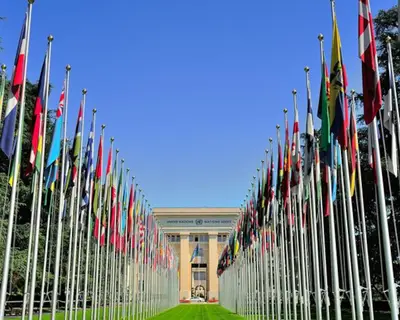
RESEARCH TRIANGLE PARK, N.C. — Efforts to finalize a global treaty to address plastic pollution are resuming in Geneva, Switzerland, where international delegates are gathering for the second part of the fifth session of the United Nations Intergovernmental Negotiating Committee on Plastic Pollution (INC-5.2). Experts from RTI International, an independent scientific research institute, are attending the negotiations as official observers.
The session, taking place Aug. 5 to 14 at the Palais des Nations, builds on previous discussions held in Busan, South Korea, in 2024. This convening body aims to settle unresolved issues and finalize a legally binding global agreement to reduce plastic pollution, particularly in marine environments. The resulting treaty is expected to be adopted in 2025.
“Plastic pollution is a complex, global challenge that requires coordinated action across the entire lifecycle of plastic,” said Jamie Pero Parker, Ph.D., RTI sustainability team lead. “This treaty has the potential to set international standards that address not only waste, but also upstream drivers like production and phasing out of chemicals of concern. Industry has struggled to address plastic pollution ad hoc and many businesses are seeking passage of an effective treaty to coordinate action and unify around goals and metrics for success.”
RTI’s delegation includes:
- Jamie Pero Parker, Ph.D., sustainability team lead
- Imari Walker-Franklin, Ph.D., research chemist
- Alan O’Connor, senior vice president, environment
- Verone Bernard, urban resilience manager
- Leah Johnson, Ph.D., senior director of biomedical technologies
These experts bring interdisciplinary experience and evidence-based insights across the full plastics lifecycle from macro to microplastic pollution, delivering solutions for improved design, use, recovery and end of life management. They are available for media interviews during the event.
"It’s essential that this treaty reflects the realities and capacities of every country, recognizing that while every nation is affected by plastic pollution, not all contribute equally to the problem, nor do they have the same resources to address it,” said Verone Bernard, RTI urban resilience manager. “The treaty rightly acknowledges the differing financial, technical and technological burdens between high- and low-income countries, but more specificity on elements like financing mechanisms is needed to ensure the treaty is practical and actionable for all.”
RTI has conducted extensive research on plastic pollution, including studies on microplastics, waste management systems, and the economic impacts of plastic use and disposal. The institute supports governments, industry and other organizations in identifying more sustainable materials, enabling the adoption of a circular economy, modeling and designing support for effective interventions, designing policies that promote sustainable materials and reduce environmental harm.
Learn more about RTI attending INC-5.2
Learn more about RTI's research to address plastics pollution






RTI International is an independent scientific research institute dedicated to improving the human condition. Our vision is to address the world's most critical problems with technical and science-based solutions in pursuit of a better future. Clients rely on us to answer questions that demand an objective and multidisciplinary approach—one that integrates expertise across social, statistical, data, and laboratory sciences, engineering, and other technical disciplines to solve the world’s most challenging problems.
For more information, visit www.rti.org.