Impact
Objective
To better understand the pathways through which people receive flood warning information to improve flood risk communication to the public for the National Oceanic and Atmospheric Administration (NOAA).
Approach
In partnership with the University of Vermont, we explored flood communication networks through a national survey and took a deep dive into networks in six communities across the U.S. We conducted interviews, focus groups, and network mapping, and used thematic coding—a qualitative analysis method—to identify patterns within and across communities. All data were translated into practical applications and recommendations.
Impact
We developed several high-level flood communication recommendations for NOAA, as well as local recommendations for each of the six communities we worked with. We also created flood communication network maps, which included high- and low-detail visual maps of how flood information flows between organizations in communities. Our work informs NOAA's operationalization of the National Water Model, which enables the first country flood inundation map and novel flood risk information and access.
Mapping How Flood Warning Information Reaches Communities
Our client asked us to clarify flood risk communication pathways
NOAA wanted to understand how best to communicate flood warning information, especially with regard to the new National Water Model, to key audiences. Although some audiences directly access NOAA information products, at the beginning of the project we knew relatively little about how intermediaries in the U.S. such as emergency managers share information, and we also knew relatively little about how local organizations outside of emergency management receive, perceive, and share flood risk communication (Image 1).
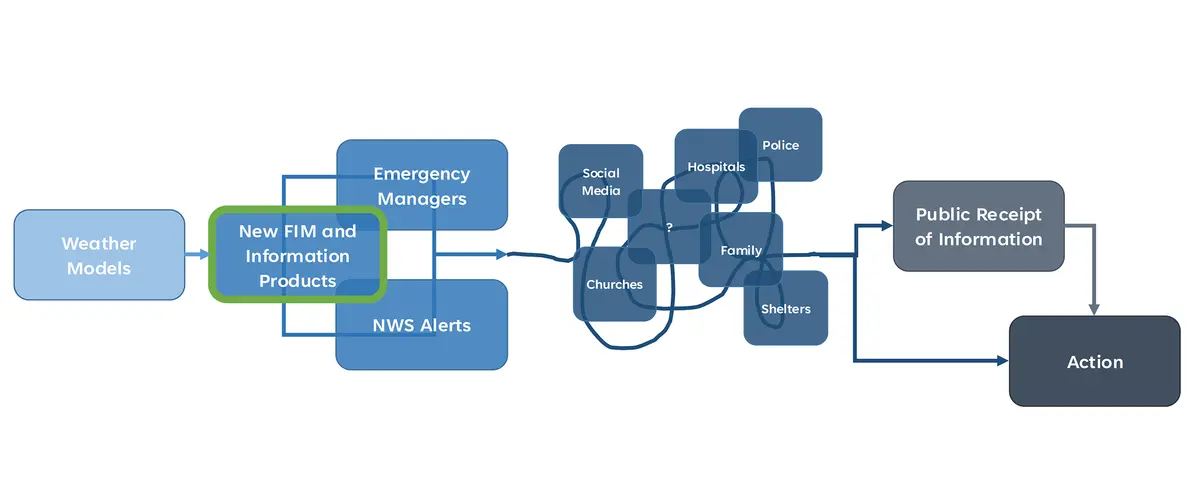
Image 1: Flood Communication Flows, with Uncertainty.
Untangling the uncertainty in flood communication flows is important because flooding is the costliest weather-based natural hazard and alerts and warnings may save lives and reduce financial losses. From 1980 to 2024, there were 45 U.S. flooding events that cost more than a billion dollars each and resulted in a total of 742 deaths, causing approximately $4.5 billion dollars in damages on average per year.
Direct impacts on people and communities warrant effective flood warning communication that can enhance flood-related decision making. As developers release new flood guidance tools (e.g., National Water Model and FIM forecast products) to public audiences, it is critical to understand the pathways through which people receive flood warning information and find effective channels and methods to reach people when they need it most. Beyond trained users of these tools (e.g. emergency managers), there are a variety of intermediary users along these pathways who receive and share flood communication with end-users. To help NOAA effectively share flood warning information, our team sought to understand three primary audience segments within these information sharing pathways: Local Authorities, Health and Human Service Organizations, and Community Interest Organizations.
Study Methodology to Understand Flood Risk Communication
Our flexible mixed-method approach was tailored to communities
Across 6 site visits, interviews and focus groups with 61 participants, 3 workshops, and a national survey, we tailored our research strategies to meet the needs of communities. You can read more about our research methods in our final report. There, you’ll find information about how we segmented our audience, identified the six communities involved in our research (Image 2), and integrated findings within our mixed methods approach. Read more about how we mapped our research onto the IDEA model—a framework articulating the key components of effective risk warning messages—in our peer-reviewed article, Applying the IDEA model to flood risk communication.
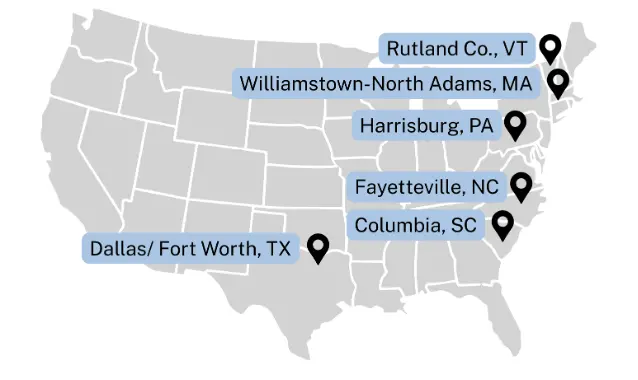
Image 2: Six communities that participated in our research.
Level of responsibility defined our audience segments
Project participants represented organizations with varying degrees of responsibility to communicate about flood risk that each fell into one of three groups:
- Local Authority Organizations: Organizations that have some responsibility for communicating flood warnings (e.g., local news, city communications, public safety).
- Health and Human Service Organizations: Organizations that may communicate about flood warnings but it's not their primary role (e.g., hospitals, shelters, schools).
- Community Interest Organizations: Organizations that have an interest in the community and share flood warnings informally, but flood risk communication is not part of their role (e.g., cultural groups, faith communities, watershed organizations).
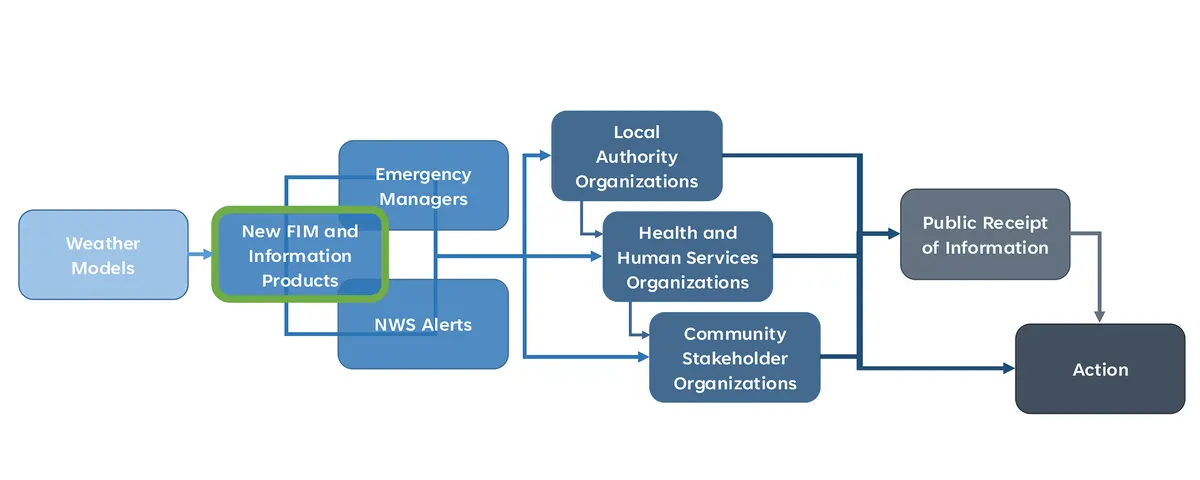
Image 3: Flood Communication Flow, with Audience Segments.
Key Findings on Flood Communication and Trust
Flood communication patterns are present across communities and audiences
Our findings reveal how flood information is perceived by participants across our audience segments and research communities. Below are examples of themes that were present in all audience segments and across our communities. You can find a full list of themes in a final report, including themes that were not present in all audience segments and communities.
- Trust in authorities is high. Organizations trust federal, state, and local authorities as sources of flood warning communication. During the time of this research, all audience segments expressed a high level of trust in NOAA and National Weather Service (NWS). Organizations expressed a high level of reliance on and trust in NOAA for flood information and noted that their consistent communication increases trustworthiness. Approximately 84% of survey respondents indicated that government weather organizations are a source of flood warning information.
- Flood risk communication is challenging. Organizations indicated that it can be hard to communicate the appropriate level of susceptibility to risk, especially for local areas. They recognize that forecasting floods is highly nuanced and complex, which can make translating information for the public difficult to do effectively. Organizations experience uncertainty about how to reach out to and motivate audiences while still controlling the quality of information they share.
- Local knowledge can contextualize flood details. Organizations shared that having local knowledge helps them interpret and contextualize the technical information in the flood communications they receive. Local knowledge includes historical experience and knowledge about where or how flooding occurs in a community. Organizations will often use their local knowledge to better communicate the flood warning to their own audiences. In the same vein, survey respondents shared that after they receive flood information from their sources, they would add more information (e.g., 92% added context, local details, recommended actions) or adapt information (e.g., 75% changed technical wording to read more clearly or interpret the data in plain language).
We translated themes into practical applications for flood communication networks
We created practical recommendations using cross-community themes. Flood risk communication networks that did not participate in our research may be able to learn from these practical applications.
| Relevant Theme | Practical Recommendations for Flood Communication Networks |
|---|---|
| Trust in authorities is high. | Authorities should establish and maintain strong, collaborative, community relationships across a range of audience segments. Communication breaks down when organizations are not talking with one another or if the message gets caught in bureaucracy. Make sure organizations are connected and receiving information from trusted authorities. |
| Risk communication is challenging. | Don’t shy away from sharing technical information. Technical information is important for organizations within flood communication networks because they expect it and understand it. It’s okay to share uncertainty as long as you are clear and transparent about it. Be sure to interpret technical information so audiences know what it means for them and their communities. |
| Local knowledge can contextualize flood details. | Include as much localized information as you can. Collaborate with Local Authorities and community organizations to obtain local, historic, and contextualized knowledge that can be incorporated into risk messaging. Build communication feedback loops into your network. |
Survey and community insights contextualized community-specific recommendations
Our research team also contextualized relevant themes with survey findings and community insights to create community-specific flood communication recommendations. Below is an example of a recommendation for one of our participating communities.
| Relevant Themes | Survey Insights | Community Insight | Practical Recommendation for Community-Specific Networks |
|---|---|---|---|
| Audiences use different channels, and socio-economic variability makes sharing information difficult. | In the survey, organizations report receiving information through nearly four channels and sharing with their audiences using three to four channels. | Local Authorities indicated that it is hard to get audience members to sign up for opt-in flood communication (e.g., alerts, social media) or pay attention to them. | Design communication channels to reach a range of audiences. Be aware of how digital divides and socioeconomic factors may impact audiences’ ability to receive flood risk communication. Create a mix of strategies including a variety of channels that will reach different audiences with different preferences and circumstances. |
Notable considerations about our flood communications research
There are a handful of valuable considerations for the generalizability of our work. Although our survey reached a wider geographic audience, we only engaged deeply with six communities in the U.S. and focused specifically on the organization level of the flood communication pathway.
By design, we did not formally talk with regional NOAA or NWS staff (e.g., Weather Forecast Offices, River Forecast Centers), or county or state emergency managers. We also did not specifically talk with members of communities who would be considered end users (e.g., students, families, volunteers).
Within each audience segment, we were not able to capture representation from all possible organizations, and in the survey we were not able to reach Community Interest Organizations at all. In some cases, we learned about additional organizations who communicate about flooding, but did not speak directly with them.
Turning Flood Communication Research Into Practical Tools
We tailored how we shared our findings and prioritized community-facing content
We had four key audiences for our deliverables: our client (NOAA), research participants and their communities, practitioners, and academic researchers. For our client, we delivered all project data and insights succinctly in reports and presentations.
Following best practices of sharing findings with research participants, we crafted community summaries, presentations, and interactive dashboards (see an example here) with community-specific network maps, insights, and recommendations.
We also anticipate adding relevant reports and papers for flood risk communication practitioners and academic audiences not involved in our research initially to invite conversations about how to best turn knowledge into practice.
Network maps visually show communication ties in communities
We developed high-detail network maps for the six communities we worked with, which include every communication tie between specific organizations in the flood communication networks.
Those ties capture details about the communication type (e.g., channel, formality, direction, strength), along with relevant barriers. The low-detail network maps (Image 4) show communication ties between audience segments and simplify our data to ease information intake and understanding. The community-specific dashboards include an orientation and legend, the low-detail map, and the high-detail map for each community, enabling users to access the level of detail they need.
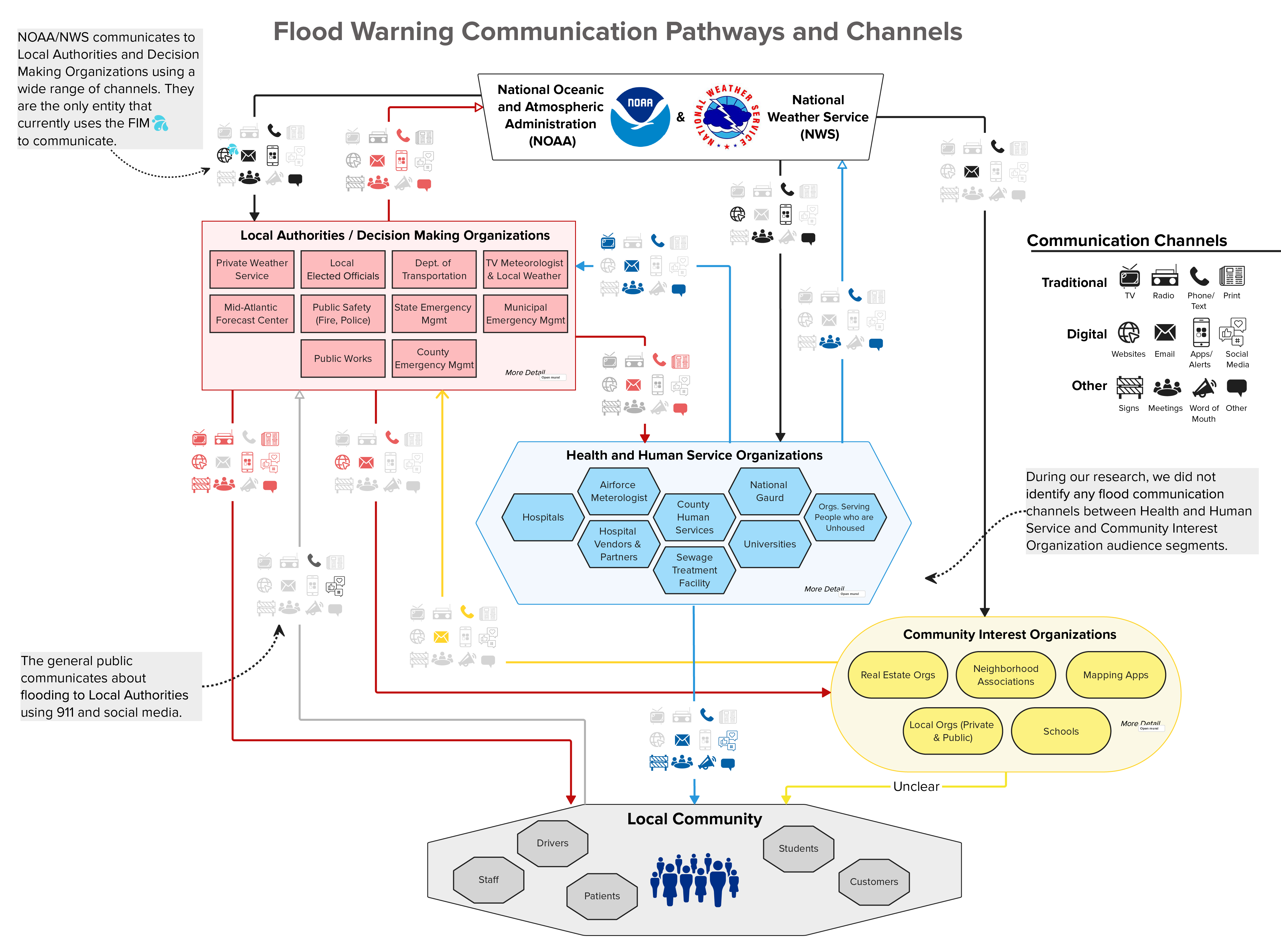
Image 4: Low-Detail Network Map.
Social science research helps us understand and improve human well-being
To improve human well-being, we must understand how humans relate to the problems we face and solutions we propose. Communication science helps create science-backed solutions that account for and integrate human understanding. We promoted engagement with our findings, increased the likelihood of solution implementation and success, and supported well-being in communities where we did research by using social science methods that engaged the humans who constitute flood communication networks.
Uncovered user perceptions of new flood information technology
NOAA’s country-wide FIM will provide novel flood risk information to trained users and new users of flood information. Our data collection illuminated key insights amid the FIM’s vast potential for positive impact, and numerous use cases. Both Local Authorities and Health and Human Service organization respondents expressed a favorable attitude toward NOAA’s FIM tool.
Both groups indicated they valued the FIM as a resource so long as it is accurate and up to date. Health and Human Service respondents seemed to be a little more hesitant but reported that they would use it if it were available to them. In fact, Health and Human Service respondents mentioned their organizations were likely to use it more than Local Authority respondents who indicated it would not change how they shared flood warning information.
The reason Health and Human Service organizations may use the FIM could be attributed to their reports about searching for flood information themselves instead of receiving it directly through federal organizations like NOAA or the NWS.
Risk communication science is essential to address environmental hazards
Scientists agree that environmental emergencies, including flooding, will increase in frequency and intensity.
To meet the growing need for effective risk communication, we must acknowledge the challenge that communication systems change over time due to infrastructure adjustments, advances in technology, shifting priorities, and more. Findings from this research can help us 1) see what strong flood risk communication systems look like, allowing replication and growth, 2) find and fill gaps in risk communication networks, and 3) understand how new technology and innovation can best fit into existing communication networks.
RTI is committed to present and future work that utilizes and builds our expertise in risk communication and environmental disaster resilience.
Acknowledgements: Community members and partners helped us in many stages of the research process, and we appreciate those efforts. A dedicated team working across several institutions has been important to completing this work, including colleagues at RTI International (Dr. Jill Brown, Ms. Schuyler DeBree, Mr. Jeremiah Hartsock, Mr. Bryan Luukinen, Mr. Patrell McMillan, Mr. Joe Milazzo, Ms. Nicole Mullen, Dr. Chris Johns, Dr. Brian Southwell, Dr. George Van Houtven, Dr. Katie van Werkhoven, Ms. Kathy Vu), the University of Vermont (Dr. Elizabeth Doran, Dr. Anne Jefferson, Mr. Henry Motes, Ms. Sarah Noyes, Dr. Lakelyn Taylor) and research partners at or affiliated with NOAA and NOAA’s National Weather Service (NWS), weather forecast offices (WFOs), and river forecast centers (RFCs).