Impact
Helping NC DPS improve the efficacy of efforts to increase safe gun storage in North Carolina
Objective
To evaluate a public education media campaign by the North Carolina Department of Public Safety (NC DPS) designed to influence adult gun owners to store their firearms safely.
Approach
We designed a multi-component evaluation to provide NC DPS with actionable data to improve the efficacy of their campaign.
Impact
Our evaluation results showed that with more funding, NC DPS’s campaign could be effective at increasing safe gun storage among adults, leading to a reduction of firearm-related injuries and deaths.
In 2024, an estimated 41.2% of adults residing in North Carolina had a firearm in or around their home. Of these, 44.8% stored their firearms both loaded and unlocked, increasing the risk for accidental harm to children. In 2021, 118 North Carolina children between newborn and 17 years of age died due to a firearm-related injury, surpassing the number of North Carolina children killed in motor vehicle crashes. Research shows that properly secured firearms can reduce the risk of unintentional injuries or suicide among youth by nearly one-third.
Unsecured firearms are also at risk for theft. Between 2019 and 2023, the Bureau of Alcohol, Tobacco, Firearms, and Explosives (ATF) estimated that an average of 10,876 firearms were stolen in North Carolina each year from private citizens. These firearms are often subsequently used to commit crimes.
The NC DPS’ Division of Juvenile Justice & Delinquency Prevention (DJJDP) launched the North Carolina Secure All Firearms Effectively (NC S.A.F.E.) Media Campaign in June 2023. The goal of the campaign was to promote safe firearm storage practices to reduce unauthorized access, firearm theft, and injuries, particularly among children. Launched as part of an initiative from then-Governor Roy Cooper to address gun violence in North Carolina, the campaign uses strategic communication and education. RTI International conducted a comprehensive evaluation of the campaign to assess its implementation and outcomes, as well as to provide evidence-based recommendations for future initiatives.
Evaluating the NC S.A.F.E. Media Campaign to Reduce Firearm Injuries Among Children
To evaluate the NC S.A.F.E. Media Campaign, RTI designed a multi-component study, including social media listening, qualitative interviews with adult gun owners, and a longitudinal efficacy study (Figure 1). We also conducted a comprehensive literature review to gather information on previous evaluations of similar initiatives (for which there were very few), and to gather metrics for the outcome evaluation survey.
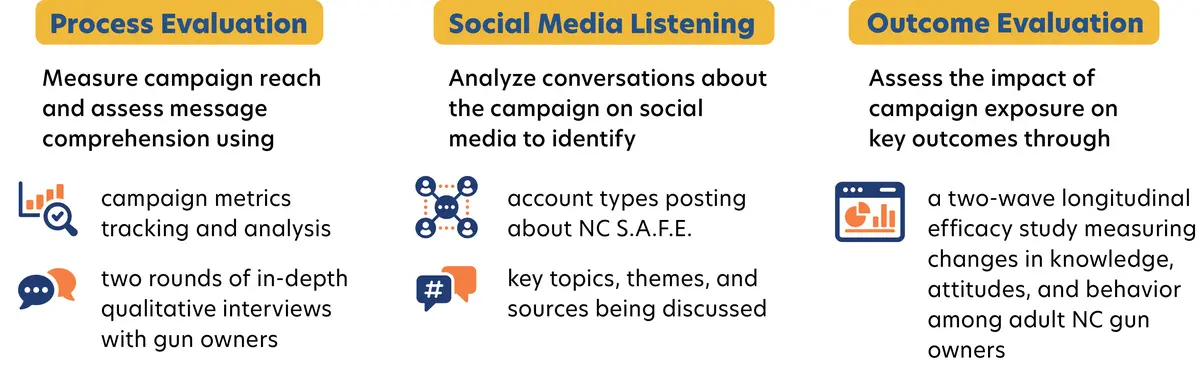
Figure 1. Evaluation overview
Social Media Listening:
We gathered information on how the NC S.A.F.E. campaign was discussed and shared online through earned media from the campaign launch in June 2023 through July 2025. Social media listening methods included:
- Identifying who was posting about the campaign
- Measuring reach and engagement of these posts
- Analyzing key themes
Earned social media content is often generated as a downstream result of paid media exposure and is not fully controlled by campaign organizers. However, strategic efforts - such as encouraging partner organizations to share campaign content - can help catalyze earned media. We analyzed the impact of earned social media, evaluated partner and stakeholder amplification, and identified opportunities to increase organic engagement among the broader audience in future outreach strategies.
Qualitative Interviews:
We conducted two rounds of qualitative interviews (N=15, each) in April and August/September 2025 with adult gun owners in North Carolina. We explored beliefs and behaviors related to safe firearm storage and obtained feedback on NC S.A.F.E. advertisements. Results of the interviews will be used in combination with the findings from the other study activities to plan for future NC S.A.F.E. campaigns.
Outcome Evaluation Efficacy Study:
Finally, we designed a longitudinal efficacy study to measure the potential effects of the campaign. Our study was based on an overarching campaign logic model built on behavior change theories such as the theory of reasoned action (that describes pathways between attitude and belief change leading to changes in intentions and behavior) and social cognitive theory (that illustrates the interaction between the environment and a person’s outcome expectations, goals, and agency) to assess the scope and effectiveness of NC S.A.F.E.
Our goal was to determine whether people changed their minds about firearm safety knowledge, beliefs, attitudes, and behaviors, after exposure to the campaign. Given the limited duration of the evaluation, we used a design that compared two groups: those who saw the ads first vs. those who answered questions about their attitudes and beliefs first.
Additionally, we measured perceived effectiveness of the campaign ads. Previous studies have shown that perceived effectiveness measures are associated with actual ad effectiveness, and when ads are well received, they are associated with subsequent belief and behavior change (Figure 2). Finally, we used data from the media vendor to measure variation in potential campaign exposure (e.g., market-level delivery). We combined those data with self-reported campaign exposure to media advertising to understand campaign reach.
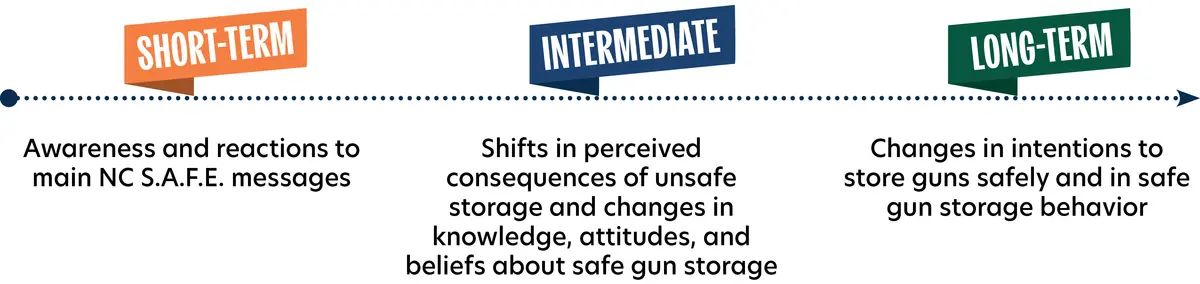
Figure 2. Expected outcomes over time
Measuring Gun Safety Campaign Reach and Impact
We collected two waves of data during the 16-month period of performance of the evaluation (Figure 3). The campaign used a multichannel approach, reaching the intended audience through TV and digital video, radio, social media, and out-of-home advertising (e.g., bus wraps, billboards). In the survey, we used a forced exposure approach by including the campaign logo, video ads, and static ads to assess each participant’s level of exposure to the ad campaign materials by asking about their frequency of exposure over the past 3 months.
We included an ad experiment within the survey by first randomly splitting the participants into a control group and an efficacy group and having each group answer survey questions relating to the ads and their awareness of them, and questions relating to the campaign outcomes (i.e., ad-related beliefs, safe gun storage knowledge, what safe and secure gun storage means, firearm storage intentions, and firearm storage behavior) in an alternate order. The control group answered the campaign outcome survey questions first and then saw the ads, whereas the efficacy group saw the ads first and then answered the survey questions related to campaign outcomes.
This experiment allowed for the detection of campaign impact and the potential for changing population level beliefs when lower levels of ad reach and recall might have limited our ability to detect campaign effects.
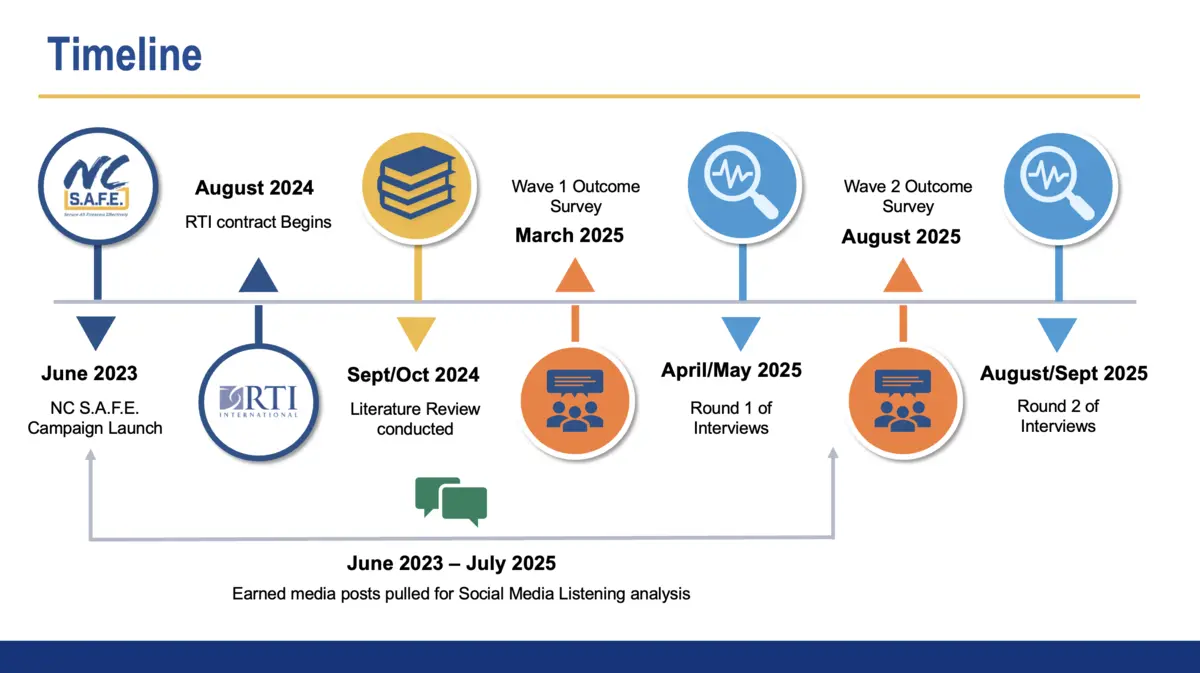
Figure 3. Study timeline
NC S.A.F.E. Shows Promise in Promoting Gun Storage and Reducing Firearm Harm
Taken together, the social media listening, qualitative interviews, and outcome evaluation key findings indicated that NC S.A.F.E. could be effective at increasing safe gun storage behavior, reducing firearm thefts and unauthorized access, and reducing firearm-related injuries.
To be effective at influencing beliefs and eventually, behavior, a media campaign must first reach its intended audience. While the qualitative interviews and outcome evaluation found that awareness was lower than recommended (overall awareness of any campaign ad was 58.8%), the campaign was pursuing the correct channels and strategies to reach its intended audience. For example, social media listening showed large increases in engagement during in-person events and that community partnerships and leadership amplification were important factors for increasing engagement and awareness on social media.
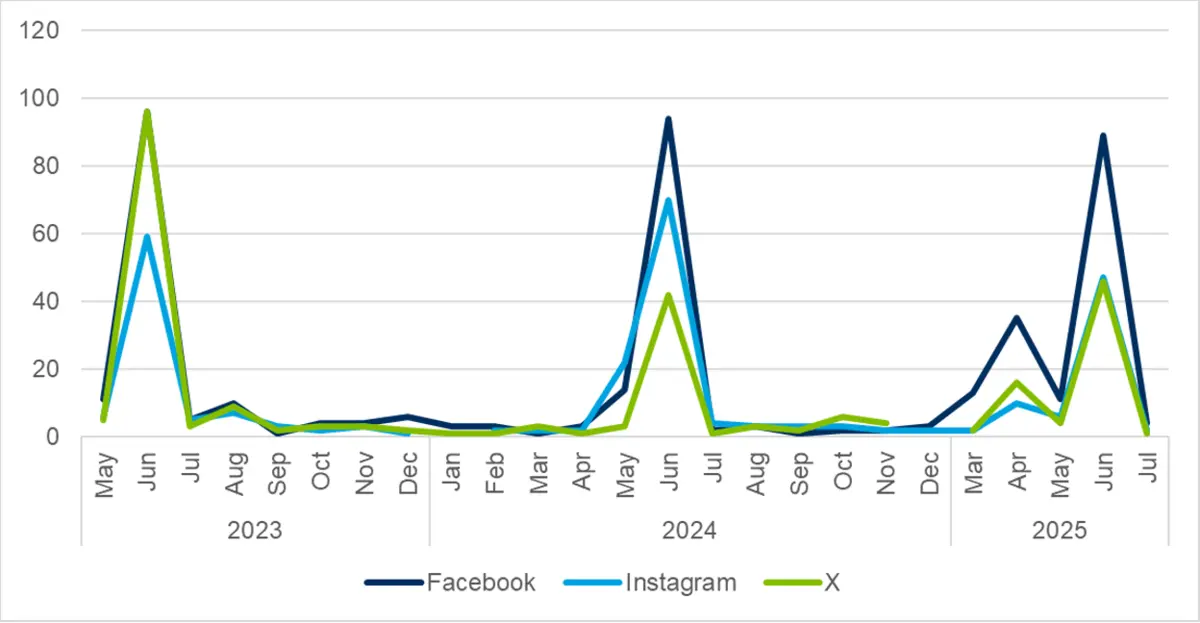
Figure 4. Earned media over time
Note: the graph indicates the number of earned media posts by month. Three peaks in campaign-related social media activity were observed in June of each year, coinciding with the launch of the campaign and the annual occurrence of the NC S.A.F.E. Week of Action, which included multiple in-person events promoting the campaign.
Reactions to the campaign and ads were extremely promising. In the outcome evaluation, 75% or more of participants agreed with each of the eight measures of perceived effectiveness, especially that NC S.A.F.E. ads were informative (87%), believable (87%), and clear (90%). Additionally, more than 75% of respondents agreed with each of the five measures of brand equity, especially that NC S.A.F.E. helped remind them to store their guns safely (87%), a primary goal of the campaign. These results were supported by the qualitative interviews, in which we found that participants related to ads that depicted people in similar circumstances to their own.
Despite lower than recommended levels of awareness, positive reactions helped the campaign to be effective at influencing attitudes and beliefs, which are precursors to behavior change. The outcome evaluation showed that campaign-related beliefs moved in the desired direction between the first wave of data collection and the second wave. These results were especially encouraging given the limitations of our data collection. Additionally, awareness was associated with increased agreement with campaign related beliefs, and the efficacy results showed significant increases in agreement with campaign related beliefs compared to the control group, a clear campaign effect.
Finally, though the evaluation did not show significant changes in behavior between waves, intentions to store guns safely were significantly higher among participants who were aware of at least one ad compared to those who were not and increased significantly from wave 1 to wave 2 in the efficacy group compared to the control, another clear effect of the campaign.
Strengthening Future Gun Safety Campaigns Through Data-driven Recommendations
Our evaluation led to three key recommendations for future campaigns:
- Conduct additional formative ad testing and use data to guide message development
- Leverage highly engaged stakeholders to extend outreach
- Expand ad placement in priority communities using a targeted approach
We formally presented these recommendations to NC DPS in December 2025. The department is now using them to improve the efficacy of their public education campaign efforts. By improving messages and increasing campaign influence on beliefs, intentions, and behavior, RTI’s work directly contributed to improving how North Carolinians learn about safe gun storage. Our work was recently mentioned in a news broadcast and a separate news article that highlighted the success of the campaign and our findings bolstered the client’s efforts to secure additional funding for this important public health issue, as reflected in Governor Stein’s request for continued funding for NC S.A.F.E.