Newsroom
Evidence-based OHTS platform helps service providers track progress and enhance care for human trafficking survivors through data-driven insights
RESEARCH TRIANGLE PARK, N.C. — RTI International, an independent scientific research institute, has launched the Outcomes for Human Trafficking Survivors (OHTS) platform, an evidence-based tool specifically designed to measure and improve outcomes for survivors of human trafficking. The free and user-friendly web application empowers case managers and service providers to comprehensively assess client progress and use data-driven insights to guide service delivery and enhance their programs.
Service providers for survivors of human trafficking have historically lacked the specialized tools needed to effectively measure program outcomes and identify where clients need the most support. The OHTS platform was developed by RTI experts to address this critical gap, providing a trauma-informed instrument completed by case managers to track progress in key areas such as safety, well-being, social connectedness and self-sufficiency.
“OHTS provides a standardized, data-driven approach that allows service providers to see what is working and for whom, ultimately allowing them to use data to guide service delivery to improve care for a highly vulnerable population,” said Dr. Jaclyn Houston-Kolnik, a community research psychologist and member of the OHTS team at RTI. “By equipping them with better data, we can help them make more informed decisions, demonstrate their impact, and build a greater understanding of what works in supporting survivors.”
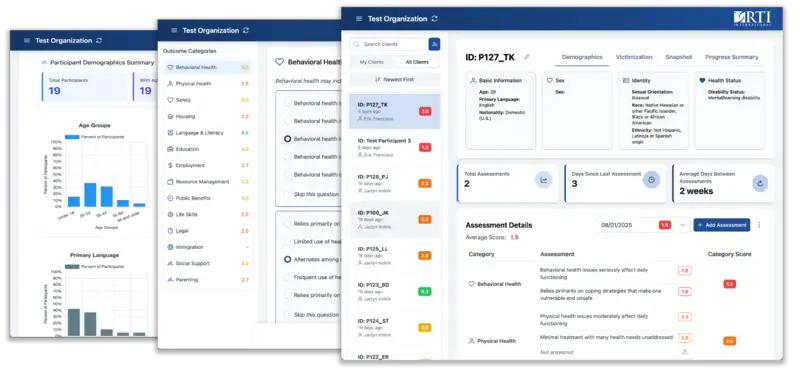
Image: Screen captures of the RTI OHTS interface including exemplary Participant Dashboard, Outcome Categories, and Data Insights.
What began as a macro-enabled spreadsheet developed by then-RTI researcher Stacey Cutbush, Ph.D., to help frontline case managers track outcomes has been redesigned into a secure, full-featured web-based platform.
OHTS allows case managers to document client status and progress over time through a series of guided assessments. The resulting data is displayed in a user-friendly dashboard with advanced data visualizations to help document program-level impact and identify areas where more services are needed. Following best practices, the platform is designed to be completed by case managers without the client present to reduce the burden on survivors.
The platform also offers enhanced analytics, role-based access, service-optimization tools, regional- and time-based trend analysis, and interactive dashboards, enabling users to derive deeper insights to deliver improved care.
California’s Office of Emergency Services is already using OHTS to inform policy decisions and enhance service delivery to better meet the needs of human trafficking survivors in California. As part of that effort, the office is providing the tool to the grantees of its Human Trafficking Victim Assistance Grant Program for periodic outcome data collection.
The goal is to expand this free resource to additional states to support improved care for human trafficking survivors.
To get started with OHTS, program managers can visit the OHTS platform (https://ohts.rti.org/) to create a free administrator account and invite their case managers to the platform.
Learn more about OHTS





RTI International is an independent scientific research institute dedicated to improving the human condition. Our vision is to address the world's most critical problems with technical and science-based solutions in pursuit of a better future. Clients rely on us to answer questions that demand an objective and multidisciplinary approach—one that integrates expertise across social, statistical, data, and laboratory sciences, engineering, and other technical disciplines to solve the world’s most challenging problems.
For more information, visit www.rti.org.