Products

Overview
RTI’s Stochastic Event Flood Model (SEFM) is a purpose‑built probabilistic flood‑hazard platform designed for modern dam safety and portfolio risk assessments. SEFM simulates thousands of plausible annual peak flood realizations that vary in magnitude, timing, and antecedent watershed conditions to produce hydrologic hazard curves of peak flow, inflow volume, or reservoir stage. These hazard curves supply the rigorous flood‑loading inputs needed for Semi‑Quantitative and Quantitative Risk Analyses (SQRA and QRA), enabling defensible, risk‑informed decision making and prioritization of risk‑reduction investments.
Why a stochastic event approach? Traditional deterministic design floods (e.g., PMF or selected design storms) can miss critical flood probabilities that can drive failure modes or life loss. SEFM applies complete precipitation frequency information to the expected range of antecedent conditions, rain‑on‑snow dynamics, and temperature variability, which captures the natural variability of watershed response. SEFM’s Monte Carlo framework explicitly represents these sources of uncertainty and variability, producing transparent, reviewable estimates of annual exceedance probabilities even for very rare events.
Comprehensive flood hazard curves are essential when:
- Assessing dam safety risks for assets impacted by varied watershed behavior
- Accurately capturing the likelihood of extreme but plausible flood loadings that deterministic methods may under‑represent
- Incorporating seasonality, temperature, and snowpack dynamics (especially in mountainous basins) into flood hazard estimates
- Supplying inputs that can confidently support SQRA and QRA workflows for complex watersheds.
Core modeling approach

- Stochastic simulation framework: SEFM generates thousands of event realizations. Each simulation samples storm attributes and watershed conditions to produce an inflow hydrograph and resulting reservoir stage time series.
- Storm sampling: For each realization SEFM samples (1) storm date from observed record, (2) watershed initial conditions consistent with that date (soil moisture, snowpack, reservoir level), (3) storm depth from precipitation frequency distributions, and (4) an atmospheric temperature sequence. (5) a storm template scaled to a sampled storm depth to develop a synthetic storm.
- Long Term Record Sampling: Watershed initial states are drawn from long term continuous simulations (or regionalized records) so antecedent moisture and snow conditions reflect realistic historical variability.
- Hydrometeorological regionalization: RTI hydrometeorologists transpose and regionalize long precipitation records to effectively extend the historical record for a target watershed, strengthening the basis for rare event probability estimation.
- Output: The ensemble of simulations is summarized into hydrologic hazard curves (e.g., annual exceedance probability vs. peak inflow or reservoir stage) and can be produced for multiple metrics (peak, volume, stage) and cohorts of operational or structural scenarios.
Inputs that RTI’s Hydrometeorological Team can
support for SEFM projects, include:
- Watershed average precipitation-frequency for extreme storms including uncertainty bounds.
- Seasonal distributions of storm timing for each storm type.
- Storm templates of spatial and temporal structure based on past storms that are used to develop synthetic storms for stochastic modeling.
- Temperature and freezing level parameters to support rain on snow and snowmelt processes across elevation zones

Key features that matter to dam safety practitioners
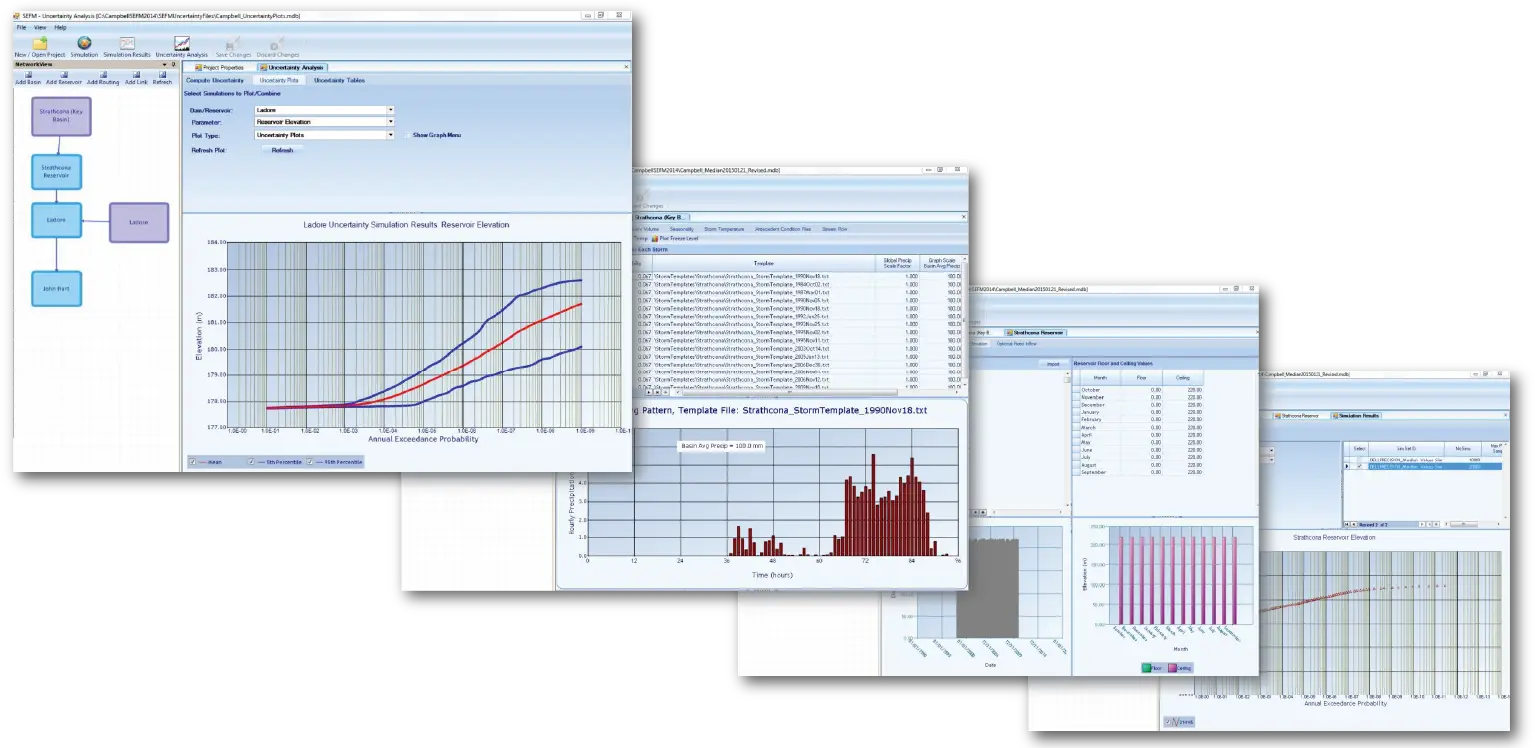
- Ability to generate probabilistic hydrologic hazard curves for peak inflow, inflow volume and reservoir stage
- Seasonality and temperature sampling to capture the proper probability of snowmelt‑driven floods
- Built‑in Hydrologic Runoff Unit (HRU) capability and flexible integration with other hydrologic/reservoir models
- Sampling of initial states (soil moisture, snowpack, reservoir level) for each event realization
- Accurate representation of reservoir operation variability and gate outage scenarios (configurable via event trees)
- Capability for full parameter uncertainty analysis (sensitivity and probabilistic parameter propagation)
- Adaptable storm templates with spatial and temporal detail used for generating synthetic storms for rainfall-runoff model to produce realistic hydrograph shapes
- Outputs tailored for SQRA/QRA: ensemble hydrographs, exceedance curves, and summary statistics suitable for risk modules
- Transparent, reviewable methods and documentation to support regulatory and stakeholder review
Advantages vs. simplified PFHA methods
- Fully captures representative storm behavior and uncertainty
- Explicitly models temperature and snowpack processes
- Incorporates operational uncertainty through sampling of initial pool levels and rule-curve variations
- Allows inclusion of failure and contingency scenarios, including gate outages and upstream breaches
- Scales from individual projects to portfolios.

Typical users and applications
- Dam safety engineers performing Probable Flood Hazard Assessments (PFHAs)
- Risk practitioners conducting SQRA and QRA to prioritize mitigation investments
- Utility and asset owners managing portfolios of dams in complex hydrologic regimes
- Regulatory bodies and consultants requiring defensible, peer‑reviewable hazard inputs
- Projects where rain‑on‑snow and seasonal temperature variability materially affect flood risk
Proven track record
Many of the industry’s largest asset owners rely on SEFM for PFHAs and risk assessments. RTI has applied SEFM successfully for clients including:
- Tennessee Valley Authority (TVA)
- Pacific Gas & Electric (PG&E)
- Idaho National Laboratory (INL)
- Tacoma Power
- Avista Utilities
- New Brunswick Power
- Southern California Edison
Configurable and interoperable
- SEFM can be configured to run with a variety of hydrologic and reservoir models and adapted to hydrologically complex watersheds.
- Event trees and operational scenarios can be represented on a per‑simulation basis to capture realistic risk pathways.
- RTI provides options for full service modeling, mixed‑mode engagements (RTI runs stochastic ensembles with client model components), or delivery of Monte Carlo inputs and scripts for client execution.
Support, validation, and services
RTI offers a suite of professional services to accompany SEFM:
- Pilot PFHA development and validation packages (deliverables: hazard curves, ensemble hydrographs, method appendix)
- Full SQRA/QRA inputs and support, including integration with risk quantification modules
- Regional precipitation and temperature record extension (regionalization/transposition) to strengthen rare event probabilities
- Sensitivity and parameter uncertainty analyses and peer review documentation
- Training, technical workshops, and QA/QC support for client teams

Extending SEFM to portfolios and special cases
- Portfolio assessments: SEFM scales to assess hydrologic hazard across many watersheds, supporting portfolio‑level prioritization and investment planning
- Mountainous and snow‑dominated basins: specialized temperature and elevation zoning to simulate rain‑on‑snow dynamics accurately
- Gate‑outage and operation‑failure scenarios: configurable scenario trees at the event level
- Integration with dam breach and consequence models for end‑to‑end risk analysis workflows