Science-based Interviewing to Improve Investigative Outcomes


Mark Severino
Retired Detective, Los Angeles Police Department


Over the past decade, the field of policing has increasingly embraced evidence-based practices-- an approach grounded in the recognition that scientific research has the potential to meaningfully inform and improve policing.
The shift toward evidence-based policing acknowledges that research not only helps us understand how policing practices directly influence outcomes, like crime prevention and clearance rates, but that it can support the broader effort to improve public trust, legitimacy, and community-police relations.
Rigorous studies can help determine what works, what doesn’t, and under what conditions, thus supporting police practitioners’ informed decision-making regarding which strategies to adopt, adapt, or abandon in pursuit of more effective outcomes.
Investigative interviewing is one of the most routine and critical tasks conducted by law enforcement. Whether responding to a chaotic scene or working through a complex case, investigators rely heavily on interviews with victims, witnesses, and suspects to make sense of what happened. These interviews are essential for generating leads, corroborating evidence, sustaining the engagement of interviewees throughout the case, and building strong cases for prosecution.
Yet, despite its importance, interviewing remains one of the least systematically taught skills in American policing. Through RTI’s work on the National Case Closed and CLEARS projects in collaboration with over 17 U.S. agencies, investigators reported that they received little or no formal training in how to conduct interviews. Instead, many learned “on the job,” guided by informal mentorship rather than structured, research-informed instruction. When training does exist, it often draws from legacy models like the Reid technique—an approach that still leans on confrontation, deception, and a narrow focus on securing confessions.
Galvanized by cases of miscarried justice involving false confessions and wrongful convictions, researchers examined how legacy interviewing techniques may have been contributing to false confessions. Several decades of research have shown that, while these tactics can be effective in eliciting statements, they prioritize compliancy over accuracy and ultimately undermine the fairness and integrity of the investigation. Legacy interviewing and interrogation techniques have shown to reduce interviewee cooperation, lead to less accurate and complete accounts, and increase the risk of false confessions.
A confrontational approach to interviewing typically relies on flawed deception detection (e.g., assuming that avoiding eye contact, fidgeting, or looking nervous means the subject is lying), guilt-presumptive questioning (e.g., “We both know you were there, so why don’t you just tell me what happened?”), and coercive tactics that pressure compliance.
Techniques such as minimization (e.g., “It’s not that big of a deal if you just lost your temper, anyone would have”) and maximization (e.g., “We already have evidence against you so if you don’t cooperate things will only get worse”) can lead subjects—especially those who are young, stressed, or vulnerable —to make false or unreliable statements.
As an alternative, researchers developed what is now called science-based interviewing (SBI), which provides an evidence-based, more structured alternative that is informed by research on:
Through understanding how people remember events, recall them, and behave in the context of an investigative interview, several interviewing techniques were developed to create protocols and guidance. This research highlights a key difference between SBI and legacy methods: rather than seeking a confession, science-based interviewing techniques are designed to elicit detailed, accurate, and reliable information from interviewees. Confessions are not the goal, rather the goal is to gather ample and useful information that can create strong, reliable cases. Subsequent research has shown its benefits over legacy interviewing techniques.
Figure 1 shows the overall structure of a science-based investigative interview based on the UK's PEACE Model. While every interview is different, the process follows three broad phases: planning and analysis, the interview itself, and closing followed by reflection.
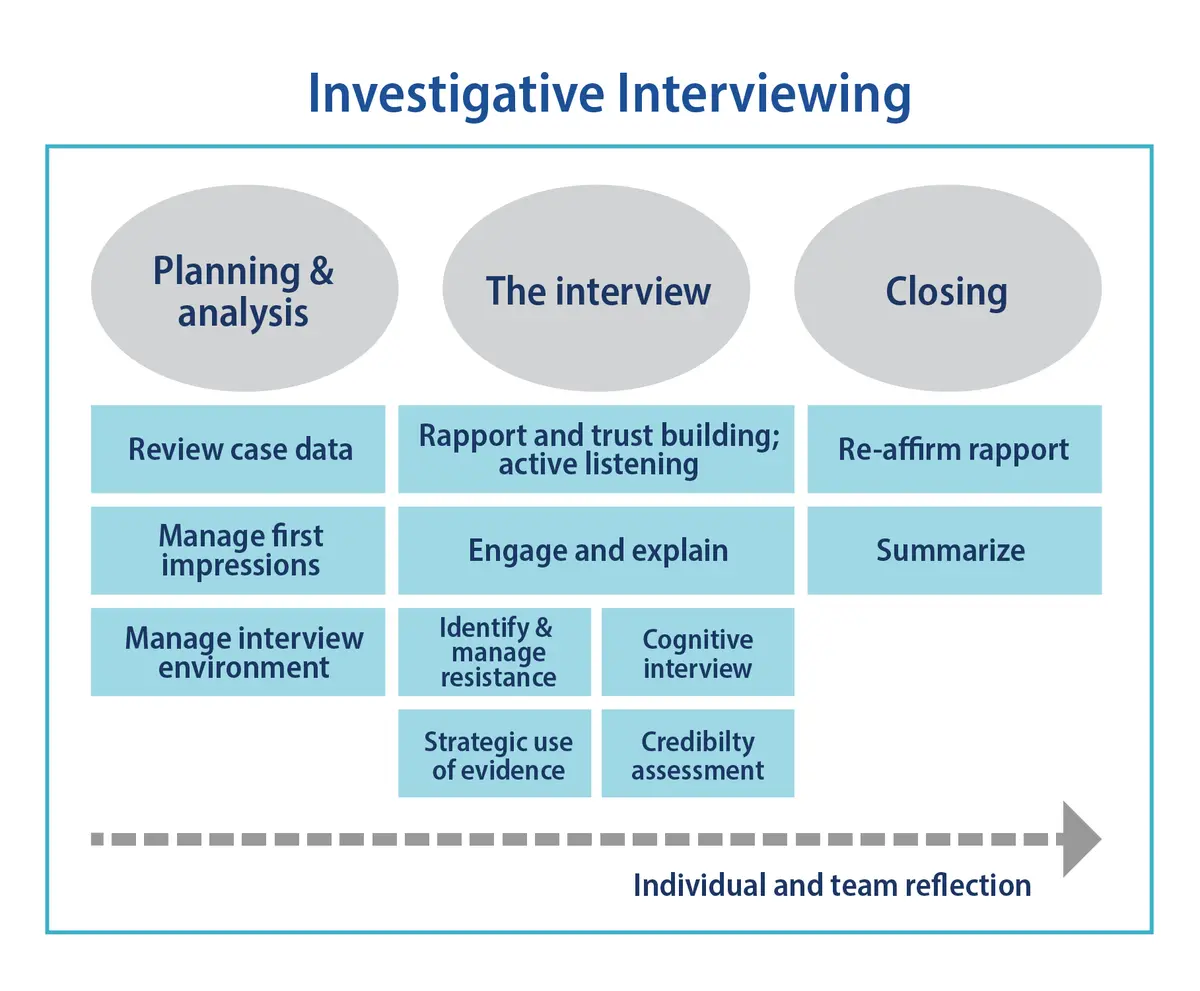
Figure 1
Planning and Analysis is key to a successful interview that yields useful information to advance the investigation. During planning, investigators review case data, think through what is already known, think about how they will manage the first impressions they’ll make on the interviewee, and prepare the interview environment. The environment would generally involve basic provisions (e.g., water, coffee), basic physical amenities (e.g., adequate space and seating arrangement), and other considerations (e.g., timing of interview). Preparation sets the conditions for a productive conversation.
The Interview is the core of the process. At the heart of an SBI interview is rapport building through active listening and clearly explaining the purpose and ground rules of the interview. Research consistently shows that when people feel heard, respected, and given some autonomy in the conversation, they are more likely to cooperate and provide useful information.
From there, investigators rely on several core SBI techniques:
Closing is not simply ending the conversation. Investigators should re-affirm rapport, summarize key information, and ensure clarity about the next steps before concluding. Some investigations are lengthy and interviewees will be interviewed again, having an intentional closing phase helps preserve cooperation.
Finally, the dotted line at the bottom of Figure 1 highlights something often overlooked: individual and team reflection. After an interview, investigators review what worked, what did not, and whether techniques were applied as intended. This reflection supports learning and continuous improvement, which is key to ensuring that SBI is applied as designed.
Together, these phases illustrate what makes SBI different compared to legacy methods: SBI techniques are meant to be used with intention and strategy, while also abiding to ethical standards. Through SBI, investigators should never use deception or false evidence ploys, nor resort to accusations. SBI works by maintaining a conversational and bi-directional relationship between investigators and interviewees.
It is important to note that SBI is not meant to be a passive or permissive approach. Rather, it offers structured control. The investigator guides the conversation, manages the flow of information, and makes strategic decisions about timing and evidence disclosure. That structure prevents the interview from becoming reactive, confrontational, or driven by premature assumptions, biases, and/or practices that increase risk and undermine the integrity of an investigation (i.e., coercion, deception, or guilt-presumptive questioning).
The structure described above stays consistent across interviews. What changes is how the detective applies it based on who they are speaking with.
Different interviewees bring different needs, risks, and levels of cooperation. A frightened victim may require trauma-informed pacing, breaks, or the presence of an advocate. A witness from a gang-impacted neighborhood may fear retaliation and need reassurance, safety planning, or a slower rapport phase before sharing details. Some suspects are well known to law enforcement and unlikely to talk at all. Other suspects are also victims—of coercion, trafficking, intimate partner violence, or exploitation—and need to be treated with the same care and protections as any other victim.
Meanwhile, some victims or witnesses withhold information to protect loved ones or avoid involvement. These realities shape how the interview is set up and supported. Yet the interview structure itself and its core techniques do not necessarily change. The engage-and-explain phase still sets expectations and builds rapport. The interviewer still begins with a free account. Questions still move from broad and open-ended to more specific. Suggestive or leading questions are still avoided.
When cooperation is limited, for example, the same structure still applies though its purpose shifts. A detailed free account is still the first step. It helps with memory, but it also helps the investigator understand what might be going on. Is the interviewee scared? Protecting someone? Minimizing their role? Unsure about details? Or possibly being deceptive?
SBI does not start by assuming someone is lying. Instead, through asking for uninterrupted free recalls, it lets the interviewee talk and the investigator now has an opportunity to look for patterns in their account. Those patterns help the investigator decide what to do next. If important inconsistencies show up, or if it seems like information is being held back, the investigator can continue asking for more detail. Even a false story can be useful because it shows how the person is framing events. If needed, the investigator may move to the SUE technique.
By holding back certain facts and revealing them carefully, the investigator can compare what the person says with what is already known. This approach encourages more information and reduces pressure, which lowers the risk of false or unreliable statements. In short, the core structure and techniques of SBI are applicable across interview types, but investigators play an active role in adjusting techniques based on how the interview unfolds.
To conclude, interviewing is one of the most powerful tools investigators have. When done well, it strengthens cases, improves cooperation, and produces detailed, reliable statements that hold up in court. When done poorly, it can contaminate memory, reduce cooperation through unnecessary confrontation, create inconsistencies that weaken credibility, or generate statements that are later challenged or suppressed in court. In the worst cases, coercive or guilt-presumptive tactics can contribute to false confessions and wrongful convictions.
SBI offers a structured alternative grounded in research rather than customary knowledge or legacy tactics. SBI focuses on information quality and ethical but effective practice thus reducing investigative risk while strengthening the evidentiary value of victim, witness, and suspect testimonies.
An illustrative example of the benefits of science-based interviewing comes from a 2012 homicide case. A passerby found a severed head in Los Angeles's Griffith Park, launching a murder investigation by the Los Angeles Police Department (LAPD) that quickly drew national attention. However, the case soon stalled when early interviews used legacy confrontational interrogation techniques that yielded little usable information from the prime suspect. The suspect deflected accusations and remained guarded, learning investigators with few leads. Two years later, investigators freshly trained on the SBI model revisited the case using this approach. Rather than relying on confrontation, they focused on building rapport, encouraging open dialogue, and refraining from accusations. This approach was effective: the suspect began talking, ultimately revealing key inconsistencies in his account that led to his arrest and conviction for murder.
This case illustrates two central points: the critical role of investigative interviews in solving complex cases and the advantages of SBI over legacy techniques.
Moving forward, it's important to note that collaboration between researchers and police practitioners is essential for successful science-based interviewing. Investigators provide the operational realities of information gathering, while academics contribute rigorous testing and evaluation. As Detective Severino describes it, the research provides the WHAT and the practitioners the HOW. This partnership ensures that SBI methods are both practical and evidence-based, maximizing investigative success while maintaining high, ethical standards.
Recently, RTI was awarded a planning grant by Arnold Ventures to design the first field randomized control trial in the United States to evaluate the impact of SBI on key case and prosecutorial outcomes. The evaluation is in partnership with the Indianapolis Metropolitan Police Department (IMPD) and focuses on three violent crime investigative units: homicide, aggravated assault, and robbery. Investigators trained in SBI will be compared to those using standard practices, or business as usual, to determine whether SBI improves outcomes at the interview-level (e.g., interviewee cooperation and the amount of shared information), at the case-level, (i.e., arrest/case clearance rates), as well as prosecutorial decisions.
This project will also offer important implementation insights, such as recommendations for effective SBI training delivery, information on how detectives apply SBI across different units and types of investigations, how consistently core techniques are used, and what organizational supports are necessary for long-term sustainability. This matters because even the best evidence-based practices fail if they are not implemented well.
Below are additional resources that may help orient investigators to SBI: