Insights





Key Takeaways
The 2025 guidelines signal a major shift in nutrition messaging. Updates emphasize “real food,” limit highly processed foods, and introduce new priorities for fats, protein, and added sugars.
Changes will impact the food industry and federal programs. Updates are expected to influence product formulation, labeling, school meals, and programs like SNAP and WIC.
Organizations must evaluate the guidance and translate it into action. Industry and government partners will need to adapt strategies, communications, and operations to align with evolving nutrition standards.
In January, the U.S. Department of Health and Human Services and the U.S. Department of Agriculture (USDA) released the 2025-2030 Dietary Guidelines for Americans (DGAs). The new DGAs reflect a major rebranding, replacing MyPlate with an inverted Food Pyramid as the visual representation of the guidelines and featuring prominent language encouraging consumption of “real food” over “highly processed food.” They also feature several changes that could have implications for federal programs and industry standards.
2020 vs. 2025 DGAs: Key Differences
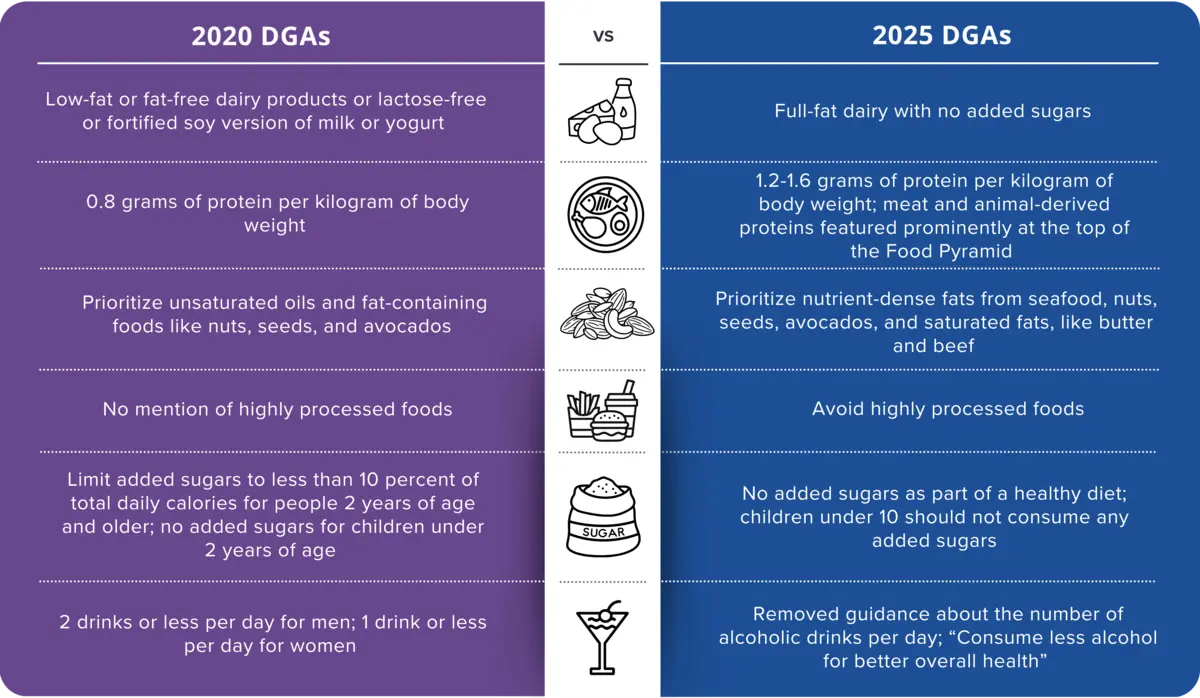
Much of the public discussion has already explored what changed and why. For many organizations, the more pressing question is what these shifts mean in practice—for the commercial food industry, federal nutrition programs, state agencies, health systems, educators, and others who must translate national guidance into real-world dietary decisions.
Potential Changes in Food Production and Marketing
Changes to the DGAs—including shifts in recommended protein intake, evolving guidance on fats, and stricter guidance on added sugars and highly processed foods—may drive changes in product formulation and marketing strategies across the food industry.
RTI supports industry and supply chain partners in preparing for these types of changes. Our experts conduct market research on consumer perceptions, develop strategies for product reformulation aligned with DGA priorities, and forecast how changes in school meal or health care food service standards may influence procurement requirements. Using mixed-methods research, behavioral insights, modeling, and technical assistance, we help clients translate evolving guidance into actionable strategies—whether that involves assessing consumer preferences, navigating compliance requirements, planning product innovation, or evaluating the effectiveness of DGA-aligned interventions.
Explore Our Work:

Assessing factors that influence consumer purchasing
RTI conducted research on the voluntary “Product of USA” labeling claim on meat products, finding that consumers notice the claim and are willing to pay a premium for products that carry it.
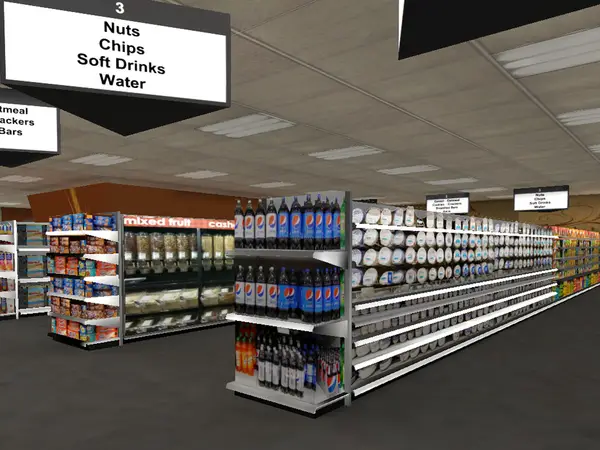
Using RTI iShoppe® to see what influences purchasing decisions
RTI iShoppe is a customizable, web-based virtual store that allows researchers to simulate shopping environments and experimentally test different scenarios to inform policy and practice.

Analyzing product reformulation to meet policy and consumer demands
RTI performed an in-depth technology review across industries to identify emerging natural preservative innovations and organized findings into an actionable framework.

Studying high-intensity sweeteners in the food industry
RTI identified trends, explored the landscape of emerging high-intensity sweeteners, and researched their impact on gut health.
How the New Dietary Guidelines Impact Federal Nutrition Programs
Changes to the DGAs may lead to new requirements for meal planning and food options across federal nutrition programs, such as the Supplemental Nutrition Assistance Program (SNAP), the Special Supplemental Nutrition Program for Women, Infants, and Children (WIC), and school meal programs. Guidance on healthy fats, limits on highly processed foods, and stricter recommendations on added sugars could change food preparation and menu planning for the National School Lunch Program and School Breakfast Program. These changes could require shifts, like preparing more meals from scratch to avoid processed frozen options, cooking with specific types of fat, or modifying dairy offerings to prioritize full fat.
Changes to meal patterns and food packages will also necessitate new educational materials and communication strategies to ensure that the public understands the updated recommendations. RTI's program evaluation, policy analysis, and behavior change communication experts work with government and philanthropic partners to assess how new guidance—including added sugar limits, protein content, or definitions of highly processed foods—may affect procurement requirements, budget planning, and consumer perceptions.
Explore Our Work:

Estimating food industry compliance costs
RTI has developed models for the U.S. Food and Drug Administration (FDA) to estimate the costs of labeling changes, product reformulation, and implementation of food defense practices.

Evaluating school meal procurement policy and nutrition education
Working with the Robert Wood Johnson Foundation, we evaluated Oregon’s school meal procurement policy and nutrition education efforts.

Assessing standards’ influence on purchasing patterns
We evaluated the DC Healthy Tots Act to see how new nutrition standards influenced purchasing patterns, supply chain decisions, menu planning, and costs.

Using human-centered design for consumer-facing materials
We developed and tested new designs for USDA’s Safe Handling Instructions label, which provides guidance to consumers on food safety during food preparation.

Examining package labels’ impact on consumers
We conducted a systematic literature review for the FDA of front-of-package labels that summarize nutrient content, looking at how consumers use these labels to identify healthier products and interpret nutrition information.
Helping Stakeholders Navigate Evolving Nutrition Guidance
As federal nutrition guidelines evolve, they bring new questions for consumers, practitioners, and programs. Ultimately, our goal is to support a healthier, more transparent, and more responsive nutrition ecosystem by providing the rigorous evidence and practical guidance that decision-makers need.
Learn more about RTI’s food innovation solutions and sign up for The Growth Brief Newsletter to get insights in your inbox.
Stay ahead of the DGA shift with science-driven strategy. Contact us to discuss your next steps.
Disclaimer: This piece was written by Kristen C. Giombi (Research Economist), Sara Andrews (Research Public Health Analyst), and Valerie Flax (Senior Public Health Research Scientist) to share perspectives on a topic of interest. Expression of opinions within are those of the author or authors.