Events
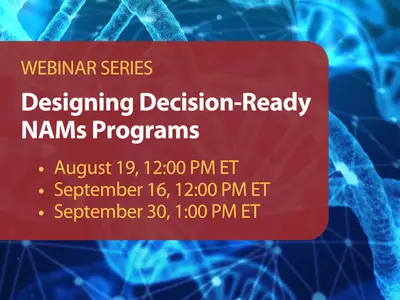
Designing Decision-Ready NAMs Programs | RTI Webinar Series
Date
August 19, 2026 - September 30, 2026
New approach methodologies (NAMs) are reshaping how organizations generate, interpret, and apply evidence across research, regulatory, and product development environments. As adoption accelerates, the central question is no longer whether NAMs can play a role, but how to use them in ways that produce reliable, defensible insights that decision-makers can trust, act on, and defend.
This three-part webinar series explores how NAMs can be integrated into practical testing and research strategies that support real-world decisions. Rather than focusing on individual tools or methods in isolation, the series examines how in vitro systems, computational approaches, and broader evidence frameworks can work together to strengthen confidence in study findings and expand their value for research and regulatory applications.
Designed for scientists, regulators, product developers, and research leaders, the series focuses on the critical gap between generating data and applying it effectively. The opening session establishes the strategic foundations for NAMs-based approaches, followed by two deeper explorations of advanced in vitro biological systems and computational modeling. Together, the sessions provide practical perspectives on evaluating evidence, understanding uncertainty, and translating scientific innovation into informed action.
Webinar 1 — Dr. David Hines | August 19, 12 PM ET
From Data to Decisions: Integrating Evidence and Managing Uncertainty in NAMs
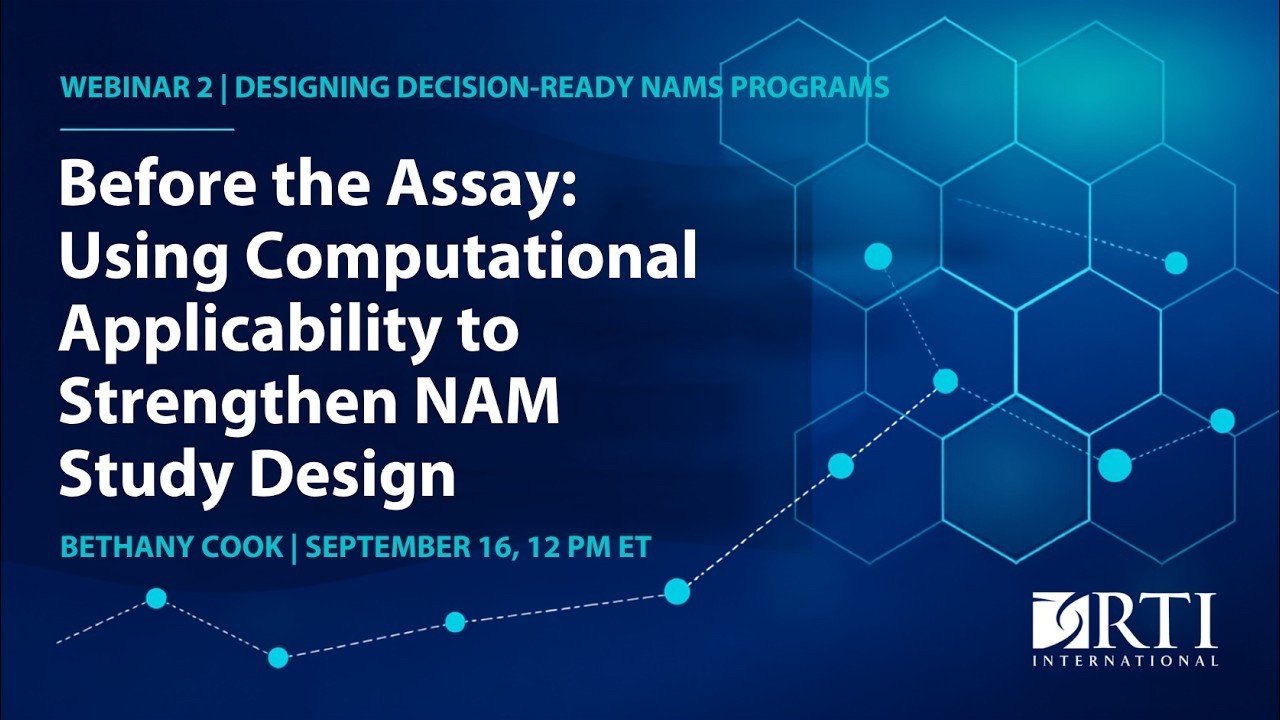
Webinar 2 — Bethany Cook | September 16, 12 PM ET
Before the Assay: Using Computational Applicability to Strengthen NAM Study Design
Webinar 3 — Dr. Erin A. Huber | September 30, 1 PM ET
Earned, Not Assumed: Designing Rigorous Primary Human in Vitro Systems
Webinar 1 Recording | From Data to Decisions: Integrating Evidence and Managing Uncertainty in NAMs

Webinar 2 Recording | Before the Assay: Using Computational Applicability to Strengthen NAM Study Design
Webinar 3 Recording | Earned, Not Assumed: Designing Rigorous Primary Human in Vitro Systems

Meet the Presenters

Dr. David Hines
David Hines is a Computational Toxicologist in RTI International's Predictive Toxicology and Exploratory Biology program whose work focuses on integrating diverse evidence streams to support toxicological decision-making. His research spans computational toxicology, exposure and dose considerations, uncertainty characterization, and the application of new approach methodologies (NAMs) in research and regulatory contexts. Dr. Hines has contributed to the development of frameworks that help define domains of applicability, evaluate confidence in predictions, and support fit-for-purpose use of emerging methods. In this webinar, he will discuss how integrated evidence, applicability, and uncertainty shape the design and interpretation of NAM-based strategies.

Dr. Erin A. Huber
Erin A. Huber is a Respiratory Biologist at RTI International specializing in advanced human-relevant in vitro systems for toxicology and inhalation science. Her work focuses on the development, characterization, and application of primary human respiratory models to better understand biological responses to environmental and consumer product exposures. Dr. Huber has experience designing physiologically relevant experimental systems that balance biological complexity, reproducibility, and interpretability. Her research emphasizes rigorous model characterization and the generation of data that can be integrated with mechanistic and computational approaches to support modern toxicology decision-making.

Bethany Cook
Bethany Cook is a Computational Chemist in RTI International's Predictive Toxicology and Exploratory Biology program. Her work focuses on applying computational approaches to understand chemical behavior, support study design, and improve interpretation of toxicological data. She has experience integrating physicochemical property information, modeling approaches, and mechanistic understanding to help determine when specific methods are appropriate for a given scientific question. Ms. Cook's research emphasizes fit-for-purpose application of computational tools, transparent communication of uncertainty, and the use of data-driven approaches to strengthen decision-making in modern toxicology. In this webinar, she will discuss how computational insight can be used to guide NAM study design, evaluate applicability, and improve confidence in study conclusions.
Learn more about RTI’s robust, science-based toxicology solutions.