Newsroom
The briefing was co-hosted by the National Prevention Science Coalition to Improve Lives (NPSC) and the Congressional Addiction, Treatment and Recovery Caucus (ATR)
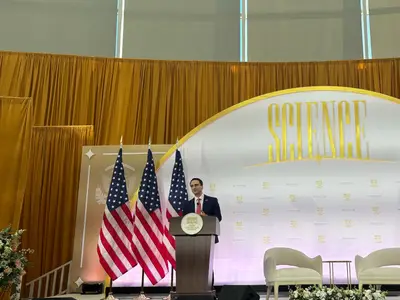
WASHINGTON, D.C. — Phillip Graham, DrPH, senior director of RTI International’s Center on Social Determinants, Risk Behaviors, and Prevention Science, emphasized the importance of preventing opioid misuse at a briefing at the Capitol Visitor’s Center in Washington D.C. on Tuesday.
The briefing, titled “The Real Dangers of Equating Opioid Dependence with Addiction,” was co-hosted by The National Prevention Science Coalition to Improve Lives (NPSC) and the Congressional Addiction, Treatment and Recovery Caucus (ATR). Graham was one of several experts, including National Institute on Drug Addiction (NIDA) director Dr. Nora Volkow, who presented.
“When you look at where we are, that trend in terms of [overdose] deaths is still going up,” said Graham, pointing to data showing the increase year-over-year in overdose deaths. “Part of my presentation today and part of my plea is that unless we understand the value and importance of prevention, we can never ever bend that curve.”
When discussing specific prevention efforts, Graham pointed to work RTI is undertaking as part of the NIDA-funded HEAL Initiative that will establish the evidence base for interventions and strategies to prevent initiation of opioid misuse and development of opioid use disorder (OUD) in at-risk older adolescents and young adults.
By sharing and testing new interventions, he said, those proven effective will ideally become easier to scale up to broader populations.
Graham noted in closing: “We are just beginning on this journey of trying to figure out how we think about this work more comprehensively. What I ask is that we move away from silos and understand the value of prevention, harm reduction and treatment in a coordinated — and not isolated — way.”
In addition to Graham and Volkow, those in attendance heard from Dr. Susan Glod from the Penn State College of Medicine, Dr. Brendan Saloner from Johns Hopkins Bloomberg School of Public Health and Congressman Bobby Scott of Virginia.
For more information on RTI’s opioid prevention research, visit: www.rti.org/emerging-issue/preventing-opioid-use-misuse-and-overdose.



RTI International is an independent scientific research institute dedicated to improving the human condition. Our vision is to address the world's most critical problems with technical and science-based solutions in pursuit of a better future. Clients rely on us to answer questions that demand an objective and multidisciplinary approach—one that integrates expertise across social, statistical, data, and laboratory sciences, engineering, and other technical disciplines to solve the world’s most challenging problems.
For more information, visit www.rti.org.