Newsroom
RTI research identifies elevated lead, manganese and PM2.5 pollution for worker housing near Hanoi’s industrial zones
RESEARCH TRIANGLE PARK, N.C. — As Vietnam becomes a major hub in the global manufacturing supply chain, a new international study reveals that many workers powering this economic growth may face significant environmental health risks where they live.
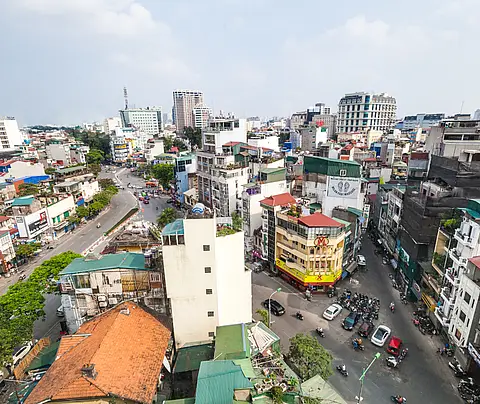
People in Vietnam living near Hanoi’s rapidly expanding industrial zones face previously underexamined environmental health risks from contaminated drinking water and unsafe air quality, according to a new research report co-authored by RTI International, an independent scientific research institute.
The study, published by RTI Press and based on sampling conducted between 2018 and 2020, provides a detailed community-level assessment of air quality before and after COVID-19, along with tap water and cooking water quality within informal housing districts serving Vietnam’s manufacturing workforce.
The authors found that 20% of household drinking water samples exceeded the American Academy of Pediatrics’ recommended lead level and 6% exceeded the World Health Organization guideline. Elevated manganese was also common, surpassing health or aesthetic thresholds in more than a quarter of samples and in nearly half of households connected to public water systems.
“These findings show that workers and their families are routinely exposed to contaminants that can have lifelong consequences,” said lead author Nikki DeLuca, a research environmental scientist at RTI. “Lead and manganese in particular were detected in both piped and bottled water, suggesting a need for stronger oversight of water sourcing and infrastructure.”
In addition to water hazards, the study found consistently high levels of fine particulate matter (PM2.5), a pollutant linked to asthma, cardiovascular disease and mental health impacts. Across four industrial zones monitored for up to 748 days, more than half of daily PM2.5 concentrations exceeded levels considered healthy.
The study also captured a dip in PM2.5 levels across all sites following Vietnam’s nationwide COVID-19 lockdown in March 2020, attributed to factors like reduced manufacturing, vehicle traffic, and international visitors.
“Vietnam’s economic growth has lifted millions of people out of poverty, but our findings show that the environmental conditions where workers live deserve much greater attention,” said Professor Mai Thi Nguyen, a co-author of the study.
Nguyen, Dr. Tho Tran of Texas A&M University and RTI’s Jennifer Hoponick Redmon designed and implemented the study.
Additional in-country collaborators included the National University of Civil Engineering and the Vietnam Academy of Social Sciences (VASS), highlighting the importance of global collaboration to better understand how rapid urbanization affects worker health.
The study builds on a related prior study focused on the qualitative effects of living and working in industrial zones. Geographically, the Noi Bai district, near the international airport, showed the highest concentrations of lead and manganese in water. Quang Minh and Bac Thang Long recorded the highest PM2.5 levels, and workers living in those neighborhoods also reported poorer health outcomes, including higher depression index scores and more doctor visits.
The authors say their findings can help inform policies to improve housing, environmental monitoring and public health protections in industrializing cities.
Read the full research report (via RTI Press)





RTI International is an independent scientific research institute dedicated to improving the human condition. Our vision is to address the world's most critical problems with technical and science-based solutions in pursuit of a better future. Clients rely on us to answer questions that demand an objective and multidisciplinary approach—one that integrates expertise across social, statistical, data, and laboratory sciences, engineering, and other technical disciplines to solve the world’s most challenging problems.
For more information, visit www.rti.org.